Modal Interchange in Harmony
Introduction to Modal Interchange
Borrowing Chords
Imagine you're in the middle of a song in a major key, like C major. Everything sounds bright and happy, following the usual rules. But what if you could add a moment of unexpected emotion, a touch of darkness or drama, without completely changing the song's key? That's the idea behind modal interchange.
Modal interchange, also known as modal mixture, is the technique of borrowing a chord from a parallel key. A parallel key shares the same starting note, or tonic, but has a different mode. For example, the parallel key of C major is C minor. They both start on C, but they have different collections of notes and a very different feel.
By borrowing a chord from C minor and slipping it into a C major progression, you can create a surprising and colorful harmonic twist.
This isn't about changing keys. The song is still firmly in C major. You're just temporarily borrowing an element from another mode to make things more interesting. It’s like adding a unique spice to a familiar recipe. The dish is still the same, but it has a new layer of flavor.
Adding Harmonic Color
The main purpose of modal interchange is to expand your emotional palette. Standard diatonic chords (the chords naturally found in a key) are great, but they can become predictable. Borrowed chords introduce notes from outside the key, creating moments of tension and release that can make a progression more memorable.
Borrowed chords are typically used as “color chords”, providing harmonic variety through contrasting scale forms, which are major scales and the three forms of minor scales.
Let's look at a simple example in C major. The standard chords built from the C major scale are:
C (I), Dm (ii), Em (iii), F (IV), G (V), Am (vi), Bdim (vii°)
A very common progression is I - IV - V - I, which in C major is C - F - G - C. It's solid and effective.
Now, let's borrow a chord from C minor. In C minor, the subdominant chord (the iv chord) is F minor. Let's swap out our F major (IV) for this F minor (iv). Our new progression is I - iv - I. In C, that's C - Fm - C.
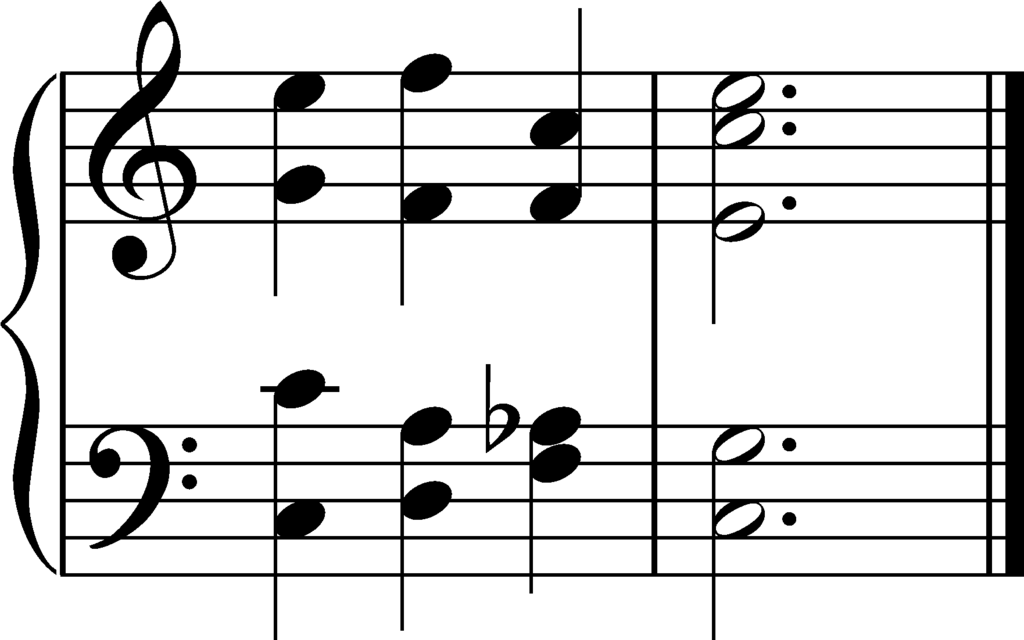
That one change, from F major to F minor, adds a sudden, darker character to the progression. The A♭ in the F minor chord is not in the key of C major, and our ears notice the difference. This temporary shift in mood is what makes modal interchange so powerful.
Interchange vs. Modulation
It's important not to confuse modal interchange with modulation. While both involve using chords from outside the home key, their function is different.
Modal interchange is a brief detour. You borrow a chord or two, but you quickly return to the chords of the original key. The overall tonal center never changes.
Modulation, on the other hand, is a full-blown key change. The music establishes a new key as the home base. You're not just visiting; you've moved to a new tonal city.
Modal mixture only temporarily borrows chords from the parallel mode, whereas a modulation begins to exclusively use chords from the parallel mode.
Think of it this way: using a borrowed chord is like quoting a line in a foreign language during a speech. A modulation is like giving the rest of the speech in that new language.
Common Borrowed Chords
The most common source for borrowed chords is the parallel minor key. Here are a few popular choices you'll hear in all kinds of music, shown here in the key of C major.
| Roman Numeral | Chord in C | Common Function & Feel |
|---|---|---|
| iv | F minor | Often called the "minor subdominant." Adds a pensive, melancholic color. |
| ♭VI | A♭ major | Creates a dramatic, sometimes epic, sound. Great for big emotional moments. |
| ♭VII | B♭ major | A very common chord in rock and pop. Adds a powerful, driving feel. |
| iiø7 | D half-diminished 7 | Creates strong tension that pulls toward the V chord (G major). |
Experimenting with these chords in your own progressions is the best way to understand their effect. Try replacing a standard diatonic chord with one of its parallel minor counterparts and listen to how it changes the mood.