Mobile Security Lab Mobile App Pentesting Masterclass
Mobile Security Foundations
Mobile Security Architectures
When shifting from general cybersecurity to mobile environments, the operating system's architecture is the battleground. Android and iOS, while both based on Unix-like kernels, take fundamentally different approaches to security. Understanding these differences is the first step in learning how to test their defenses.
The Android Stack
Android is built on a layered architecture, with each layer relying on the security of the one below it. This structure provides a clear separation of concerns, but also creates distinct areas for potential vulnerabilities.
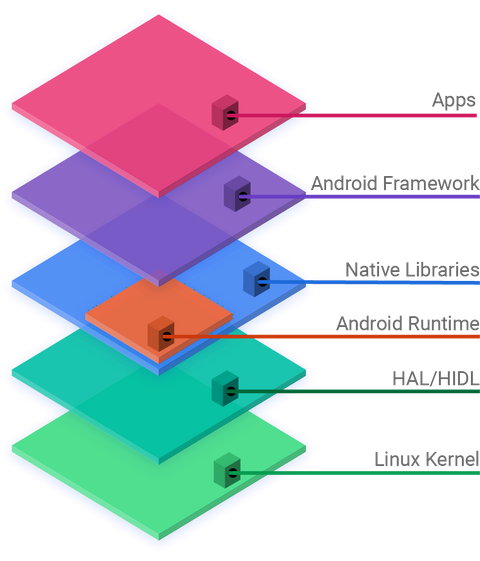
At the bottom is the Linux Kernel. This is the core of the OS, managing processes, memory, and device drivers. Android's security model is built directly on Linux features. For instance, every app is assigned a unique Linux user ID (UID) upon installation. This isn't just a label; it's a fundamental security boundary. The kernel enforces permissions between apps based on these UIDs, effectively isolating them from each other and from the system itself. This process is known as sandboxing.
Just above the kernel is the Hardware Abstraction Layer (HAL). The HAL provides a standard interface for hardware vendors to create drivers without revealing their proprietary source code. It allows the higher-level Android framework to communicate with hardware like the camera or Bluetooth radio, acting as a critical bridge.
The Android Runtime (ART) is where app code is executed. It compiles app bytecode into native instructions, managing the app's execution and memory. Above this sits the Application Framework, which provides the high-level services apps use, like the activity manager and notification system.
The iOS Walled Garden
Apple's approach to iOS security is famously restrictive, often described as a "walled garden." The goal is to control the entire ecosystem, from hardware to software, to create a tightly integrated and secure user experience. This philosophy is enforced through several key mechanisms.
First is the secure boot chain. When an iOS device powers on, it begins a sequence where each component cryptographically verifies the next. The process starts with immutable code in the processor's Boot ROM, which checks the signature of the next-stage bootloader, which in turn checks the OS kernel, and so on. Any failure in this chain of trust halts the boot process, preventing tampered software from running.
Next, every application that runs on iOS must have a valid digital signature from Apple. This mandatory code signing ensures that only approved apps from the App Store (or registered developers) can be installed. It prevents the installation of unvetted, potentially malicious software.
Finally, iOS enforces a strict sandbox on every app. Unlike Android's UID system, the iOS sandbox is defined by a complex set of rules and profiles that limit what an app can do. An app has no access to data from other apps or most of the operating system. Critical user data is further protected by a dedicated security chip called the Secure Enclave, which handles cryptographic operations for things like Face ID, Touch ID, and Apple Pay.
Architectures Compared
The philosophical differences between Android's relative openness and iOS's locked-down control lead to distinct security trade-offs. An ethical hacker must adapt their methodology depending on the target platform.
| Feature | Android | iOS |
|---|---|---|
| Sandboxing | App-as-UID, kernel-enforced isolation | Profile-based rules, strict limitations |
| App Distribution | Open (Google Play, third-party stores, sideloading) | Closed (Apple App Store only) |
| Permissions | Granular, requested at runtime | Granular, requested at runtime |
| File System | Ext4 or F2FS | Apple File System (APFS) with built-in encryption |
| Code Integrity | Optional app signing, Verified Boot | Mandatory code signing, Secure Boot Chain |
Common Battlegrounds
Despite their differences, mobile apps on both platforms face similar threats. Security researchers and developers rely on frameworks to categorize and address these risks. The most widely recognized is the Mobile Top 10, which outlines the most critical security risks for mobile applications.
The 2024 OWASP Mobile Top 10 highlights key areas like Improper Credential Usage, Insecure Authentication/Authorization, Insecure Communication, and Insufficient Cryptography as persistent threats.
Understanding how Android's UID isolation or iOS's code signing works provides the context for how these vulnerabilities are exploited. A flaw in how an app stores its credentials, for example, has different implications depending on the underlying OS protections.
What is the primary mechanism Android's Linux kernel uses to enforce sandboxing and isolate applications from each other?
Which iOS security feature is a dedicated hardware chip that handles cryptographic operations for features like Face ID and Apple Pay?
Grasping these foundational architectures is non-negotiable. It dictates the tools you'll use and the attack vectors you'll look for. In later sections, we'll build on this knowledge to start probing these security boundaries.