MMA Fighter Integration and Strategy
Striking Integration and Footwork
Building a Hybrid Stance
A traditional Muay Thai stance is a fortress. It's square-on, with a high guard and weight often settled on the lead leg, ready to check kicks or power into a roundhouse. Kung Fu stances are different; they are often more mobile and linear, designed for rapid entries and evasive footwork. When you step into the MMA cage, neither of these pure forms is enough. The wrestler wants to shoot for your legs, and the boxer wants to circle and find an angle. A pure Thai stance is a target for a double-leg takedown, while a bladed Kung Fu stance can be chewed up by low kicks.
The solution is a hybrid. You need to sink your weight slightly, creating a lower centre of gravity than a typical Kung Fu practitioner, which helps in defending takedowns. But you can't plant your feet like a Thai fighter. The stance needs to be wider, with the weight distributed more evenly, perhaps 60/40 on the back foot. This allows you to stay light enough to move in and out, using Kung Fu's linear footwork, but stable enough to check a kick or sprawl when an opponent changes levels. Your chin is tucked, more like a boxer, and your hands are active, ready to parry, frame, or post—not held high and static.
The goal is a stance that is neither purely offensive nor defensive, but adaptable. It must be able to launch an attack, absorb a blow, and nullify a takedown attempt from the same neutral position.
Controlling the Distance
Distance management is where the fusion truly shines. Kung Fu styles excel at closing the gap with explosive, linear entries. Think of a quick side-kick or a trapping hand combination to bridge the distance. In MMA, this can be used not just to strike, but to set up a different phase of combat. You can use a long, ranging side-kick to keep your opponent at bay, frustrating their attempts to set up their own attacks. This buys you time and forces them to react.
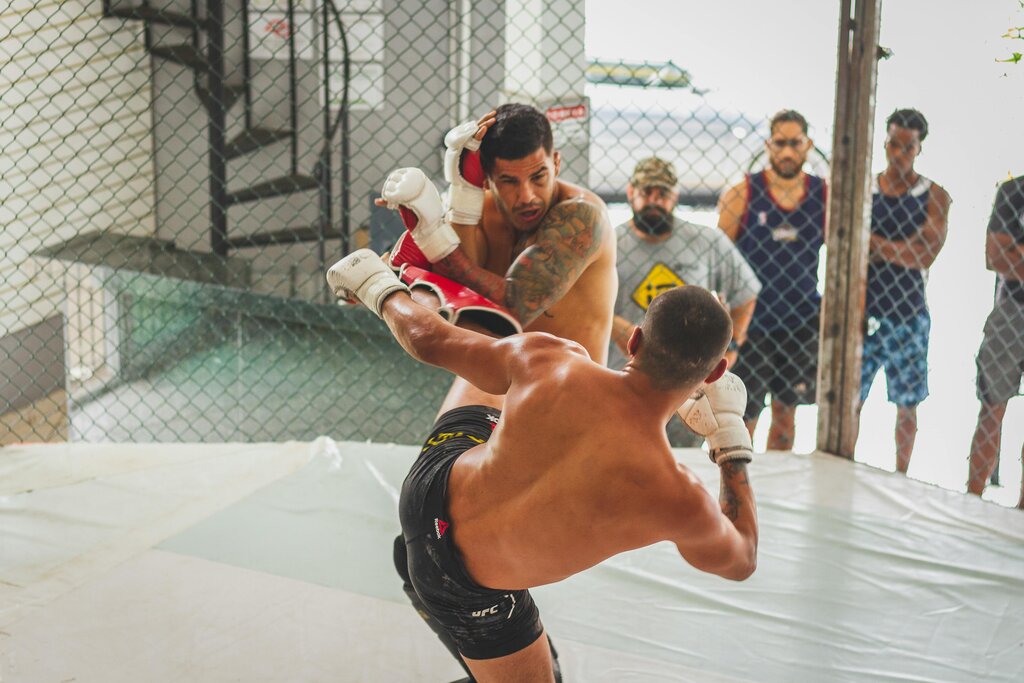
Once they become preoccupied with your linear kicks, they might lunge forward carelessly. This is the moment to transition. Instead of retreating, you can crash forward into the clinch, the classic domain of the Muay Thai fighter. You've used a Kung Fu tool to create an opening for a Muay Thai attack. Suddenly, the fight is in close quarters, where knees and elbows dominate. This constant threat-switching—from long-range linear attacks to punishing close-range circular power—is incredibly difficult for an opponent to solve.
Weight and Balance
Everything comes back to weight distribution. A fighter who is too heavy on their front foot, like in many Thai stances, will struggle to defend a takedown. A fighter who is too bladed and light on their feet may be pushed over or find their base compromised. The hybrid approach requires constant, subtle shifts in weight. When you're at range, you can afford to be lighter, ready to spring in or out. As the distance closes, your weight sinks, anchoring you to the mat.
Utilizing proper footwork techniques, such as pivoting, circling, and angling, allows fighters to control distance, evade strikes, and set up their own attacks.
This readiness for the takedown is non-negotiable in MMA. By keeping your hips low and your weight balanced, you are always in a position to react. If you see your opponent drop their level for a shot, you don't need to take a preparatory step. You can immediately push your hips back and away, sprawling to kill the takedown attempt. This defensive readiness, born from the threat of wrestling, is what forces both Muay Thai and Kung Fu principles to adapt into something new, creating a striking system that is truly mixed martial arts.
What is a primary weakness of a traditional Muay Thai stance when applied directly to MMA without adaptation?
According to the text, a successful hybrid MMA stance distributes weight more evenly, often 60/40 on the back foot. What is the main benefit of this?
By blending these distinct striking arts, a fighter creates a puzzle that is difficult to solve, armed with tools for every range of stand-up combat.