Mixture Separation and Pigment Exploration
Introduction to Mixtures
What Is a Mixture?
Most things we encounter aren't pure substances. The air we breathe, the water in the ocean, and the salad you eat for lunch are all mixtures. A mixture is what you get when you combine two or more substances in a way that no chemical reaction occurs. The individual substances just hang out together, keeping their own identities.
Think of it like a party. People in a room are mixed together, but they are all still individual people. They haven't chemically bonded to become a new type of super-person.
Because they aren't chemically combined, the components of a mixture can usually be separated by physical means. You can pick the croutons out of your salad, for example. The ratio of substances in a mixture isn't fixed, either. You can have a little dressing on your salad or a lot. It's still a salad.
Two Kinds of Mixtures
Mixtures fall into two main categories based on how uniformly their components are distributed: heterogeneous and homogeneous.
Heterogeneous Mixtures
In a heterogeneous mixture, the composition is not uniform. You can often see the individual components with the naked eye. A classic example is oil and water. They don't mix, and you can clearly see the separate layers.
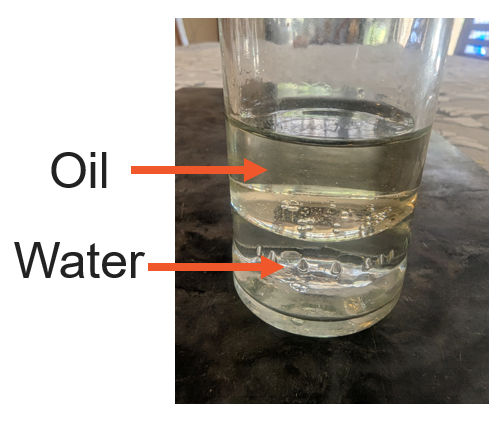
Other everyday examples include a bowl of cereal with milk, a salad with vegetables and dressing, or sand mixed with shells. Each part of the mixture retains its own properties, and samples taken from different parts of the mixture might have very different compositions.
heterogeneous
adjective
Composed of parts of different kinds; having a varied composition.
Homogeneous Mixtures
A homogeneous mixture has a uniform composition throughout. Any sample you take from the mixture will be the same as any other sample. These mixtures are also called solutions.
Salt dissolved in water is a perfect example. Once stirred, you can't see the individual salt particles. The water tastes salty whether you sip from the top or the bottom.
Air is another common homogeneous mixture. It’s a solution of gases, primarily nitrogen and oxygen, that is consistent wherever you are in the room. Other examples include coffee, vinegar, and metal alloys like brass (a mixture of copper and zinc).
homogeneous
adjective
Of the same kind; alike. Having a uniform composition or character.
Properties of Mixtures
Understanding mixtures means recognizing a few key properties. First, the components of a mixture keep their original chemical properties. Mixing salt and sand doesn't change the fact that salt is salty and sand is grainy.
Second, the components can be separated by physical means. You can evaporate the water to get salt back, or filter sand out of water. This is different from compounds, where chemical reactions are needed to break them apart.
Finally, the melting and boiling points of mixtures are often variable and can change depending on the ratio of the components. Pure water has a fixed boiling point ($100°C$ at sea level), but saltwater boils at a higher temperature, and that temperature depends on how much salt is dissolved in it.
| Property | Mixture | Pure Substance (Compound) |
|---|---|---|
| Composition | Variable ratios | Fixed ratio by mass |
| Separation | Can be separated physically | Can only be separated chemically |
| Properties | Components keep their original properties | Has new properties different from its elements |
| Melting/Boiling Point | Variable; occurs over a range of temperatures | Fixed and sharp |
Recognizing the difference between mixtures and pure substances is a fundamental concept in chemistry. It helps us understand the makeup of the world around us, from the food we eat to the air we breathe.
Time to check your understanding.
What is the primary characteristic of a mixture?
A cup of black coffee with no sugar is considered a homogeneous mixture.
Grasping the nature of mixtures is the first step toward understanding how we can separate them into their useful components, a process vital in everything from medicine to manufacturing.