Mitochondria The Powerhouses of Your Cells
Mitochondrial Structure
The Cell's Powerhouse
Inside almost every one of your cells are tiny structures called mitochondria. You might have heard them called the “powerhouses” of the cell, and for good reason. Their main job is to generate the energy your body needs to function. But to understand how they do that, we first need to look at how they're built. The structure of a mitochondrion is perfectly suited for its job, with distinct compartments and features that all play a critical role.
A Double-Layered Design
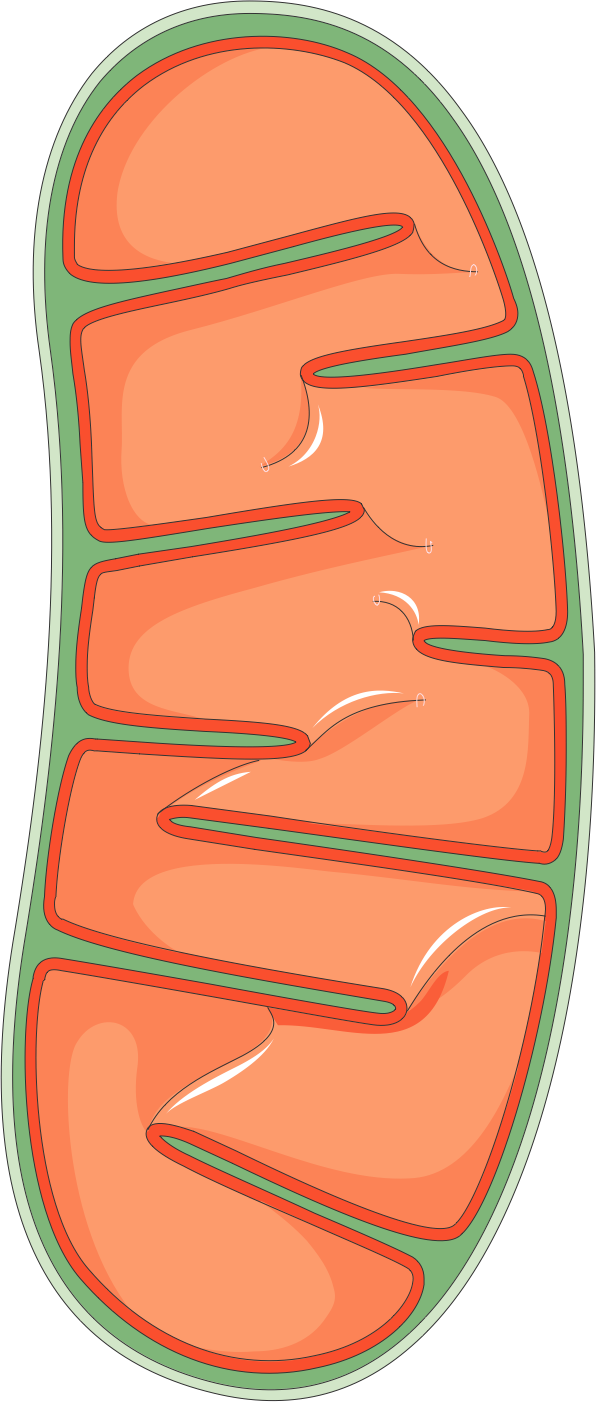
A mitochondrion is enclosed by two separate membranes, one inside the other. This double-layered system creates distinct compartments, allowing different processes to happen without interfering with each other.
The outer membrane is smooth and surrounds the entire organelle like a skin. It contains proteins called porins, which form channels that allow small molecules to pass through easily from the cell's cytoplasm into the mitochondrion.
Just inside this layer is the intermembrane space. It's a narrow gap between the outer and inner membranes. Think of it as a holding area, where ions and molecules can accumulate before being used in later processes.
The inner membrane is where things get more complex. Unlike the smooth outer membrane, this one is highly folded and selective about what it lets pass through. It's the functional core of the mitochondrion, packed with the proteins and machinery needed for energy conversion. Its unique structure is crucial for creating the conditions necessary for this process.
The inner membrane has infoldings called the cristae that increase the surface area for the complexes and proteins that aid in the production of ATP, the energy rich molecules.
The Inner Compartments
The extensive folding of the inner membrane creates shelf-like projections called cristae. These folds dramatically increase the surface area of the membrane. Imagine trying to fit a long piece of paper into a small box. By folding it back and forth, you can pack a much larger surface area into the same volume. This is exactly what cristae do, providing more real estate for energy-producing reactions to occur.
Within the inner membrane is the matrix, a gel-like substance that fills the center of the mitochondrion. It's a dense mixture of enzymes, ribosomes, and another surprising component: its own DNA.
That's right, mitochondria have their own unique set of genetic instructions, separate from the main DNA stored in the cell's nucleus. This mitochondrial DNA (mtDNA) is a small, circular molecule. It contains genes that are essential for building parts of the energy-production machinery.
This separate DNA is a major clue to the evolutionary origins of mitochondria. The leading theory, called endosymbiosis, suggests that mitochondria were once free-living bacteria that were engulfed by an ancient host cell. Instead of being digested, they formed a mutually beneficial relationship that has persisted for over a billion years.