Missing Factors Worksheet
Understanding Multiplication
A Faster Way to Add
Imagine you have 4 bags, and each bag has 3 apples. How many apples do you have in total? You could add them up: 3 + 3 + 3 + 3 = 12. That works, but it's a bit slow. Multiplication is just a shortcut for this kind of repeated addition.
Instead of adding 3 four times, we can say we have "4 times 3" apples. We write this as:
This equation tells us the same thing as the repeated addition, but it's much quicker to write and solve. Both methods give you 12 apples.
In a multiplication problem, the numbers have special names.
factor
noun
A number that is multiplied by another number to find a product.
product
noun
The result obtained after multiplying two or more numbers.
The Multiplication Table
To become quick with multiplication, it's helpful to memorize the most common calculations. These are organized into a grid called a multiplication table, sometimes called the "times tables." It shows the product of every number from 1 to 12 with every other number in that range.
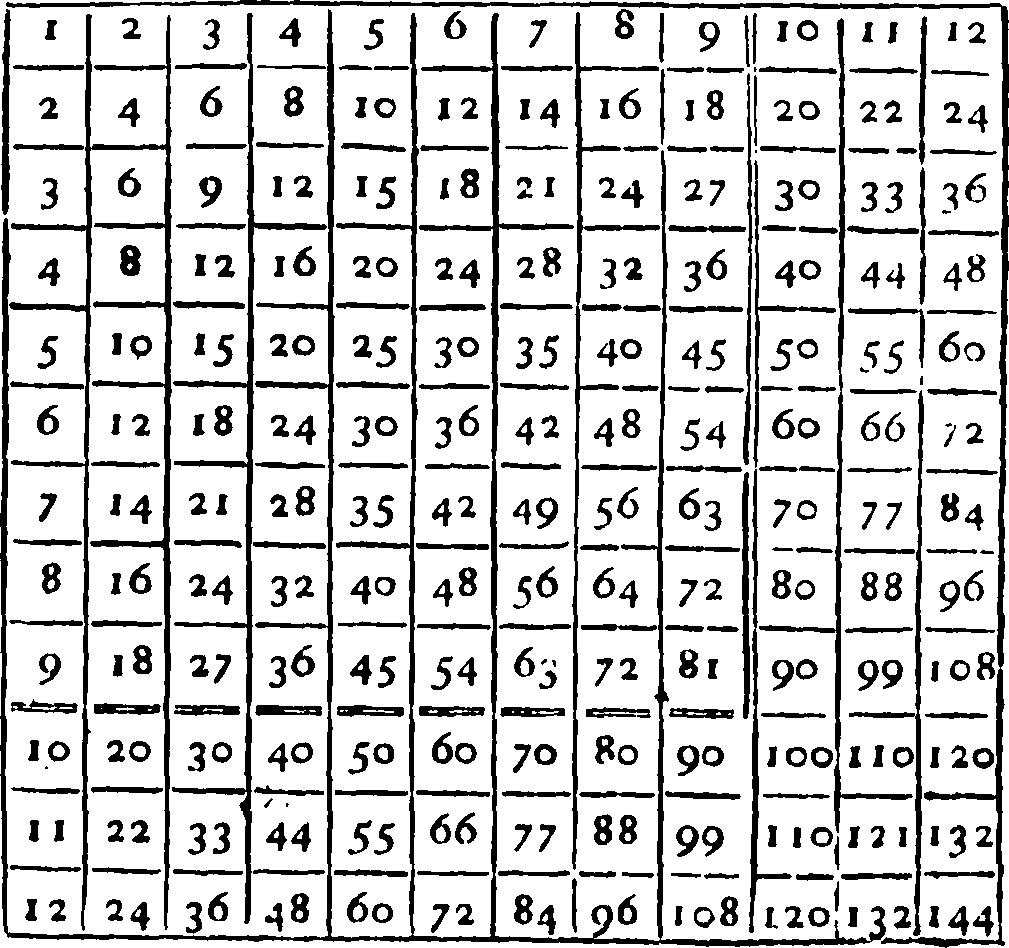
Learning this table might seem like a lot, but there are patterns that make it easier. For example, any number multiplied by 1 is just that number. Any number multiplied by 10 just gets a 0 added to the end (like ). Also, the order of the factors doesn't change the product. So, is the same as .
Knowing your multiplication facts by heart is a huge advantage. It makes solving bigger math problems much faster and easier.
Let's see it in action. Suppose a small theater has 9 rows of seats, and each row has 11 seats. To find the total, you could add 11 nine times. That would take a while. But if you know your multiplication table, you can look for where row 9 and column 11 meet. You'll find the answer instantly.
There are 99 seats in the theater. No repeated addition required! This is why multiplication is such a powerful tool.
Which of the following expressions is the same as adding 3 four times (3 + 3 + 3 + 3)?
Multiplication is a shortcut for repeated addition.