Milestones of Computer Evolution
Mechanical Computational Origins
From Gears to Logic
The idea of outsourcing calculation to a machine isn't new. While aids like the abacus helped humans track numbers, the 17th century saw the first real attempt to automate the process of calculation itself. The goal was to eliminate human error from tedious but critical tasks like creating astronomical and navigational tables.
French mathematician Blaise Pascal took a major step in 1642. As a teenager helping his father, a tax supervisor, he grew tired of endless, error-prone addition. His solution was the Pascaline, a brass box filled with interconnected gears and wheels. Each wheel represented a digit (0-9). When one wheel completed a full rotation from 9 back to 0, a small mechanism would kick the next wheel forward by one position. This was a mechanical implementation of the 'carry' operation in addition.
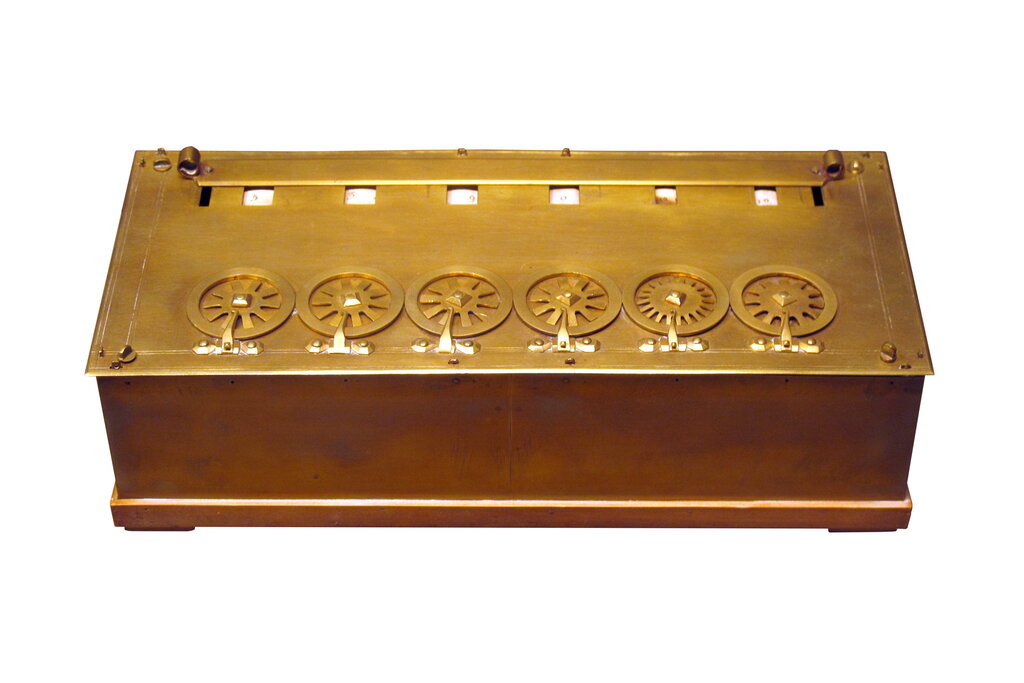
Decades later, German polymath Gottfried Wilhelm Leibniz expanded on this. He believed that human reasoning could be reduced to a kind of calculation. His (completed in 1694) could not only add and subtract but also multiply and divide. It used a special 'stepped drum' — a cylinder with teeth of varying lengths — to represent numbers, allowing for much more complex operations than Pascal's machine. These early devices proved that logical processes could be mirrored in physical machinery.
The Programmable Dream
The next leap required separating the machine from the instructions. Inspiration came from an unlikely place: the textile industry. In 1804, Joseph Marie Jacquard invented a loom that used punched cards to control the weaving of complex patterns. Each card corresponded to one row of the design; a hole in the card meant a specific hook was engaged, lifting a thread, while no hole meant the hook stayed down. By stringing cards together, a weaver could automate the creation of incredibly intricate fabrics. This was, in essence, a storage system for instructions.
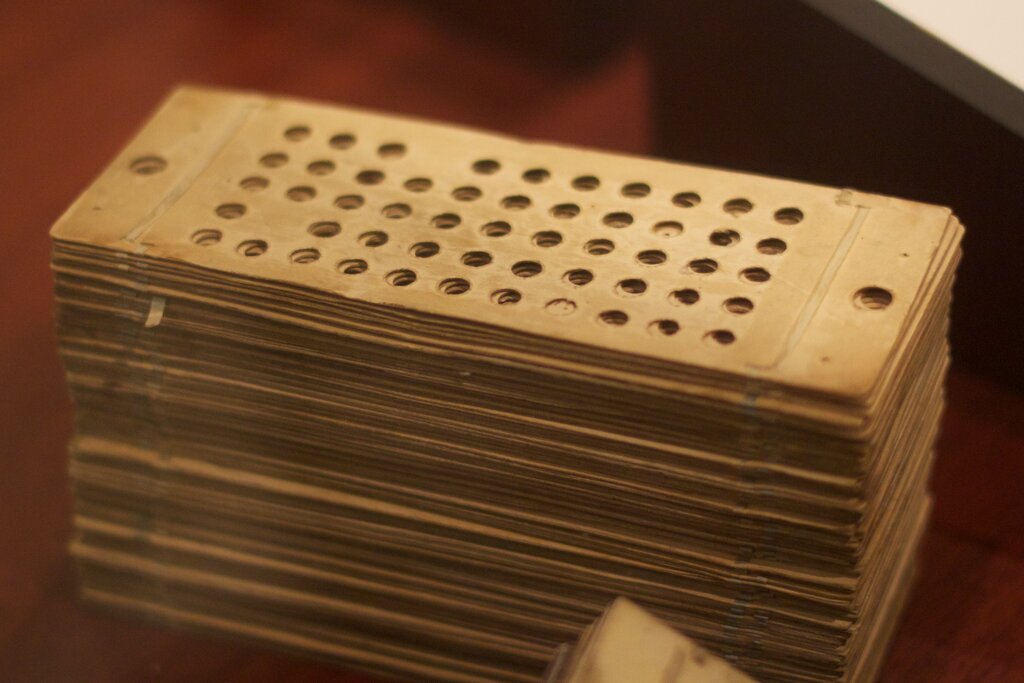
English mathematician Charles Babbage saw the potential of this system for computation. After designing the Difference Engine, a special-purpose calculator for polynomial functions, he conceived of a far more ambitious machine: the Analytical Engine in the 1830s. This was the first design for a general-purpose, programmable computer.
‘A machine which had a separate store for holding numbers (memory) and a ‘mill’ for working on them (arithmetic unit). The machine used a punched card system for specifying the sequence of instructions (input) and for obtaining results (output)’
Babbage's design had four key components that mirror modern computers: an arithmetic unit (the 'Mill'), a memory (the 'Store'), a processor to interpret instructions (the 'Control Barrel'), and input/output using punched cards. This was a radical separation of program and data. The machine could be given a set of instructions (a program) on one set of cards and the data to work on with another set, and it would perform the calculation automatically.
Working closely with Babbage was Ada Lovelace, a gifted mathematician. She saw the Analytical Engine's potential beyond mere number crunching. She realised that if numbers could represent other things, like musical notes or letters, the engine could manipulate symbols and create, not just calculate. In her notes on the engine, she published what is considered the first algorithm intended to be processed by a machine — a method for calculating Bernoulli numbers. This conceptual leap from calculation to general-purpose computation was profound.
Data on a Grand Scale
While Babbage's engine remained a dream, the idea of using punched cards for data processing found its first major real-world application decades later. The 1880 United States census had taken nearly eight years to tabulate by hand. With a growing population, officials feared the 1890 census would take longer than the decade between counts.
Herman Hollerith, a former census employee, developed a solution. He created an electromechanical tabulating machine that read data from punched cards. Each card represented one person, with holes punched in specific locations to denote demographic data like age, gender, and origin. When a card was fed into the machine, metal pins passed through the holes, completing an electrical circuit and advancing a corresponding counter on a large display. This dramatically sped up the process.
Hollerith's tabulator reduced the 1890 census processing time to just two and a half years, saving the government millions of dollars. More importantly, it marked the birth of automated data processing. It proved that the principles envisioned by Babbage — storing data on a medium separate from the machine and processing it automatically — had immense practical value.
What was the primary motivation behind the earliest attempts to automate calculation in the 17th century?
The Jacquard loom, which used punched cards to control weaving, provided a key inspiration for Charles Babbage. What was this key concept?
These mechanical and electromechanical systems laid the physical and logical groundwork for the electronic computers that would follow. They established core concepts: mechanised logic, stored programs, and large-scale data processing.