MikroTik Port Forwarding for Ruijie RG-6260 via ZeroTier
Understanding Port Forwarding
Your Network's Front Door
Think of your home network like an apartment building. The entire building has one street address, which is like your public IP address. It’s the single address the rest of the world uses to find you. Inside, there are many different apartments, each with its own number (1A, 2B, etc.). These are like the private IP addresses of your devices: your laptop, phone, and smart TV.
When your laptop requests a webpage, it sends a message out into the internet. The building's doorman, your router, notes which apartment sent the request. When the webpage data returns to the building's main address, the doorman knows exactly which apartment to deliver it to. This process works great for requests that start from inside your network.
But what happens when someone on the outside wants to connect directly to one of your devices? If a friend tries to connect to your game server, they only know the building's street address. The router, acting as the doorman, receives the request but has no idea which apartment to send it to. By default, for security, it simply turns the request away. Your internal devices are hidden and inaccessible from the outside internet.
The Role of NAT
The process that lets all your devices share a single public IP address is called Network Address Translation, or NAT. It's the core function that makes your router work like that helpful doorman. NAT keeps a table of all outgoing connections. When your phone (with its private IP, say 192.168.1.10) asks for a video, the router sends the request to the internet using its public IP address. It records that apartment 192.168.1.10 is waiting for that specific video.
When the video data comes back to the router's public IP, NAT checks its table, sees the entry it made, and forwards the data to your phone at 192.168.1.10. Every device on your network does this, allowing hundreds of conversations to happen simultaneously through one public address. This translation is fundamental to how the modern internet works, as it conserves the limited number of available public IPv4 addresses.
NAT acts as a basic firewall. Since it has no instructions for handling unsolicited incoming traffic, it simply drops it. This is great for security, but it's a problem when you want to allow specific traffic in, like for a home server or an online game.
Opening a Direct Line
This is where port forwarding comes in. Port forwarding is a rule you create in your router's configuration that tells NAT what to do with certain kinds of incoming traffic. It's like leaving a note for the doorman that says, "Anytime a package arrives addressed to Port 8080, please deliver it directly to the device at 192.168.1.50."
This rule, also called a NAT rule, creates a direct path through the router's firewall to a specific device on your private network. You are essentially poking a small, controlled hole in your network's defenses for a very specific purpose.
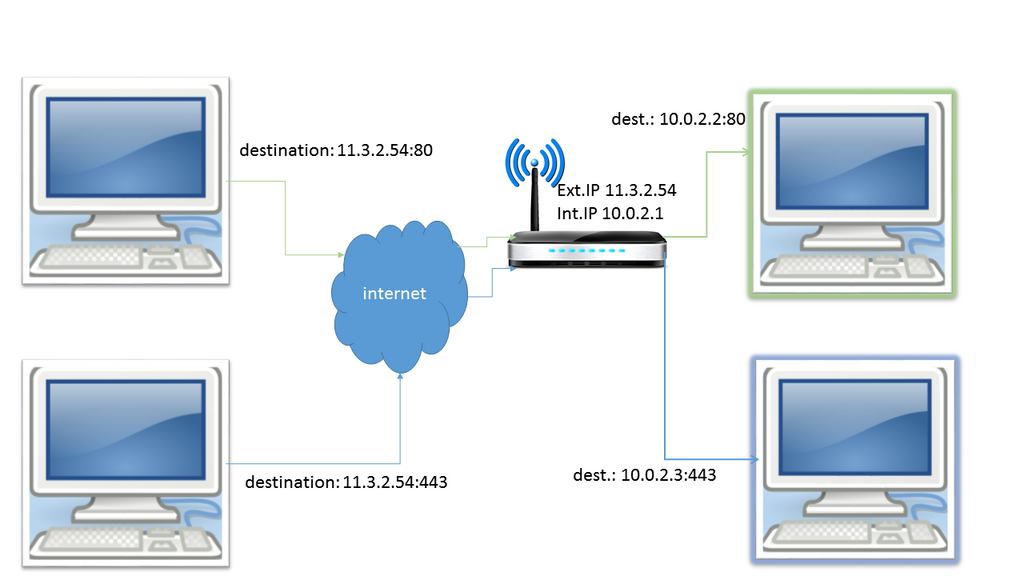
A typical port forwarding rule has three main parts:
- External Port: The port on your public IP address that the router will listen on (e.g., 8080).
- Internal IP Address: The private IP address of the device you want to receive the traffic (e.g., 192.168.1.50).
- Internal Port: The port on the destination device that the service is running on. Often, this is the same as the external port, but it doesn't have to be.
By setting this up, you allow external devices to bypass the normal NAT blocking process and connect directly to a service you're hosting, whether it's a web server, a file server, or a multiplayer game session.
Port forwarding is essential for making services on a private network accessible to the internet. It works hand-in-hand with NAT to guide traffic to the correct destination.
Now that you understand the 'what' and 'why' of port forwarding, you're ready to learn how to apply these rules.
In the provided apartment building analogy, what does the router's function as a 'doorman' represent?
What is the primary purpose of Network Address Translation (NAT)?