Microwave Wireless Power Transformers Explained
Electromagnetic Waves
Electric and Magnetic Ripples
Electromagnetic (EM) waves are disturbances that travel through space. Unlike ripples in a pond, which are disturbances in water, EM waves are ripples in electric and magnetic fields. These invisible fields exist everywhere. When an electric charge, like an electron, accelerates, it creates a ripple in these fields that spreads outward.
An EM wave has two parts: an oscillating electric field and an oscillating magnetic field. They are always perpendicular to each other and also perpendicular to the direction the wave is traveling. Because the oscillations are perpendicular to the direction of energy transfer, EM waves are known as transverse waves.
Crucially, EM waves don't need a medium to travel. They can move through the vacuum of space, which is why we can see light from distant stars. In a vacuum, all EM waves travel at the same incredible pace: the speed of light, denoted as . This speed is approximately 299,792,458 meters per second.
Properties of a Wave
All waves, including EM waves, have a few fundamental properties that describe their shape and behavior. The three most important are wavelength, frequency, and amplitude.
Wavelength
noun
The distance between two consecutive peaks or troughs of a wave. It's represented by the Greek letter lambda ().
Frequency
noun
The number of full wave cycles that pass a point in one second. It's measured in Hertz (Hz) and represented by the letter .
Wavelength and frequency are inversely related. If a wave has a long wavelength, fewer crests will pass a point each second, so it has a low frequency. If it has a short wavelength, more crests pass each second, giving it a high frequency.
This relationship is captured in a simple, powerful equation that connects a wave's speed, its frequency, and its wavelength.
Since is constant, if you increase the frequency (), the wavelength () must decrease, and vice versa. This trade-off defines the entire electromagnetic spectrum.
The Electromagnetic Spectrum
Electromagnetic waves exist across a vast range of frequencies and wavelengths. This continuous range is called the electromagnetic spectrum.
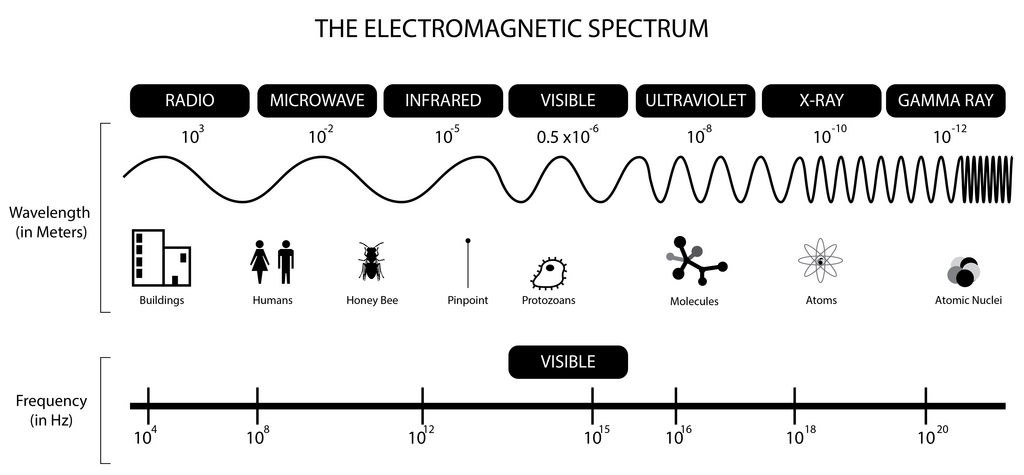
The only difference between a radio wave, a microwave, visible light, and an X-ray is its wavelength and frequency. They are all the same fundamental phenomenon: traveling ripples of electric and magnetic fields.
| Wave Type | Typical Wavelength | Comparison |
|---|---|---|
| Radio Waves | Meters to kilometers | Buildings, mountains |
| Microwaves | Centimeters | Baseballs, marbles |
| Infrared | Micrometers | Pinheads, cells |
| Visible Light | Nanometers | Bacteria, viruses |
| Ultraviolet | Nanometers | Molecules |
| X-rays | Angstroms | Atoms |
| Gamma Rays | Picometers | Atomic nuclei |
Despite their different names and uses, all types of electromagnetic waves travel at the exact same speed through a vacuum.
Wave Propagation
We know EM waves can travel through the vacuum of space, but what happens when they encounter matter? When an EM wave moves from a vacuum into a medium like air, water, or glass, it slows down. This change in speed can cause the wave to bend, a phenomenon called refraction.
The interaction also depends on the wave's frequency and the properties of the material. For example, radio waves pass through the walls of your house, but visible light does not. X-rays can pass through soft tissue but are blocked by bone. Microwaves are absorbed by water molecules, which is how a microwave oven heats food.
Understanding how different materials affect EM waves is key to designing any wireless system.