Microprocessor Fundamentals
Microprocessor Basics
The Brain on a Chip
At the heart of every digital device, from your smartphone to your car's engine management system, is a microprocessor. Think of it as the device's brain, a complex circuit etched onto a tiny piece of silicon. Its job is to read instructions, process data, and perform calculations. It's the engine that makes software run.
Imagine a chef in a kitchen. The recipe is a set of instructions, the ingredients are the data, and the chef is the microprocessor. The chef reads each step of the recipe (an instruction), takes the right ingredients (the data), and performs an action, like chopping or mixing (a calculation). The microprocessor does this billions of times per second, executing instructions from computer programs to produce a result.
From Room-Sized to Pocket-Sized
Before the microprocessor, computers were enormous. They filled entire rooms, built from thousands of individual components like vacuum tubes or transistors. Each component had to be wired together by hand. This made them expensive, power-hungry, and prone to failure.
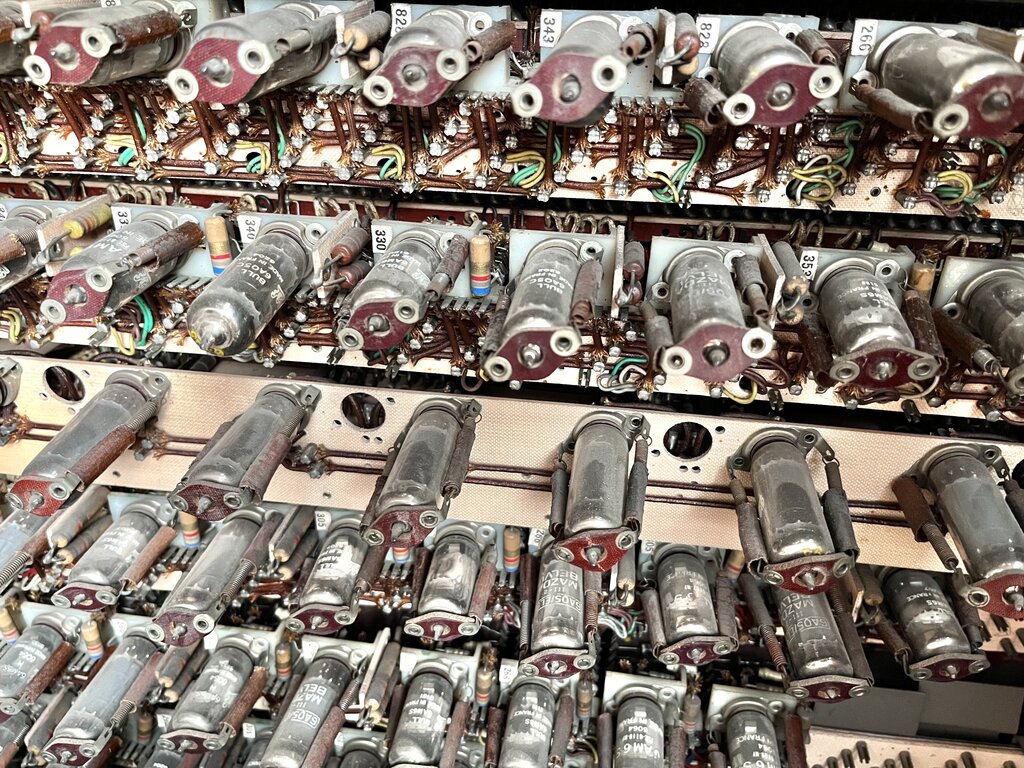
The game changed with the invention of the integrated circuit, which allowed engineers to place many transistors onto a single chip. This led to a major breakthrough in 1971: the Intel 4004, the world's first commercially available microprocessor. For the first time, all the essential parts of a computer's central processing unit (CPU) were combined onto a single piece of silicon.
This innovation kicked off a period of rapid advancement. Engineers found ways to cram more and more transistors onto chips, making them exponentially more powerful each year. Processors evolved from handling 4 bits of data at a time to 8 bits, then 16, 32, and now the 64-bit chips common in today's computers. Each step up allowed them to handle more complex tasks more quickly.
A Glimpse Inside
While modern microprocessors are incredibly complex, they are all built around a few core components. Think of these as the main departments within the 'brain'. We won't dive into what each one does just yet, but it's helpful to know their names. A typical microprocessor contains:
Together, these components work in a cycle to fetch, decode, and execute the instructions that make our software work. They are the fundamental building blocks responsible for the processing power we often take for granted.
Now, let's test what you've learned about these essential components of modern technology.
In the analogy of a chef in a kitchen, what does the microprocessor represent?
What key technological innovation made the creation of the microprocessor possible?