Microeconomics Essentials
Introduction to Microeconomics
The Small Picture
Economics is all about choices. Every day, you make hundreds of them. Should you buy a coffee or save the $5? Should you study for another hour or watch a movie? Businesses and even governments face similar dilemmas on a much larger scale. Microeconomics is the field of economics that zooms in on these individual decisions.
Microeconomics is a branch of economics that studies how individuals, households, and firms make decisions to allocate limited resources, typically in markets where goods or services are being bought and sold.
Think of it as looking at the economy through a microscope. Instead of focusing on big-picture issues like national unemployment or inflation, microeconomics examines the behavior of individual players. Why does one person choose to buy an apple instead of an orange? How does a single company decide how many workers to hire or what price to charge for its product? These are the kinds of questions we explore in microeconomics.
Scarcity and Choice
The fundamental problem of economics is simple: our wants are unlimited, but our resources are not. This tension is known as scarcity. You might want a new phone, a vacation, and a new car, but you probably don't have enough money to buy all of them right now. Time is also a scarce resource. You only have 24 hours in a day, so you can't study for an exam, work a full-time job, and get eight hours of sleep all at the same time.
scarcity
noun
The basic economic problem that arises because people have unlimited wants but resources are limited.
Because of scarcity, we are forced to make choices. We have to decide how to allocate our limited resources to satisfy our most important wants. A company might have to choose between investing in new machinery or giving its employees a raise. A government must decide whether to spend more on healthcare or on education. Every decision, big or small, involves a trade-off.
The Cost of a Choice
Every time you make a choice, you give something up. This is a core idea in economics called opportunity cost. It isn't just about money. The opportunity cost of any decision is the value of the next-best alternative that you had to forgo.
opportunity cost
noun
The value of the next-highest-valued alternative use of that resource. It's the benefit you miss out on when you choose one option over another.
Let's say you have a free afternoon. You can either go to the park with friends or stay home and read a book. If you choose to go to the park, the opportunity cost is the enjoyment and knowledge you would have gained from reading the book. If you choose to read, the opportunity cost is the fun and social time you missed at the park.
Businesses face this constantly. If a farmer decides to plant corn, the opportunity cost is the wheat they could have planted instead. Understanding opportunity cost helps us see the true cost of our decisions.
There's no such thing as a free lunch. Every choice has an opportunity cost, even if no money changes hands.
Micro vs. Macro
Economics is broadly divided into two main branches: microeconomics and macroeconomics. We've been talking about microeconomics, which focuses on the small-scale actions of individuals and firms. Macroeconomics, on the other hand, looks at the big picture.
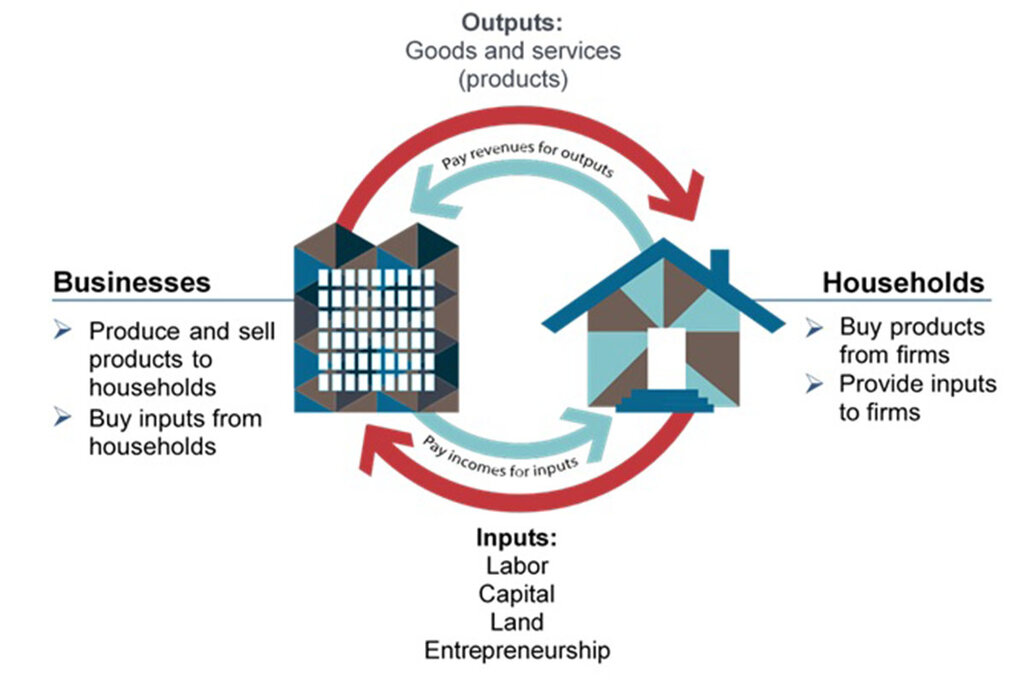
Macroeconomics deals with the economy as a whole. It studies economy-wide phenomena such as inflation, unemployment, and economic growth. While microeconomics might ask why coffee prices went up at your local cafe, macroeconomics would ask why the overall price level in the country is rising.
An easy way to remember the difference is that "micro" means small, and "macro" means large. Microeconomics is the study of the trees; macroeconomics is the study of the forest.
| Aspect | Microeconomics | Macroeconomics |
|---|---|---|
| Focus | Individual economic agents (households, firms) | The economy as a whole |
| Scope | A single market, city, or industry | A country's entire economy or the global economy |
| Key Questions | How are prices determined? What influences a consumer's choice? | What causes inflation? What determines economic growth? |
| Examples | A family's budget, a company's hiring decisions | National unemployment rate, gross domestic product (GDP) |
Even though they are distinct, microeconomics and macroeconomics are closely linked. The overall health of the forest (macro) depends on the health of the individual trees (micro). The decisions made by millions of individuals and firms shape the macroeconomic outcomes we observe.
Ready to test your understanding? Let's see what you've learned about the foundations of microeconomics.
Which of the following questions would most likely be studied by a microeconomist?
The core economic problem that all societies face is that resources are limited, but human wants are unlimited. What is this concept called?
By understanding these basic principles—scarcity, choice, and opportunity cost—you have the foundation for thinking like an economist.