Methylation Profiling and Analysis
Mapping CpG Landscapes
The CpG Landscape
While methyl groups can attach to cytosine bases throughout the genome, they don't do so uniformly. The placement of these epigenetic marks follows a distinct geography. The most significant landmarks in this landscape are regions dense with CpG sites, where a cytosine nucleotide is immediately followed by a guanine. These clusters are known as (CGIs).
Think of CGIs as bustling city centers for gene activity. They are typically unmethylated, which allows the genes they control to be expressed. Over 70% of human gene promoters are associated with a CpG island, highlighting their fundamental role in keeping essential "housekeeping" genes active in all cells.
Just outside these islands are the CpG shores (up to 2,000 base pairs away) and, further out, the CpG shelves (2,000 to 4,000 base pairs away). While CGIs themselves are usually static, the shores and shelves are where the action is. These regions show the most variable methylation patterns between different tissues and, importantly, between healthy and diseased cells. In many cancers, for example, it's the aberrant methylation in CpG shores, not the islands, that correlates most strongly with the silencing of tumor-suppressor genes.
Beyond the Coastline
The vast genomic regions outside of islands, shores, and shelves are called the 'open sea'. This territory, which makes up most of the genome, is typically heavily methylated. This widespread methylation is thought to help silence repetitive DNA elements and prevent them from jumping around the genome, which could cause mutations.
However, the open sea is not uniform. It contains large 'hypomethylated blocks'—stretches of DNA with unusually low levels of methylation. These blocks often correspond to regions of the genome that are late to replicate and are associated with increased genomic instability, a hallmark of cancer.
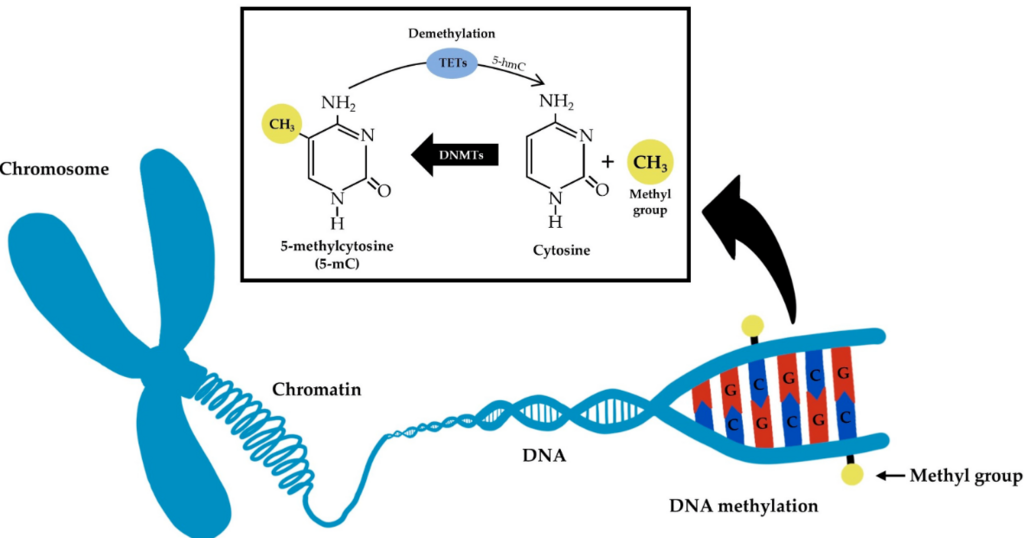
The location of methylation matters. While methylation at a gene's promoter almost always acts as a dimmer switch, turning gene expression down or off, methylation within the main body of a gene can have a different effect. Gene-body methylation is often found in actively transcribed genes and is thought to help ensure the transcriptional machinery reads the gene smoothly from start to finish, preventing accidental initiation of transcription from within the gene itself.
Tissue-Specific Signatures
If every cell in your body has the same DNA, what makes a liver cell different from a neuron? The answer lies largely in epigenetics, and specifically in regions with unique methylation patterns. These are called (T-DMRs).
These regions gain or lose methylation in a highly specific way as cells differentiate into their final types. A T-DMR might be unmethylated in blood cells, allowing a blood-specific gene to be active, but heavily methylated and silenced in muscle cells. This cellular memory, written in methylation, is what maintains a cell's identity throughout its life.
Time to see what you've learned about the geography of the epigenome.
What is the primary characteristic of a CpG island (CGI)?
In the context of cancer development, aberrant methylation leading to the silencing of tumor-suppressor genes is most strongly correlated with changes in which genomic region?
Understanding the landscape of CpG sites is key to interpreting methylation data. The patterns in islands, shores, and the open sea provide critical clues about gene regulation, cell identity, and disease.