Methanol: The Simple Alcohol
Methanol Basics
The Simplest Alcohol
Meet methanol, the simplest member of the alcohol family. Its chemical formula is . This tells us it's made of one carbon atom (C), four hydrogen atoms (H), and one oxygen atom (O). The key part that makes it an alcohol is the hydroxyl group, written as . This is simply an oxygen atom bonded to a hydrogen atom, which is then attached to the carbon atom.
The atoms in a methanol molecule aren't arranged flat on a page. The carbon atom sits at the center of a three-dimensional shape, with the three hydrogen atoms and the oxygen atom branching off from it. This specific structure is what gives methanol its unique properties.
Physical Traits
If you had a vial of pure methanol, it would look just like water. It's a clear, colorless liquid at room temperature. However, it has a distinct, sharp odor that sets it apart.
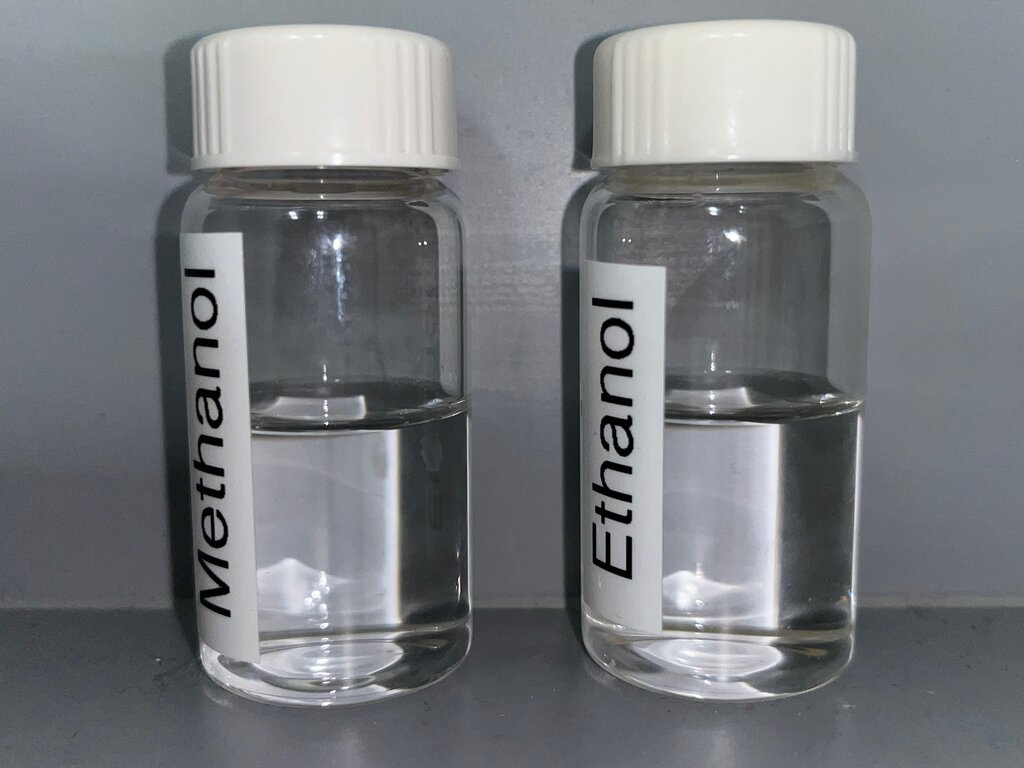
Methanol's physical properties are determined by the way its molecules interact with each other. The hydroxyl group () is key, as it allows methanol molecules to form strong connections called hydrogen bonds. These bonds affect things like its boiling and melting points.
| Property | Value |
|---|---|
| Boiling Point | 64.7°C (148.5°F) |
| Melting Point | -97.6°C (-143.7°F) |
| Density | 0.792 g/cm³ |
Methanol also mixes completely with water. The term for this is miscible. Because both water () and methanol () have hydroxyl groups, they can form hydrogen bonds with each other just as easily as they can with themselves. It's like having two crowds of people who speak the same language; they can mingle together perfectly.
Chemical Behavior
One of methanol's most important chemical properties is its flammability. It burns in the presence of oxygen with a nearly invisible, clean blue flame. The combustion reaction breaks down the methanol molecule and creates two very common substances: carbon dioxide and water.
This equation shows that for every two molecules of methanol that burn, three molecules of oxygen are needed. The reaction produces two molecules of carbon dioxide and four molecules of water.
Methanol can also act as a very weak acid. The hydrogen atom in the hydroxyl () group can be removed under certain conditions, but this is much less common than its combustion reaction.
While similar to ethanol (the alcohol in drinks), methanol is highly toxic to humans and should never be ingested.
Time to review what we've learned about this simple but important molecule.
What is the chemical formula for methanol?
The presence of which functional group is characteristic of alcohols like methanol?
Understanding methanol's basic structure and properties is the first step to seeing how it behaves in more complex chemical scenarios.