Metal Guitar Mastery
Metal Guitar Foundations
The Core of Metal Riffs
The heavy, aggressive sound of metal guitar isn't just about distortion. It’s born from the picking hand. How you attack the strings defines the rhythm's character. Three techniques form the foundation of nearly every metal riff: palm muting, downpicking, and alternate picking. Let's break them down.
Palm Muting
Palm muting is what gives metal riffs that tight, chunky, percussive sound. Instead of letting notes ring out, you dampen them slightly to create a controlled "chug." Think of it like a drummer hitting a cymbal and then grabbing it to cut the sound short. That abrupt stop is what creates the punch.
To do it, you'll use the fleshy side of your picking hand, right below your pinky finger. Lightly rest this part of your hand across the strings, right where they come out of the bridge. Don't press down hard; it's a gentle touch. If you mute too far from the bridge (towards the neck), you'll kill the note entirely. If you're too far back on the bridge itself, you won't get any muting effect. There’s a sweet spot you have to find by feel.
The goal is to dampen the string just enough to remove the sustain while still allowing a clear, pitched note to sound.
Try picking a single low string while adjusting your hand's position. You'll hear the sound change dramatically. Once you find that perfect spot, practice picking simple patterns while keeping your hand steady. This technique is fundamental for rhythm guitar in almost every subgenre of metal.
Relentless Downpicking
If palm muting provides the texture, downpicking provides the force. Downpicking is exactly what it sounds like: playing notes exclusively with downward pick strokes. Instead of moving your pick up and down, you strike the string, lift the pick back up, and strike down again for the next note.
Why do this? It creates an incredibly consistent and aggressive attack. Every note hits with the same power, producing a driving, machine-like rhythm that’s perfect for heavy riffs. It’s less efficient than other techniques, but the sonic payoff is huge. It's a physical technique that requires you to use your wrist and forearm, building stamina over time.
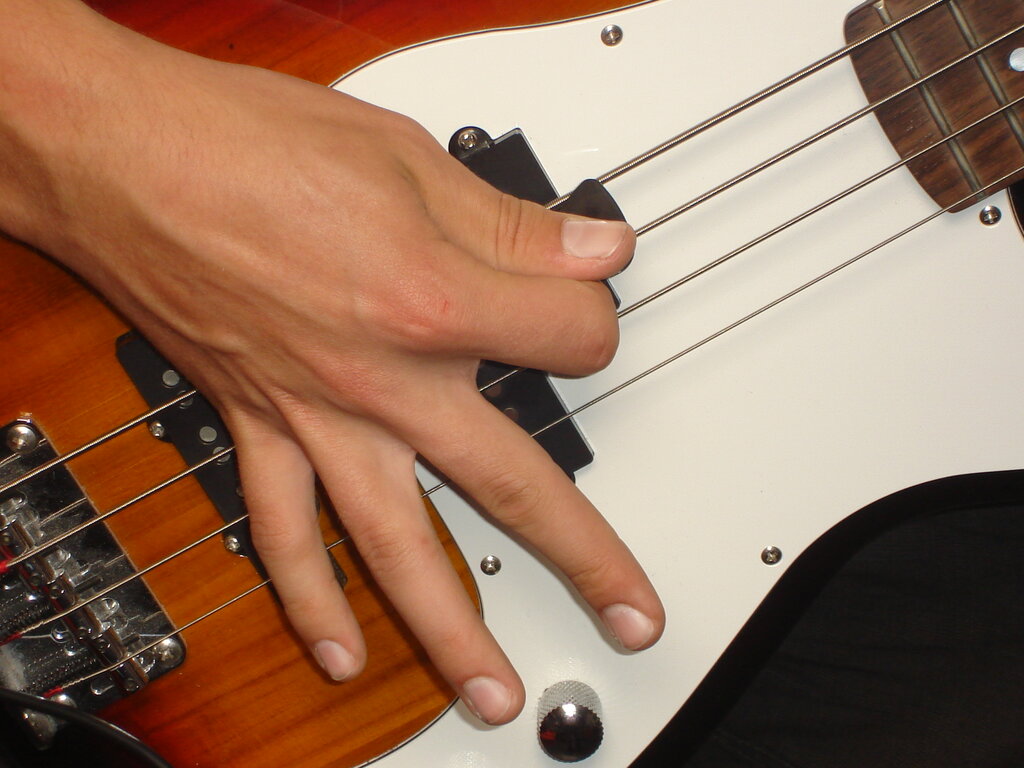
To practice, set a metronome to a slow tempo. Try playing eighth notes on a single open string, using only downstrokes. Focus on keeping your motion relaxed but firm. As you get comfortable, slowly increase the speed. Your arm will get tired, but that's part of building the muscle needed for this style.
Alternate Picking for Speed
While downpicking is great for power, it has a speed limit. For faster passages, metal guitarists turn to alternate picking. This technique involves a strict down-up-down-up motion with the pick.
This is the most efficient way to pick. Every movement of your hand produces a note, so no motion is wasted. It allows for fast, fluid lines that would be impossible with downpicking alone. Mastering alternate picking is crucial for playing fast riffs and eventually, for lead guitar solos.
For lead guitar, down-up style ‘alternate’ picking is the most efficient way to play: follow every downstroke of the pick with an upstroke so you’re plucking the string every time the pick passes it.
The key to good alternate picking is economy of motion. Keep your pick movements as small as possible, just enough to clear the string on the upstroke. Start with a metronome and practice simple scales or chromatic exercises. Pay close attention to your picking pattern, ensuring every downstroke is followed by an upstroke and vice versa. It should feel smooth and even, not jerky.
Time to test your knowledge of these core techniques.
What is the main sonic characteristic that palm muting adds to a metal guitar riff?
To achieve the classic palm mute effect, where should you gently rest the side of your picking hand?
These three techniques are the building blocks of metal rhythm guitar. Practice them slowly and consistently, and you'll build a solid foundation for playing your favorite heavy riffs.