Merging Boltzmann Machines
Introduction to Boltzmann Machines
What is a Boltzmann Machine?
A Boltzmann Machine is a type of neural network that learns from data by discovering patterns. What makes it special is its use of probability. Instead of giving a single, fixed answer, it thinks in terms of likelihoods, making it great for tasks where uncertainty is part of the problem. It's particularly good at understanding data where the inputs are binary, like pixels in a black-and-white image (on or off) or survey answers (yes or no).
Think of it as a network of simple units, or neurons, that can be either 'on' (1) or 'off' (0). These units are all connected, and the network learns by adjusting the strength of these connections. The goal is to create a model that captures the underlying probability distribution of the data it's trained on. This means it learns not just what the data looks like, but the chances of seeing different patterns.
At its core, a Boltzmann Machine is a system for learning the probabilities of different states, inspired by principles from statistical physics.
Energy-Based Models
Boltzmann Machines belong to a class of models called Energy-Based Models (EBMs). The core idea is simple and elegant: desirable or likely configurations of the network have low 'energy', while unlikely configurations have high 'energy'.
Imagine a landscape with hills and valleys. The valleys represent low-energy states. A ball rolling on this landscape will naturally settle in a valley. Similarly, a Boltzmann Machine learns to shape its energy landscape so that the patterns it saw during training correspond to the deep valleys. Unfamiliar or nonsensical patterns are pushed up onto the high-energy hills.
This 'energy' isn't physical energy; it's a number calculated by a special function. For a given state of the network (a specific on/off configuration of all its units), the energy function tells us how plausible that state is. The lower the energy, the more plausible the state.
Low energy means high probability. High energy means low probability. The network's job is to learn an energy function that reflects the training data.
The energy of a particular configuration of visible () and hidden () units is calculated based on the connection weights () and the biases (). A simplified version of the energy function looks like this:
Here, the sums are taken over all connections and all units. The network learns by adjusting the weights () and biases () to lower the energy for valid data patterns.
Architecture and Components
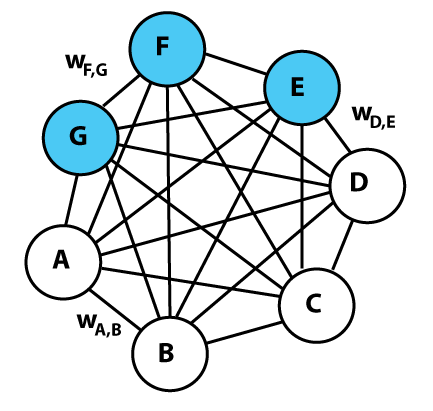
The structure of a general Boltzmann Machine is straightforward but powerful. It consists of a set of units, often divided into two groups.
Visible Units
noun
These are the units that interact with the outside world. During training, they hold the input data. When the machine generates new data, the output appears on these units.
The second group of units works behind the scenes.
Hidden Units
noun
These units do not directly interact with the data. Their purpose is to capture more complex relationships and higher-order patterns within the data. Think of them as the network's internal memory or feature detectors.
In a fully connected Boltzmann Machine, every unit is connected to every other unit, visible or hidden. There are no self-connections. This dense web of connections allows the model to capture very complex dependencies.
The problem with this fully connected structure is that it's computationally very expensive to train. Calculating the exact probabilities requires summing over every possible state of the network, which grows exponentially with the number of units. This difficulty led to the development of a simplified version called the Restricted Boltzmann Machine (RBM), where connections are only allowed between visible and hidden units, not among units of the same type. For now, just know that training a general BM is a tough challenge.
Training and Applications
Training a Boltzmann Machine means finding the right values for the weights and biases that create the desired energy landscape. Because exact calculation is often impossible, we rely on approximation algorithms. A common approach involves a technique called Gibbs sampling, which is a way of wandering around the state space to collect samples that represent the model's learned probability distribution.
The algorithm essentially alternates between two phases. In one phase, it observes the real data (clamping the visible units) and figures out how the hidden units should behave. In the other phase, it lets the network run freely to generate its own data. By comparing the statistics from these two phases, the algorithm knows how to adjust the weights to make the network's generated data look more like the real data.
Due to their complexity, full Boltzmann Machines are not as common today as their restricted counterparts. However, they are foundational to deep learning and have been applied in several areas:
- Collaborative Filtering: They can be used in recommendation systems to predict user preferences. For example, by learning patterns in movie ratings, a BM can suggest new movies a user might like.
- Feature Learning: BMs are excellent at finding meaningful features in data. The patterns activated in the hidden units can serve as a new, more useful representation of the input for another machine learning model.
- Image Reconstruction: A BM can be trained on a set of images and then used to fill in missing parts of a new, incomplete image.
Understanding Boltzmann Machines provides a key insight into how neural networks can work with probability and uncertainty, a concept that is central to many modern AI systems.
What is a key characteristic that distinguishes a Boltzmann Machine from many other types of neural networks?
In the context of an Energy-Based Model like a Boltzmann Machine, what does a state with 'low energy' signify?