Mercedes W201 Models and Forgotten Maintenance
W201 Model Overview
The Compact Executive
In the early 1980s, Mercedes-Benz took a bold step. Known for its large, luxurious sedans, the company introduced a smaller, more accessible model: the W201 series. Affectionately nicknamed the “Baby Benz,” the 190, as it was badged, was designed to bring the brand's legendary engineering and quality to a wider audience. Produced from late 1982 to 1993, it was a massive success and set the stage for the future C-Class.
The W201 was a marvel of engineering for its time. It featured a revolutionary multi-link rear suspension that provided excellent handling and comfort, a design that would be adopted by many other automakers. Despite its compact size, it was built with the same focus on safety and durability as its larger siblings, featuring anti-lock brakes and airbags later in its production run.
North American Lineup
When the W201 arrived in the United States and Canada for the 1984 model year, the lineup was straightforward. Buyers could choose between a gasoline model, the 190E 2.3, and a diesel model, the 190D 2.2. The 'E' in 190E stood for Einspritzung, German for fuel injection, while the 'D' denoted a diesel engine. Both were built to last, but offered very different driving experiences.
The 190E 2.3 was equipped with a 2.3-liter four-cylinder gasoline engine, offering a good balance of performance and economy. The 190D 2.2 used a 2.2-liter four-cylinder diesel engine, which was praised for its incredible fuel efficiency and longevity, though it was not particularly fast.
Evolution and Performance
As the years went on, Mercedes-Benz expanded the W201 lineup in North America. In 1987, the 190E 2.6 arrived, boasting a smooth and powerful 2.6-liter inline-six engine. This model offered a significant boost in performance and refinement, bringing the compact sedan closer to the experience of a larger Mercedes.
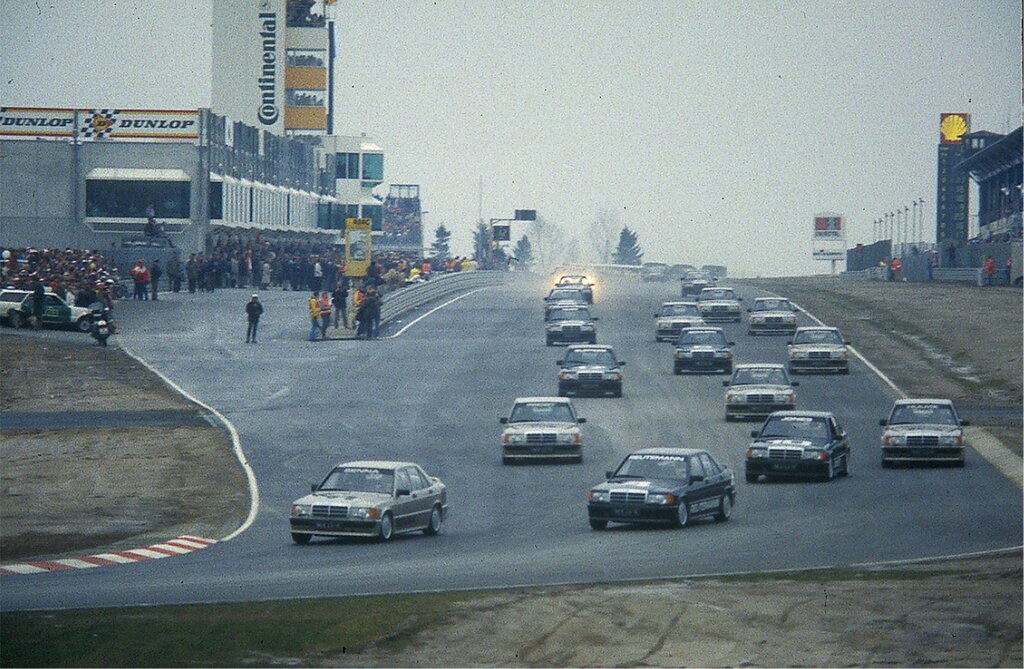
The most famous W201 models, however, were the high-performance variants developed with Cosworth. The 190E 2.3-16, available from 1986 to 1987 in the US, was a true sports sedan. It featured a potent 16-valve version of the 2.3-liter engine, an aerodynamic body kit, a sport-tuned suspension, and a dog-leg manual transmission. It was a direct competitor to the BMW M3 and established the W201's credentials on the racetrack.
The diesel line also saw an upgrade with the introduction of the five-cylinder 190D 2.5 in 1986, and later, the 190D 2.5 Turbo in 1987. The turbocharged model provided a much-needed increase in power, making it a far more capable highway cruiser without sacrificing the diesel's trademark efficiency.
| Model | Engine | Horsepower (U.S. Spec) | North American Years |
|---|---|---|---|
| 190E 2.3 | 2.3L 8v Inline-4 (M102) | 113 - 130 hp | 1984–1993 |
| 190D 2.2 | 2.2L 8v Inline-4 Diesel (OM601) | 72 hp | 1984–1985 |
| 190D 2.5 | 2.5L 10v Inline-5 Diesel (OM602) | 93 hp | 1986–1989 |
| 190D 2.5 Turbo | 2.5L 10v Inline-5 Turbodiesel (OM602) | 121 hp | 1987 |
| 190E 2.6 | 2.6L 12v Inline-6 (M103) | 158 hp | 1987–1993 |
| 190E 2.3-16 | 2.3L 16v Inline-4 (M102) | 167 hp | 1986–1987 |
Over its ten-year production run, the W201 received several updates, including subtle exterior revisions and interior upgrades. By the time the last car rolled off the line in 1993, the “Baby Benz” had proven that a compact car could deliver the uncompromising quality and prestige of a Mercedes-Benz. It remains a beloved modern classic for its robust engineering, timeless design, and engaging driving dynamics.