Membrane Filtration in Water Engineering
Transport Mechanisms and Models
How Molecules Cross a Membrane
We know that membranes like Microfiltration (MF) and Ultrafiltration (UF) have larger pores than Nanofiltration (NF) and Reverse Osmosis (RO). But the size of the pores is only part of the story. The way water and solutes travel through these barriers is fundamentally different, and understanding this difference is key to understanding why, for example, RO requires so much more pressure than UF.
Two primary models describe this transport: the Pore Flow model, which is essentially a sophisticated sieving process, and the Solution-Diffusion model, which involves molecules dissolving into and moving through the membrane material itself.
The Pore Flow Model
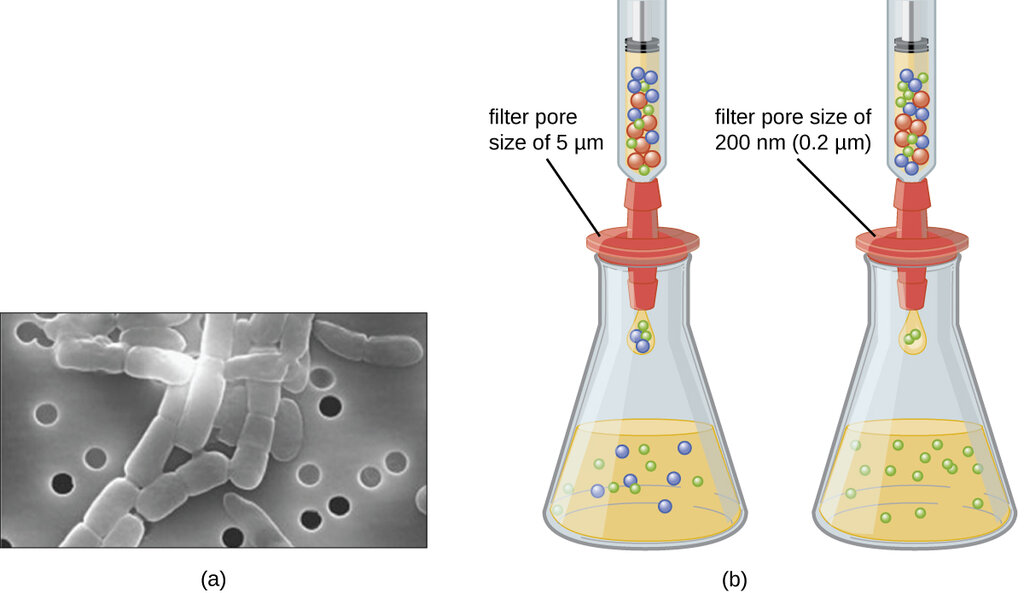
The Pore Flow model applies to membranes with distinct, continuous pores, like MF and UF. Think of it as a very precise sieve. In this model, transport is driven by a pressure gradient. Water is physically pushed through the pores, carrying along any solutes small enough to fit.
This process is governed by a principle called convective coupling. The bulk flow of the solvent (water) literally drags dissolved solutes along with it. The movement of the solute is directly linked, or 'coupled,' to the movement of the water. Imagine a river flowing through a narrow canyon; the current carries along not just water, but also any small debris floating in it.
Because the mechanism is a physical passage, the permeability of the membrane is highly dependent on the viscosity of the solvent. If the water becomes more viscous (for instance, at lower temperatures), it will flow more slowly through the pores, reducing the overall flux. The relationship is straightforward: higher viscosity means lower permeance.
The Solution-Diffusion Model
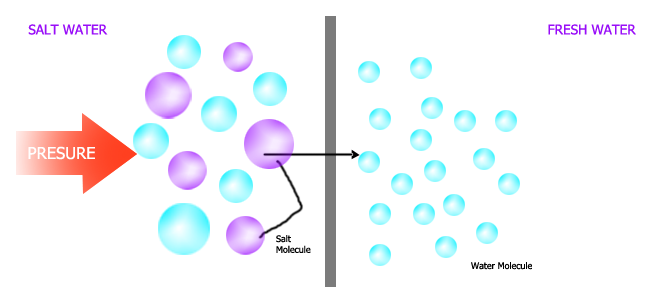
For dense membranes like RO and NF, which lack defined pores, a different mechanism is at play. The Solution-Diffusion model describes transport as a three-step journey:
- Sorption: Solute and solvent molecules dissolve into the membrane material on the high-pressure side.
- Diffusion: These molecules then move, or diffuse, through the polymer matrix of the membrane.
- Desorption: Finally, the molecules are released from the membrane surface on the low-pressure side.
In this model, there are no channels to flow through. Transport depends on the chemical affinity between the molecules and the membrane material. It's a process of dissolving and migrating, not sieving.
The driving force in the Solution-Diffusion model is not pressure itself, but the gradient in chemical potential. This is a thermodynamic concept that accounts for the effects of pressure, concentration, and temperature. Simply put, molecules move from an area of high chemical potential to an area of low chemical potential to reach equilibrium.
This is why RO can separate salt from water. Applying high pressure to salt water raises its chemical potential. Water molecules can dissolve into and diffuse through the membrane to the lower-pressure side (which has a lower chemical potential). Salt ions, however, have a very low solubility in the membrane material and thus diffuse much, much slower, leading to their effective rejection.
Comparing the Models
The distinction between these two models explains the operational differences we see in filtration systems. Pore flow is a size-based, mechanical separation driven by hydraulic pressure. Solution-diffusion is a chemical, phase-change process driven by a gradient in chemical potential.
| Feature | Pore Flow Model (MF, UF) | Solution-Diffusion Model (NF, RO) |
|---|---|---|
| Mechanism | Sieving through physical pores | Dissolving into and diffusing through membrane material |
| Driving Force | Pressure Gradient | Chemical Potential Gradient |
| Solute Transport | Convective Coupling (dragged by water) | Independent diffusion based on solubility |
| Membrane Structure | Porous | Dense, non-porous polymer matrix |
| Effect of Viscosity | High impact on permeance | Minor impact on permeance |
Understanding which model applies helps predict how a membrane will perform. In a pore flow system, increasing pressure directly increases flow. In a solution-diffusion system, pressure is needed to overcome the osmotic pressure of the feed solution and create the necessary chemical potential gradient for transport to occur. This is why RO systems for desalination require such high operating pressures; they are fighting against the natural osmotic tendency of water to flow into the concentrated salt solution.
Which transport model is characteristic of membranes with distinct, continuous pores, such as Microfiltration (MF) and Ultrafiltration (UF)?
What are the three sequential steps of the Solution-Diffusion transport model?
Grasping these transport models provides the physical basis for selecting the right membrane technology for a given separation task.