Medieval Structures and Social Dynamics
Feudal Dynamics and Subinfeudation
A Tangled Web of Oaths
The idea of feudalism is often pictured as a neat pyramid, with the king at the top, followed by his great lords, their knights, and finally the peasants. But the reality was far messier. A single knight or lord could hold different pieces of land, called fiefs, from several different overlords. This created a serious problem: if two of your lords went to war with each other, whose side were you on? This wasn't a rare occurrence; it was a central challenge of the medieval political landscape. The entire system was less a rigid hierarchy and more a complex, overlapping network of personal loyalties and obligations.
Subinfeudation
noun
The practice by which a tenant, holding land from a lord, grants a portion of that land to a subordinate tenant. This process could be repeated, creating a chain of lordship and vassalage.
This process of granting out fiefs that had already been granted was called and it was the source of much of the system's complexity. Imagine a duke receives a vast territory from the king. The duke can't manage it all himself, so he grants large parcels to several counts. Those counts, in turn, grant smaller manors to local knights. Each link in this chain involved a personal oath of homage and fealty, where the vassal promised specific services in exchange for the land. The two most important duties were military aid and counsel, known by their Latin terms, auxilium et consilium.
This system flourished after the breakup of the mighty Carolingian Empire in the 9th century. With no strong central authority, power devolved to regional strongmen. Vast territories like the Duchies of Aquitaine, Normandy, and Burgundy became kingdoms in all but name. Their rulers, while technically vassals of the French king, often commanded more wealth and military power than the king himself. They were the masters of their own domains, using subinfeudation to build private armies and project power.
The Priority Clause
To solve the problem of divided loyalty, medieval law developed a clever solution: the distinction between simple homage and liege homage. Simple homage was a standard oath of vassalage. You promised to support your lord, but the obligation wasn't absolute. If that lord went to war with another of your lords, you could technically stand aside.
, however, was different. It was an oath of primary, unbreakable loyalty. A vassal who swore liege homage to a lord had to support him against all others, without exception. A wise king would demand liege homage from his most important vassals, while those same vassals might only accept simple homage from their own knights, ensuring their primary loyalty flowed upward.
| Feature | Simple Homage | Liege Homage |
|---|---|---|
| Primacy | Non-exclusive | Exclusive and primary |
| Military Duty | Obligated, but with exceptions | Absolute, against all others |
| Conflict | Can declare neutrality | Must fight for liege lord |
Aquitaine a Case Study
The in southwestern France provides a classic example of these feudal dynamics. For centuries, the Duke of Aquitaine was a vassal of the King of France. However, the duchy was vast, wealthy, and culturally distinct. In 1152, Eleanor of Aquitaine's marriage to Henry Plantagenet, who soon became King Henry II of England, threw the system into chaos.
Now, the King of England was also the Duke of Aquitaine, and therefore technically a vassal of the King of France. The English kings had to swear homage to the French kings for their lands in France, a situation that was both a legal necessity and a constant source of political tension. This dual-loyalty was a major contributing factor to the centuries of conflict between the French and English crowns, including the Hundred Years' War.
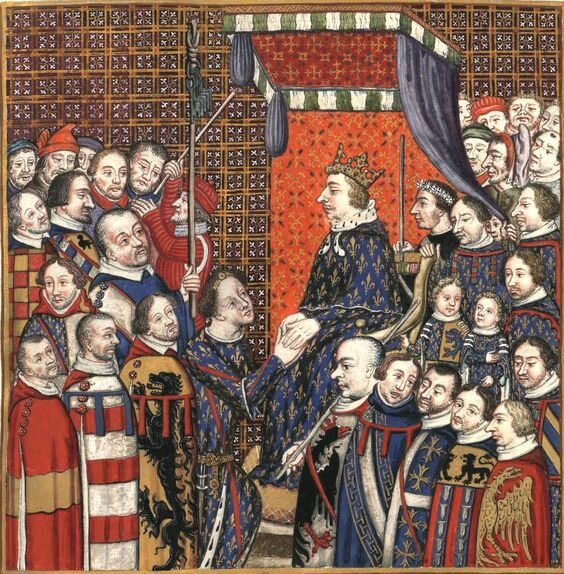
The promise of auxilium et consilium—aid and counsel—was the bedrock of the feudal contract. Aid primarily meant military service, typically 40 days a year, but could also include financial contributions. Counsel meant the vassal had a duty to attend the lord's court to offer advice and help adjudicate disputes.
This web of interlocking duties, conflicting allegiances, and legal workarounds defined medieval politics. It was a decentralized system born of necessity, where personal oaths held society together, however tenuously.
What was the practice of a vassal granting a portion of their fief to another person, creating a chain of lord-vassal relationships?
A knight holds fiefs from both Baron Gaston and Count Leopold. If the Baron and the Count go to war with each other, what type of oath would obligate the knight to fight for Count Leopold against everyone, including Baron Gaston?