Medieval Farming Practices
Introduction to Medieval European Agriculture
A New Way of Farming
After the fall of the Roman Empire, life in Europe changed dramatically. The large, interconnected trade networks frayed, and communities had to become more self-sufficient. Feeding everyone was the central challenge, and the old ways of farming weren't always up to the task, especially in the heavier, clay-rich soils of northern Europe.
The Romans had typically used a two-field system. Farmers would plant crops in one field for a season while leaving the other field empty, or fallow, to recover its nutrients. The next year, they would swap. It was a simple system, but it meant that half the land was always out of production.
The Three-Field System
Around the 8th century, a more efficient method began to spread: the three-field system. This was a game-changer. Instead of dividing land into two fields, farmers divided it into three.
Each year, one field was planted in the autumn with winter wheat or rye. A second field was planted in the spring with crops like oats, barley, peas, or lentils. The third field was left fallow. The crops were rotated through these three fields over a three-year cycle.
This new system immediately increased the amount of land in production from one-half to two-thirds. More food could be grown, leading to a surplus. It also provided a kind of insurance. If a wet spring damaged the spring crops, the autumn crops might still be fine. Planting legumes like peas and beans also enriched the soil with nitrogen, making it more fertile for the next planting.
Better Tools for the Job
Innovation wasn't limited to planting schedules. A crucial new tool, the heavy plough, transformed farming in northern Europe. The light, wooden scratch plough used by the Romans was fine for the sandy soils of the Mediterranean, but it barely made a dent in the dense, wet clay soils found further north.
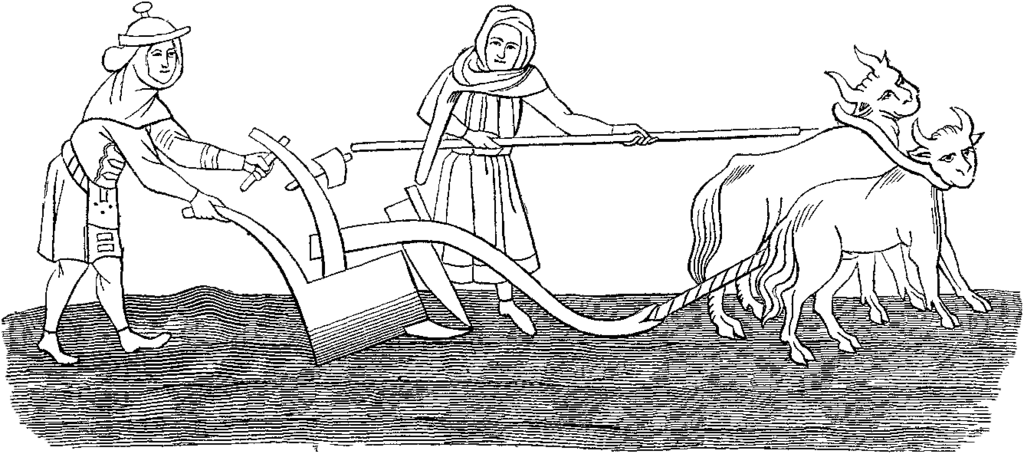
The heavy plough was a more complex machine. It had a sharp blade called a coulter to vertically slice into the tough turf. Behind it, a horizontal blade called a ploughshare cut the soil at the roots. Most importantly, it had a curved mouldboard that lifted and turned the soil over. This process aerated the ground, buried weeds, and brought fresh nutrients to the surface. The heavy plough required more power to pull, often needing a team of eight oxen, but the dramatic increase in yield was worth it.
The Manorial System
These agricultural advancements were organized within a social and economic structure known as the manorial system. A manor was a large, self-sufficient estate controlled by a lord. The land was worked by peasants, or serfs, who were tied to the land.
In exchange for the lord's protection and a small piece of land to farm for their own families, serfs worked the lord's fields, called the demesne. This system organized the labor needed for large-scale farming with tools like the heavy plough and practices like the three-field system. While life was hard, this structure provided a stable food supply and a clear social order for much of the Middle Ages.
Alongside the plough, other tools improved efficiency. Scythes with long, curved blades were better for mowing hay, and sickles were used to harvest grain. This combination of better techniques, more powerful tools, and an organized labor system allowed Europe's population to grow, setting the stage for the rise of towns, cities, and a more complex society.
What was the primary advantage of the three-field system of crop rotation over the two-field system?
The heavy plough was a significant technological advancement primarily because it could effectively cultivate which type of soil?