Medical Terminology for Professional Billing
Cardiology ICD-10 Coding
Translating Clinical Language
In cardiology, the physician's notes tell a story. As a coder, your job is to translate that story into the precise language of ICD-10-CM. This isn't just an administrative task. The codes you assign determine how a patient's case is categorized for billing and data analysis, directly impacting the hospital's reimbursement through systems like MS-DRGss.
Specificity is everything. Vague documentation leads to vague codes and potential revenue loss. We'll focus on how to find the clinical details needed to code the most common and complex cardiac conditions accurately.
The Hypertension Connection
When a physician documents hypertension, your first question should be: what else is going on? ICD-10-CM assumes a cause-and-effect relationship between hypertension and conditions like heart failure and chronic kidney disease (CKD), even if the doctor doesn't explicitly link them. This is known as the "with" convention.
If the documentation mentions both hypertension and heart disease, you'll use a code from category I11, Hypertensive heart disease. If it mentions hypertension and CKD, you'll look in category I12. If all three are present, you'll use a combination code from category I13. The only time you wouldn't link them is if the physician explicitly documents the conditions as being unrelated.
| Code Category | Condition |
|---|---|
I10 | Essential (Primary) Hypertension |
I11 | Hypertensive Heart Disease |
I12 | Hypertensive Chronic Kidney Disease (CKD) |
I13 | Hypertensive Heart & Chronic Kidney Disease |
For categories I12 and I13, you must also assign a second code from category N18 to specify the stage of the chronic kidney disease. Forgetting this secondary code is a common error that results in an incomplete clinical picture.
Example: A patient record notes "uncontrolled hypertension" and "stage 4 CKD." You would assign
I12.9(Hypertensive chronic kidney disease with stage 1 through stage 4 chronic kidney disease, or unspecified chronic kidney disease) andN18.4(Chronic kidney disease, stage 4).
Myocardial Infarction and Acuity
When coding a myocardial infarction (MI), or heart attack, acuity is the most important factor. The key distinction is between an ST-elevation MI (s) and a non-ST-elevation MI (NSTEMI). The diagnosis comes directly from EKG findings and cardiac enzyme levels in the blood, such as s.
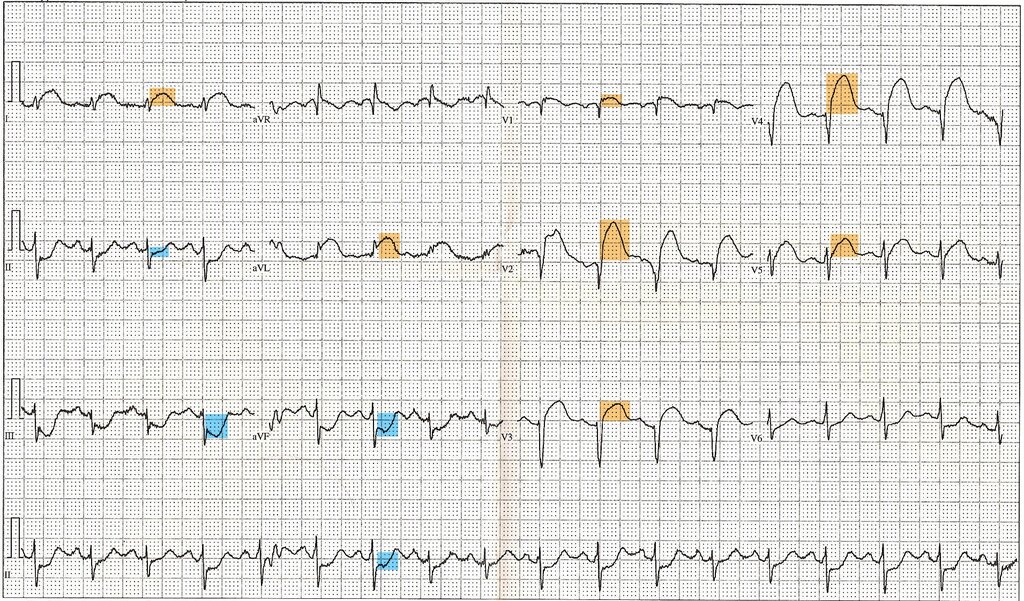
A STEMI indicates a full-thickness injury to the heart muscle and is coded differently than an NSTEMI, which signifies a partial-thickness injury. The ICD-10-CM codes for acute MI fall under category I21. Pay close attention to the specific location of the infarction (e.g., anterior wall, inferior wall) as documented, as this determines the fourth character of the code.
| Feature | STEMI | NSTEMI |
|---|---|---|
| EKG Finding | ST-segment elevation present | No ST-segment elevation |
| Cardiac Enzymes | Elevated | Elevated |
| ICD-10 Codes | I21.0-I21.3 (based on location) | I21.4 |
An MI is considered 'acute' if it occurred within the last 4 weeks (28 days). If a patient is admitted for a separate issue but had an MI five weeks ago, you would use a code for 'old myocardial infarction' (
I25.2) from the chronic ischemic heart disease category.
Coding Heart Failure
Heart failure coding requires you to identify two key details in the documentation: the type and the acuity. The primary types are systolic and diastolic heart failure, which describe different functional problems with the heart's ventricles.
Systolic
adjective
The heart muscle doesn't contract with enough force, so it pumps out less oxygen-rich blood. This is a pumping problem.
Diastolic
adjective
The heart muscle can't relax normally between beats, so the ventricle doesn't fill with enough blood. This is a filling problem.
Once you know the type, you must determine if the condition is acute, chronic, or an acute-on-chronic exacerbation. This detail, which can drastically change the MS-DRG assignment, is often found in the admission notes or discharge summary. If the documentation is unclear, a query to the physician is necessary.
| Acuity | ICD-10 Code Examples (for Systolic) |
|---|---|
| Acute | I50.21 |
| Chronic | I50.22 |
| Acute-on-Chronic | I50.23 |
Just as with hypertension, you'll often see heart failure linked with other conditions. Be prepared to use combination codes or follow "code also" instructions, especially for patients with hypertensive heart disease.
A patient's chart documents a history of hypertension and new-onset chronic diastolic heart failure. The physician has not explicitly stated a link between the two conditions. According to ICD-10-CM guidelines, what code category should be used?
When coding for a patient with hypertensive chronic kidney disease (category I12), it is always necessary to add a second code from category N18 to specify the stage of the CKD.
Accurate cardiology coding hinges on your ability to dissect clinical documentation and apply the specific conventions of ICD-10-CM. By focusing on the links between conditions, acuity, and specific terminology, you ensure the codes reflect the true complexity of the patient's condition.