Mechanisms of Photosynthesis and Plant Bioenergetics
Photosystems and Excitation
The Light-Harvesting Machinery
Inside the thylakoid membrane, photosynthesis is orchestrated by massive protein and pigment complexes called photosystems. Think of each photosystem as a sophisticated satellite dish, designed not for radio waves, but for light. The vast majority of pigment molecules, like chlorophyll and carotenoids, act as an "antenna complex." Their job isn't to perform chemistry, but to absorb photons and pass the energy along.
This energy transfer happens through a process called resonance energy transfer, a bit like a quantum-mechanical game of hot potato. When a pigment molecule absorbs a photon, one of its electrons jumps to a higher energy level. Instead of falling back down and releasing light, it transfers that energy (not the electron itself) to a neighboring pigment molecule. This handoff continues, funneling energy with remarkable efficiency towards a single, special pair of chlorophyll molecules at the heart of the complex: the reaction center.
Photosystem II and the Water Split
The process begins at Photosystem II (PSII). Its reaction center chlorophyll is called P680 because it's best at absorbing light with a wavelength of 680 nanometers. When the antenna complex channels enough energy to P680, it excites an electron, which is then ejected and grabbed by a primary electron acceptor molecule. This leaves the P680 with a positive charge, making it extremely eager to get an electron back.
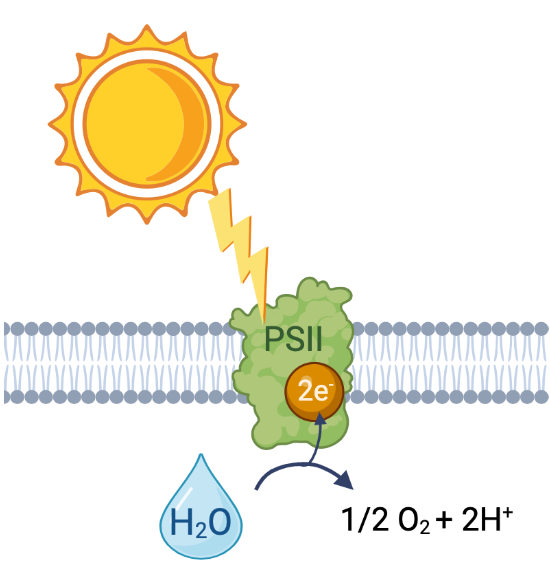
This is where water comes in. The P680’s powerful pull is strong enough to rip electrons from H₂O molecules. This reaction, called photolysis, is managed by a cluster of manganese and other ions known as the oxygen-evolving complex. For every two water molecules split, four electrons are produced to replenish P680, four protons (H⁺) are released into the thylakoid lumen, and one molecule of diatomic oxygen (O₂) is formed. This is the source of nearly all the oxygen in our atmosphere.
The Z-Scheme Journey
The energized electron that left PSII doesn't stay put. It travels down an electron transport chain, a series of proteins embedded in the thylakoid membrane. As the electron is passed from one protein to the next—from plastoquinone to the cytochrome complex and then to plastocyanin—it loses energy. This released energy is used by the cytochrome complex to pump more protons (H⁺) from the stroma into the thylakoid lumen, further strengthening the proton gradient that will eventually power ATP synthesis.
This pathway, from PSII down through the transport chain and then up through PSI, is called the Z-scheme because when charted on a graph of energy levels, the electron's journey looks like the letter Z tilted on its side.
Photosystem I and the Final Boost
By the time the electron reaches Photosystem I (PSI), it has lost much of the energy it gained at PSII. PSI's job is to give it a final boost. Light energy, funneled through PSI's antenna complex, excites an electron at its reaction center, called . This time, the arriving low-energy electron from the transport chain is what replenishes the P700 after it ejects its own energized electron.
The highly energized electron from P700 is passed down a very short second electron transport chain. At the end of this chain, the enzyme NADP⁺ reductase uses the electron, along with a proton from the stroma, to reduce NADP⁺ into NADPH. This molecule is a high-energy electron carrier, which, along with the ATP produced by the proton gradient, will provide the chemical energy needed for the Calvin cycle.
Now that we've seen how light energy is captured and converted, let's test your knowledge of the key players in this process.
What is the primary function of the antenna complex pigments within a photosystem?
Where do the replacement electrons for the P680 reaction center in Photosystem II come from?
With the energy carriers ATP and NADPH now fully charged, the cell has successfully converted light energy into chemical energy, ready to be used to build sugars in the next stage of photosynthesis.