Mechanisms of Living Systems
Metabolic Flux and Regulation
Controlling the Flow
Metabolic pathways aren't like free-flowing rivers; they're more like a city's water supply system, with a complex network of pipes, valves, and junctions. The rate at which molecules travel through a pathway is called metabolic flux. Just like a city engineer needs to manage water pressure and flow, a cell must precisely control the flux through its metabolic networks to match supply with demand.
This control isn't applied equally to every step. Most reactions in a pathway operate near equilibrium, able to flow backward or forward with ease. However, a few key reactions are highly exergonic and essentially irreversible under cellular conditions. The enzymes that catalyse these steps act as bottlenecks or control points. These are the rate-limiting enzymes, and they dictate the overall pace of the entire pathway.
One of the most elegant ways cells control these enzymes is through a process where a regulatory molecule binds to the enzyme at a site other than the active site. This binding event changes the enzyme's shape, either activating or inhibiting its function. It’s like a dimmer switch for enzymatic activity, allowing for fine-tuned adjustments rather than just a simple on/off state.
The final product of a pathway often acts as an allosteric inhibitor for an enzyme at the beginning of that same pathway. This is called feedback inhibition, a classic example of a negative feedback loop that prevents the cell from wasting resources by producing more of a substance than it needs.
Sensing the Energy Level
How does a cell know when to ramp up energy production or slow it down? It constantly monitors its energy charge, primarily through the ratio of ATP to AMP. A high ATP/AMP ratio signals that the cell is rich in energy, prompting a slowdown in catabolic (breakdown) pathways. Conversely, a low ATP/AMP ratio, where AMP levels rise, indicates an energy deficit, triggering an increase in catabolism to generate more ATP.
Think of AMP as an alarm signal for low energy. Even a small drop in ATP leads to a proportionally much larger increase in AMP, thanks to an enzyme called adenylate kinase that maintains equilibrium between ATP, ADP, and AMP. This makes the system highly sensitive to changes in the cell's energy state.
The key sensor that responds to this ratio is AMP-activated protein kinase, or . When activated by high AMP levels, AMPK phosphorylates a host of downstream targets. This action stimulates pathways that generate ATP (like glycolysis and fatty acid oxidation) while simultaneously inhibiting pathways that consume ATP (like protein and lipid synthesis). It's a master regulator ensuring the cell's energy budget is always balanced.
Gatekeeping the Citric Acid Cycle
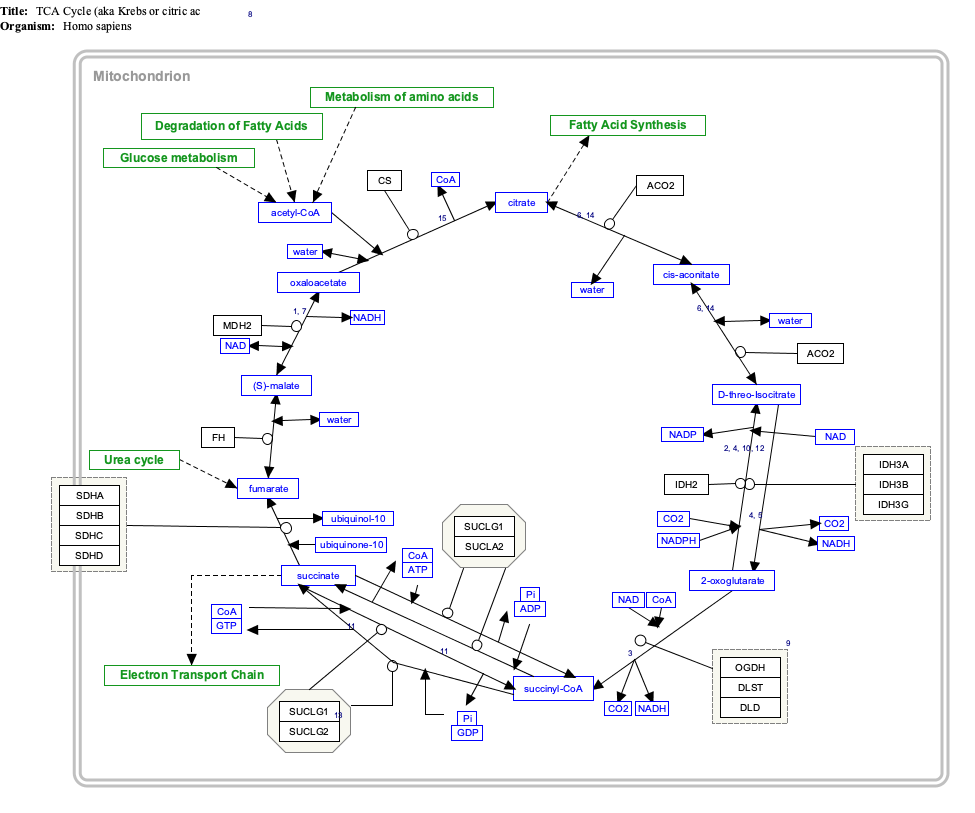
The entry of pyruvate into the citric acid cycle is a critical control point, linking glycolysis to aerobic respiration. This step is catalysed by the pyruvate dehydrogenase complex (PDC), a massive enzyme assembly that converts pyruvate into acetyl-CoA. Given its pivotal position, the PDC is subject to tight regulation.
The complex is controlled in two main ways. First, it experiences product inhibition: high levels of its products, acetyl-CoA and NADH, directly compete with the substrates and slow the reaction down. Second, and more importantly, its activity is modulated by covalent modification. A specific kinase can phosphorylate the complex, which inactivates it. This kinase is itself allosterically activated by high levels of ATP, acetyl-CoA, and NADH, the very signals of high energy.
In short, when the cell has plenty of energy, it switches off the PDC to stop feeding fuel into the citric acid cycle. When energy is low, a phosphatase removes the phosphate group, reactivating the complex.
The citric acid cycle itself isn't just for breaking things down (catabolism). It’s an meaning it's involved in both catabolism and anabolism (building up). While it oxidises acetyl-CoA to produce energy carriers, its intermediates also serve as essential building blocks for other molecules. For example, citrate can be shuttled out of the mitochondria to be used for fatty acid synthesis, while α-ketoglutarate and oxaloacetate can be converted into amino acids. This dual role means the cycle's flux must be carefully managed to balance the cell's needs for both energy and biosynthesis.
A Tale of Two Strategies
Cells face a fundamental trade-off between efficiency and speed when it comes to energy production. Aerobic respiration is highly efficient, yielding around 32 molecules of ATP per molecule of glucose. Anaerobic fermentation is incredibly fast but yields only 2 ATP per glucose.
This trade-off is illustrated by the . In the 1920s, Otto Warburg observed that cancer cells consume vast amounts of glucose and predominantly produce lactate, even when plenty of oxygen is available for aerobic respiration. This switch to aerobic glycolysis seems counterintuitive; why choose the inefficient pathway when the efficient one is an option?
The answer lies in the demands of rapid proliferation. A rapidly dividing cell needs more than just ATP; it needs metabolic intermediates to build new cellular components like lipids, nucleotides, and amino acids. By running glycolysis at a high rate, cancer cells can divert glycolytic intermediates into biosynthetic pathways. The speed of anaerobic fermentation, though wasteful in terms of ATP yield from glucose, provides a quick supply of both energy and the necessary building blocks to support rapid growth.
This isn't just a phenomenon in cancer. Many rapidly proliferating normal cells, such as activated immune cells, also exhibit this metabolic switch. It highlights a universal principle: metabolic pathways are not just about energy, but about providing the raw materials for life, and their regulation reflects a constant balancing act between efficiency, speed, and biosynthesis.
Which characteristic best describes the reactions catalysed by rate-limiting enzymes in a metabolic pathway?
A cell is experiencing a significant drop in its energy charge, leading to a high AMP/ATP ratio. What is the most likely response of AMP-activated protein kinase (AMPK)?