Mechanisms of Evolutionary Change
The Modern Synthesis
A House Divided
By the early 1900s, biology was at a crossroads. Charles Darwin's theory of natural selection was a powerful explanation for the diversity of life, but it had a critical weakness: it couldn't explain inheritance. Darwin, like most of his contemporaries, believed in a form of blending inheritance, where offspring were simply an average of their parents' traits. If a fast rabbit and a slow rabbit mated, their offspring would be medium-speed. This posed a huge problem. Any new, advantageous trait would be diluted out of existence within a few generations, like a drop of black paint disappearing in a can of white.
Meanwhile, the forgotten work of an Austrian monk, , was rediscovered. His experiments with pea plants showed that traits were passed down in discrete units, what we now call genes. Traits didn't blend; they were either present or absent. This discovery was revolutionary, but it didn't immediately solve the problem. In fact, it created a rift. Biologists split into two camps: the Mendelians, who focused on these discrete traits, and the biometricians, who studied the continuous variation Darwin described, like height and weight. The two views seemed completely incompatible.
The key insight that united these factions was understanding that complex, continuous traits were not the result of a single gene, but were influenced by many genes acting together, each following Mendel's rules.
A New Synthesis
During the 1920s to the 1940s, a group of scientists, including R.A. Fisher, J.B.S. Haldane, and Sewall Wright, forged a new understanding. They used mathematics to show how Mendelian genetics and Darwinian selection could work together. This framework became known as the Modern Synthesis.
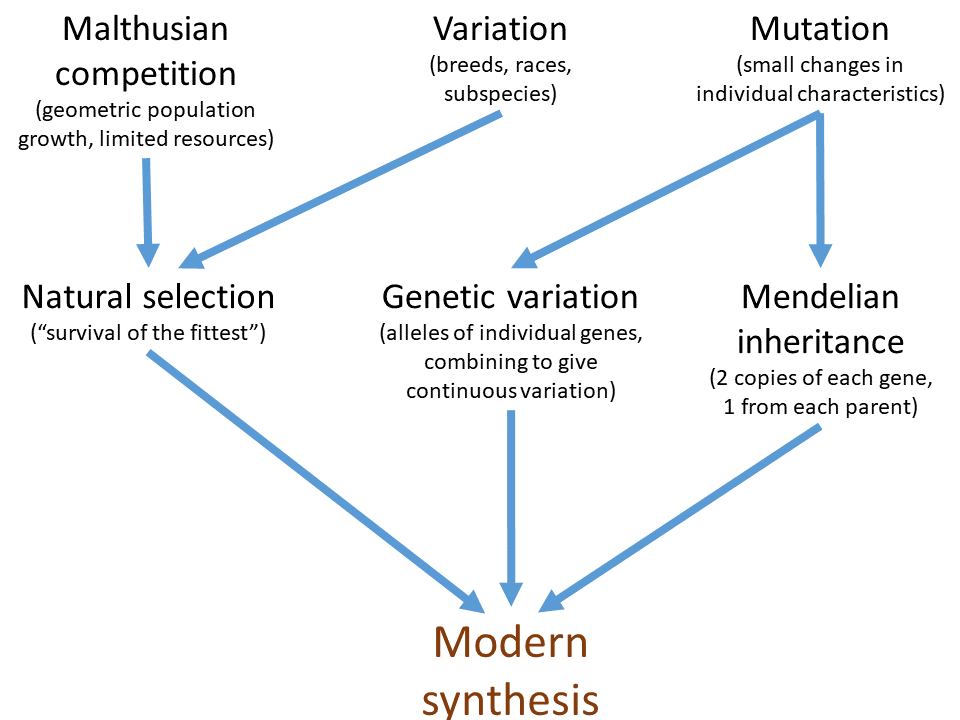
The central idea was a shift in perspective. Evolution wasn't about the struggles of an individual organism, but about changes in a whole population. The focus moved to the gene pool: the complete set of genes and their different versions (alleles) within a population. From this viewpoint, evolution is simply a change in the frequency of alleles in a population over time. A population of beetles might evolve to have a higher frequency of a dark-colored allele because it provides better camouflage, allowing those beetles to survive and reproduce more successfully.
The fusion -- called the modern evolutionary synthesis, or neo-Darwinian evolution -- describes evolution as we now know it: Genetic mutations produce changes that sometimes become part of a species' heritage and, when enough changes accumulate, produce new species.
The Null Hypothesis of Evolution
To study how allele frequencies change, scientists needed a baseline. What would a population look like if it wasn't evolving at all? This question led to the development of the Hardy-Weinberg principle, a cornerstone of population genetics. It acts as a null hypothesis, stating that allele and genotype frequencies in a population will remain constant from generation to generation in the absence of other evolutionary influences.
The principle relies on a set of ideal conditions:
- No mutation
- Random mating
- No gene flow (no migration in or out)
- No natural selection
- A very large population size (to avoid random chance, or genetic drift)
Of course, no real population ever meets all these conditions. That's the point. When a population's observed genotype frequencies differ from what the Hardy-Weinberg equation predicts, it's a clear signal that evolution is happening. By identifying which condition is being violated, scientists can figure out how the population is evolving.
What was the critical weakness in Charles Darwin's original theory of natural selection that the Modern Synthesis later resolved?
The Modern Synthesis shifted the focus of evolutionary study from the individual organism to the...
The Modern Synthesis provided a robust, mathematically grounded framework for understanding life's history. It confirmed that populations, not individuals, are the fundamental units of evolution, and that the engine of this change is the shifting frequencies of genes from one generation to the next.