Mechanisms of Cell Division
Cell Cycle Mechanics
The Cell's Internal Clock
A cell's life isn't just a simple story of growth and division. It's a highly regulated, cyclical process known as the cell cycle. Think of it as a carefully choreographed dance with checkpoints and triggers ensuring everything happens at the right time. For eukaryotic cells, the majority of this cycle is spent in a preparatory stage called interphase. This isn't a resting period; it's a bustling time of growth and DNA replication.
Interphase is divided into three distinct phases: Gap 1 (G1), Synthesis (S), and Gap 2 (G2). Each phase has a specific job to do before the cell can proceed to mitosis, or the actual division.
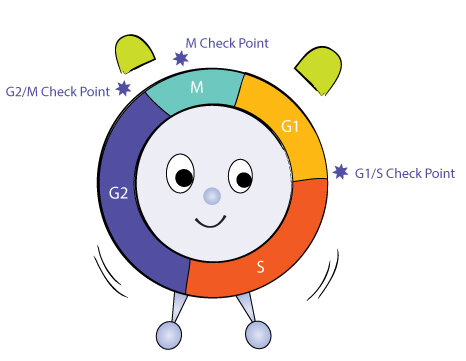
Growth and Decision Making: The G1 Phase
After a cell divides, each new daughter cell enters the G1 phase. This is primarily a period of growth. The cell increases in size and synthesizes the proteins and RNA necessary for its specific function. It’s carrying out its normal job within the organism, whether it's a skin cell providing a barrier or a liver cell metabolizing nutrients.
More importantly, G1 is a major decision-making crossroads. During this time, the cell monitors its own health and receives signals from its environment. Is the organism in need of new cells? Are there enough nutrients available to support division? Based on these cues, the cell makes a critical choice: either commit to another round of division or exit the cycle.
If conditions aren't right, or if the cell is a type that doesn't divide often (like a mature neuron), it can enter a quiescent state called the . It's a kind of holding pattern where the cell is metabolically active but not progressing toward division. This decision to proceed past G1 is tightly controlled by molecular switches, primarily proteins called cyclins and (CDKs), which act as gatekeepers for the next stage.
The Point of No Return: S Phase
Once a cell passes the G1 checkpoint, it commits to division and enters the S phase. The 'S' stands for synthesis, because this is when the cell synthesizes a complete copy of its DNA. Every single chromosome is meticulously duplicated. This process is the most fundamental task of the cell cycle and is a massive undertaking. The entire genome, consisting of billions of base pairs in humans, must be copied with extremely high fidelity.
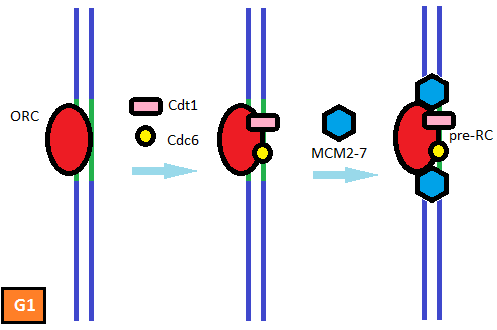
This mechanism allows the cell to accumulate many of these complexes ‘ahead of time’ (starting in G1) but then post-translationally activate them all at once in order to suddenly start massive-scale DNA replication in the S phase.
The process doesn't just start randomly. Replication begins at thousands of specific sites along the DNA called origins of replication. In G1, a group of proteins assembles at each origin, forming a pre-replicative complex (pre-RC). This complex includes the (ORC) and other licensing factors. However, these complexes are kept inactive until the cell receives the go-ahead signal to enter S phase. Once S phase begins, specific CDKs activate the pre-RCs, and DNA replication machines get to work across the entire genome simultaneously. Kicking off S phase is an irreversible step; the cell is now locked into completing division.
Final Preparations: The G2 Phase
After the S phase is complete, the cell enters the G2 phase. At this point, the cell has two complete sets of its genome. The G2 phase is another period of growth, but it's more specifically focused on preparing for mitosis. The cell replenishes its energy stores and synthesizes proteins required for the physical act of division, such as the components of microtubules that will form the mitotic spindle.
Crucially, G2 also hosts another critical checkpoint. Before proceeding into mitosis, the cell must verify that DNA replication is fully complete and that there is no damage to the duplicated DNA. If the G2 checkpoint detects problems, it will halt the cycle to allow for DNA repair. Only after getting the all-clear can the cell finally proceed to the main event: mitosis, where it will divide its duplicated chromosomes into two new daughter cells.
Now, let's test your understanding of these crucial preparatory phases.
What is the primary event that occurs during the S phase of the cell cycle?
A cell, such as a mature neuron, is metabolically active but not progressing towards division. Which phase of the cell cycle is it most likely in?
Understanding these phases—G1, S, and G2—reveals the cell cycle as a process of careful preparation and regulation, not just simple division. Each step ensures the cell is ready for the next, safeguarding the integrity of the organism.