Mechanisms and Impacts of Earth Erosion
Fluvial Sediment Dynamics
The River's Toolkit
Water's power to sculpt landscapes comes down to a simple ability: picking things up and moving them. A gentle stream might only nudge fine grains of silt, while a raging flood can roll boulders the size of cars. This process isn't random. It's governed by the physics of energy, friction, and gravity.
The key factors are the water's velocity and the size of the sediment particles. A faster flow has more energy to dislodge and carry material. Heavier particles require more energy to move than lighter ones. This relationship seems intuitive, but the details are surprisingly complex.
This diagram, the , shows the relationship between water velocity, particle size, and the three main phases of sediment dynamics: erosion (entrainment), transportation, and deposition. Notice the dip in the erosion curve for sand-sized particles; they are the easiest to pick up. Counterintuitively, very fine clay particles require high velocities to erode. This is because cohesive forces, like static electricity, make them stick together, forming a smooth, resistant bed.
Once a particle is lifted, it takes less energy to keep it moving than it did to initially dislodge it. That's why the deposition curve is always below the erosion curve. As the river slows down, it loses energy and begins to drop its load, with the heaviest particles settling out first.
The Physics of the Push
To understand why a river can move sediment, we need to think about forces. As water flows over the riverbed, it exerts a drag force, known as (). This is the force per unit area that the moving fluid applies parallel to the bed. When this stress overcomes the forces holding a particle in place (like gravity and friction), the particle begins to move. This point is called the entrainment threshold.
More advanced models like the Shields diagram refine this concept by relating the critical shear stress needed for motion to the properties of the fluid and the sediment grains. They provide a more physically robust way to predict exactly when erosion will begin.
How Sediment Travels
Once in motion, sediment travels in two primary ways. Larger, heavier particles like sand and gravel move along the bottom as They roll, slide, and bounce along the riverbed in a process called saltation. This type of transport requires significant energy and is responsible for the powerful, grinding erosion that can carve through solid rock over millennia.
Smaller, lighter particles like silt and clay are easily swept up into the main flow of the river. They travel as the suspended load. The internal chaos of the water, known as turbulence, provides the upward eddies that keep these particles from settling. This is what gives rivers their muddy or cloudy appearance. A river's suspended load can be transported over vast distances, eventually being deposited in lakes or oceans.
The distinction between bed load and suspended load is critical. Bed load shapes the river channel itself, while suspended load primarily affects water quality and depositional features downstream.
Flow, Power, and Erosion
The style of flow also plays a major role. At very low velocities, water moves in smooth sheets, a condition called laminar flow. As velocity increases, the flow becomes chaotic and disorganized, filled with swirling eddies. This is
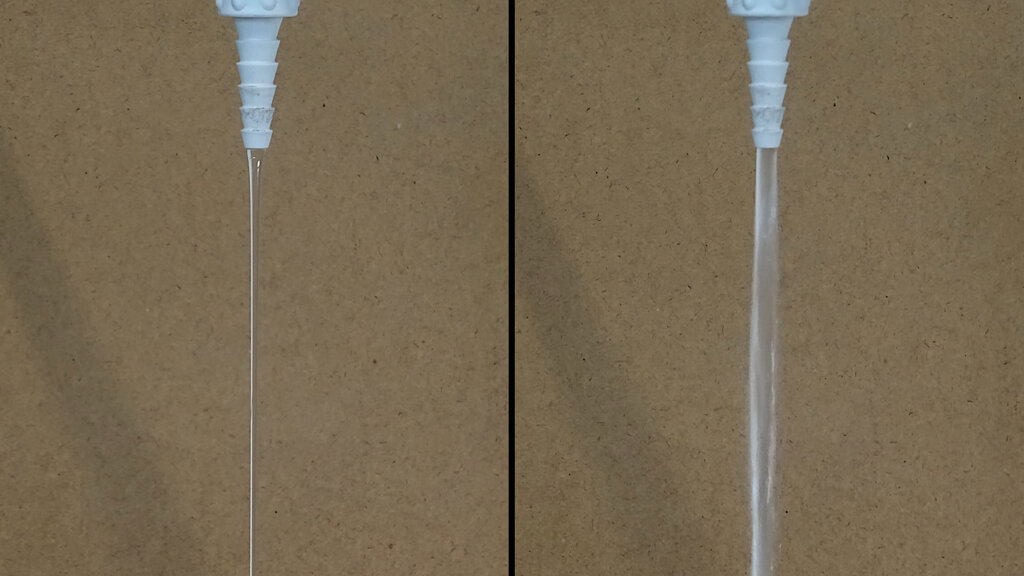
Virtually all natural rivers exhibit turbulent flow. This turbulence is a form of energy dissipation. The total rate at which a river loses potential energy as it flows downhill is called its stream power. This energy is spent overcoming friction with the bed and banks, and, crucially, on transporting sediment.
The more stream power a river has, the more erosional work it can do. A steep mountain stream has high stream power, allowing it to move large boulders. A slow, meandering river on a flat plain has low stream power and primarily transports fine silt and clay.
According to the Hjulström curve, why does it require a surprisingly high water velocity to erode very fine clay particles?
What is the term for the drag force per unit area that moving water exerts parallel to a riverbed?
Understanding these physical principles allows us to see a river not just as a body of water, but as a dynamic system for moving earth.