Mechanics of Universal Gravitation
Universal Law Foundation
Every Mass Attracts Every Other Mass
Gravity isn't just about things falling down. It's a universal force of attraction that exists between any two objects with mass. You have a gravitational pull on the person next to you, the moon, and a distant star. They all pull back on you with an equal and opposite force. The reason we don't feel these smaller pulls is because the force is incredibly weak unless at least one of the objects is enormously massive, like a planet.
Isaac Newton captured this relationship in a single, elegant equation. It describes the gravitational force between any two objects in the universe.
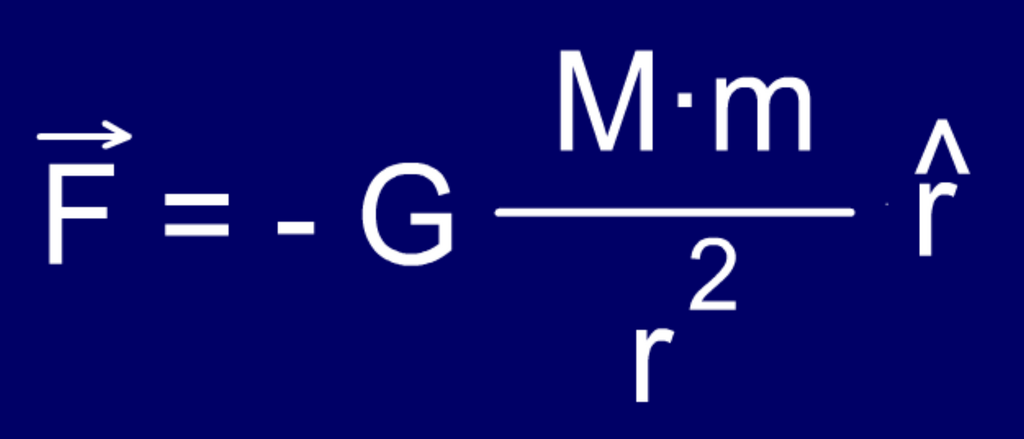
Let's break that down. The formula is:
The key takeaway is that force () is directly proportional to the product of the masses. If you double the mass of one object, the gravitational force between them also doubles. If you double the mass of both objects, the force quadruples.
The Inverse-Square Law
The most crucial part of the formula might be the in the denominator. This part of the equation is known as the inverse-square law and it shows up all over physics, from the intensity of light to the strength of electric fields.
An inverse-square law states that a specified physical quantity is inversely proportional to the square of the distance from the source of that quantity.
What does this mean for gravity? It means the force weakens dramatically as the distance increases. If you double the distance between two objects, the gravitational force between them doesn't get cut in half—it drops to one-fourth of its original strength (). If you triple the distance, the force drops to one-ninth ().
This rapid drop-off is why the gravitational pull of distant stars, though immense, has a negligible effect on us compared to the pull of the relatively close and massive Earth.
Now you have the tools to understand how any two objects in the universe interact gravitationally. Let's review the key terms.
Ready to test your understanding?
According to the principle of universal gravitation, which of the following exerts a gravitational pull on you right now?
If you double the distance between two objects, the gravitational force between them drops to one-fourth of its original strength. This relationship is known as the:
With this law, we can calculate the forces that keep planets in orbit, form galaxies, and hold the universe together.