Mechanics of the Human Mind
Synaptic Dynamics
The Synapse in Motion
Neurons don't just talk, they learn. The conversations between them, happening at the synapse, are not static. Every experience, every thought, every memory subtly reshapes these connections, making some whispers turn into shouts and others fade into silence. This ability of synapses to strengthen or weaken over time is called synaptic plasticity, and it's the cellular foundation of all learning and memory.
Hebb’s hypothesis, often summarized as “neurons that fire together wire together,” suggested that learning and memory result from synaptic plasticity, a cornerstone of modern biopsychology.
The core idea, known as , is elegantly simple: when one neuron consistently helps fire another, the connection between them gets stronger. It’s a rule of neurological reinforcement. This isn't just a theoretical concept; it's a physical process involving intricate molecular machinery.
Strengthening Connections: LTP
Long-Term Potentiation (LTP) is the molecular embodiment of Hebb's rule. It’s a long-lasting enhancement in signal transmission between two neurons that results from stimulating them synchronously. Think of it as carving a path of least resistance in the brain. The process hinges on the interplay between two key types of glutamate receptors on the postsynaptic membrane: AMPA and NMDA receptors.
AMPA receptors are the workhorses. When glutamate binds, they open and allow sodium ions () to flow in, causing a small, quick depolarization.
NMDA receptors are the gatekeepers. They are unique because they are both ligand-gated (require glutamate) and voltage-gated. At rest, they are blocked by a magnesium ion ().
For LTP to occur, the postsynaptic neuron needs to be strongly stimulated. Here’s how it works:
- Strong Signal: A high-frequency burst of action potentials causes the presynaptic neuron to release a large amount of glutamate.
- AMPA Activation: Glutamate binds to many AMPA receptors, causing a significant influx of and a strong depolarization of the postsynaptic membrane.
- NMDA Unblocking: This strong depolarization is enough to eject the plug from the NMDA receptors.
- Calcium Influx: With the plug gone and glutamate still present, the NMDA receptor opens, allowing calcium ions () to flood into the cell. This calcium influx is the critical trigger for LTP.
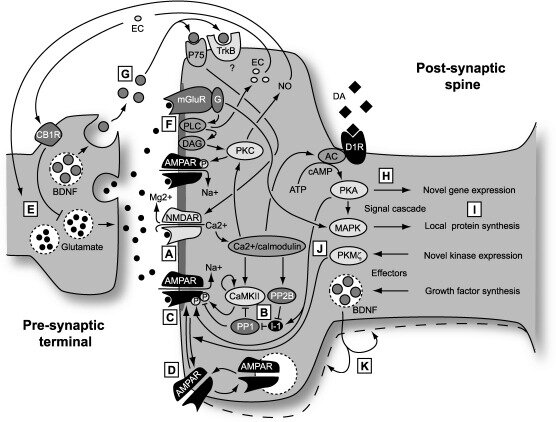
Once inside, calcium acts as a powerful second messenger, kicking off a cascade of biochemical events. It binds to a protein called calmodulin, and this complex activates a crucial enzyme: Calcium/calmodulin-dependent protein kinase II, or .
Activated CaMKII has two major effects to strengthen the synapse:
- Enhances existing receptors: It phosphorylates AMPA receptors already on the surface, increasing their ion flow. It's like turning up the volume on the existing receivers.
- Adds new receptors: It triggers the insertion of additional AMPA receptors from an intracellular reserve pool into the postsynaptic membrane. More receptors mean the synapse is much more sensitive to future glutamate release.
This process creates a more robust and reliable synaptic connection. The same presynaptic signal now produces a much larger postsynaptic response. This change can last for hours, days, or even a lifetime, forming the physical trace of a memory.
Weakening and Forgetting: LTD
Just as it's important to strengthen connections, it's also crucial to weaken them. This is necessary for refining motor skills, overwriting old memories, and preventing our neural circuits from becoming over-saturated. This process is called Long-Term Depression (LTD).
LTD is not simply the opposite of LTP, but it's often described as its mirror image. It's typically induced by a long period of low-frequency stimulation.
This weak, prolonged stimulation causes a small but persistent trickle of calcium through NMDA receptors. Instead of the massive flood that triggers CaMKII for LTP, this slow, low-concentration calcium influx activates a different set of enzymes: protein phosphatases. These enzymes do the opposite of kinases; they remove phosphate groups from proteins.
These phosphatases target AMPA receptors, causing them to be removed from the synapse and internalized back into the cell. With fewer AMPA receptors on the surface, the synapse becomes less responsive to glutamate. The connection is weakened, and the pathway becomes less efficient.
A Delicate Balance
LTP and LTD are not opposing forces in a battle, but rather two essential tools for sculpting the brain's circuitry. The brain is constantly fine-tuning its connections, strengthening relevant pathways while pruning away irrelevant ones. It is this dynamic balance between potentiation and depression that allows for both the formation of new memories and the flexibility to adapt and learn throughout life.
Synaptic plasticity is the persistent process that ensures optimal function, maintaining a delicate balance between LTP and LTD.
Understanding these molecular mechanisms reveals how profoundly our experiences shape our biology. From learning a new language to remembering a childhood friend, the process starts with a flood of calcium, the activation of enzymes, and the trafficking of receptors at a single, microscopic synapse.
What is the fundamental principle of synaptic plasticity?
During Long-Term Potentiation (LTP), what is the direct role of the strong depolarization of the postsynaptic membrane?