Mechanics of the Event Horizon
General Relativity and Collapse
Gravity as Geometry
Isaac Newton described gravity as a force, an invisible rope pulling objects toward each other. Albert Einstein offered a radically different picture with his theory of in 1915. He proposed that gravity isn't a force at all, but a consequence of mass and energy warping the very fabric of spacetime. Think of placing a bowling ball on a stretched rubber sheet. The ball creates a dip, and a marble rolled nearby will curve toward it, not because of a force, but because it's following the curve in the sheet. In the universe, stars and planets are the bowling balls, and their mass dictates the curvature of spacetime around them.
The more massive an object, the deeper the curve it creates in spacetime. This curvature is what we experience as gravity.
The Stellar Battle
Throughout its life, a massive star is a battleground of titanic forces. The immense gravity of its own mass constantly tries to crush it inward. In its core, nuclear fusion creates tremendous outward pressure, balancing gravity and keeping the star stable for millions of years. This is the star's main sequence phase.
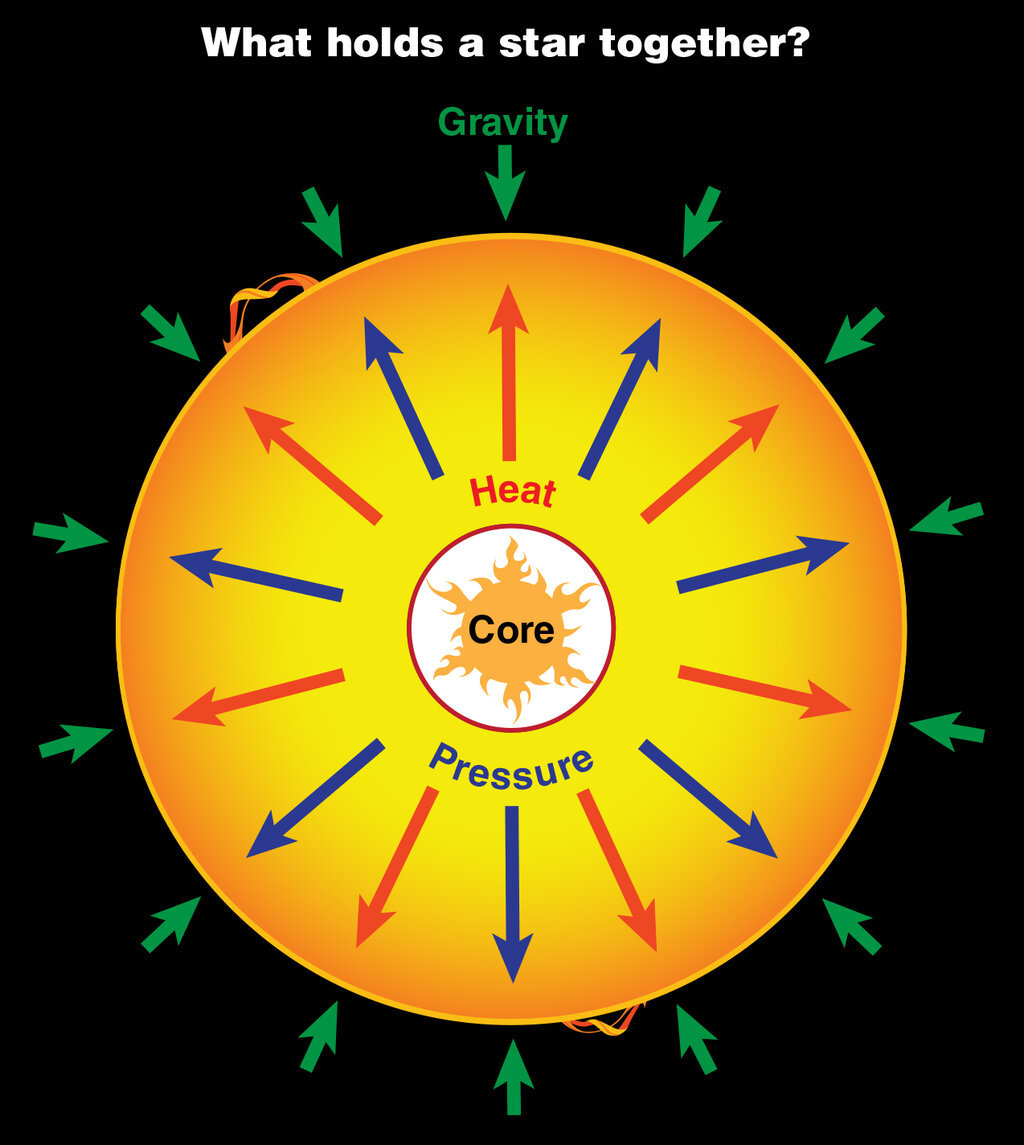
But when a massive star runs out of nuclear fuel, this balance is broken. Gravity gains the upper hand and the core begins to collapse. As the core compresses, electrons are forced into a state governed by the Pauli exclusion principle, creating a powerful outward force called electron degeneracy pressure. For stars up to about 1.4 times the mass of our sun, this pressure is enough to halt the collapse, creating a white dwarf.
In more massive stars, gravity is strong enough to overcome even this. The collapse continues, crushing electrons and protons together to form neutrons. These neutrons, now packed tightly, exert their own kind of quantum mechanical resistance: neutron . This pressure can halt the collapse of stellar cores up to a certain point, forming an incredibly dense object known as a neutron star.
Collapse and Catastrophe
There is a final limit. If the collapsing stellar core has a mass greater than about 2 to 3 times that of our sun, not even neutron degeneracy pressure can stop the crush of gravity. This critical threshold is known as the . Once this limit is crossed, there are no known forces in the universe capable of preventing a total and catastrophic collapse.
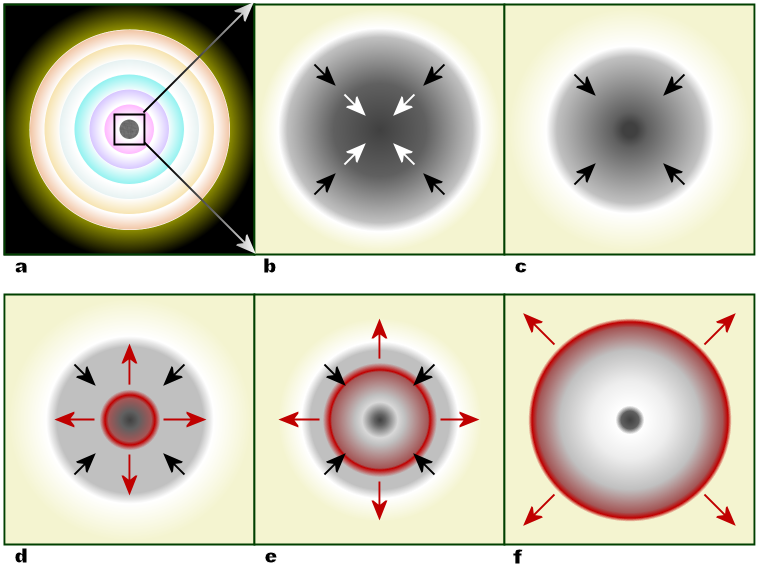
The core collapses indefinitely, compressing all its matter into an infinitely dense point called a singularity. The surrounding spacetime becomes so severely curved that it effectively closes in on itself, forming a region from which nothing, not even light, can escape. A black hole is born.
The Point of No Return
The boundary of this region is the event horizon. Its size is defined by the Schwarzschild radius, a critical threshold where the escape velocity required to leave the object's gravitational pull equals the speed of light. Anything that crosses this boundary is trapped forever.
The Schwarzschild metric, an early solution to Einstein's field equations, describes the geometry of spacetime around a non-rotating, uncharged mass. As an object approaches its Schwarzschild radius, the effects of spacetime curvature become extreme. One of the most fascinating consequences is gravitational redshift.
As light climbs out of a deep gravity well, it loses energy. Since the energy of light is related to its frequency, this energy loss manifests as a shift toward the red end of the spectrum. An observer watching a light source fall into a black hole would see its light become progressively redder and dimmer, appearing to freeze at the event horizon before fading away entirely.
According to Albert Einstein's theory of General Relativity, what is gravity?
What is the primary outward pressure that counteracts gravity and keeps a massive star stable during its main sequence phase?