Mechanics of the Cosmos
Newtonian Gravitational Dynamics
The Universal Pull
Gravity isn't just what keeps your feet on the ground. It's a fundamental force of nature, a mutual attraction between any two objects with mass. Isaac Newton realized that the force pulling an apple to the Earth is the same force keeping the Moon in orbit. This insight led to his Law of Universal Gravitation, which describes this force with elegant precision.
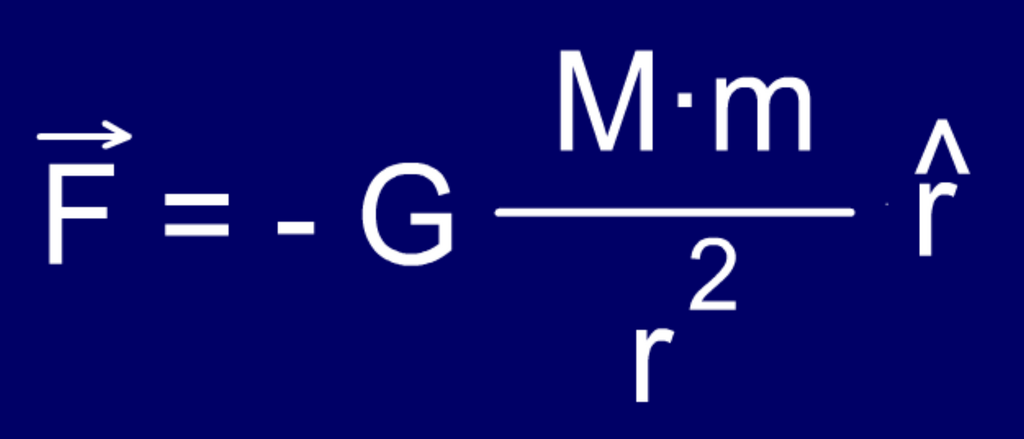
The equation states that the gravitational force, , is directly proportional to the product of the two masses, and , and inversely proportional to the square of the distance, , between their centers. The constant of proportionality, , is the gravitational constant, an empirical value that scales the force.
The Inverse Square Law
Why does the force of gravity weaken with the square of the distance? Imagine a single point of mass radiating its gravitational influence outward in all directions. This influence spreads out over the surface of an ever-expanding sphere. The surface area of a sphere is . As the distance from the mass increases, the same amount of gravitational influence, or flux, must cover a larger area. This means its strength at any single point on that sphere must decrease proportionally to the area it's covering, hence the relationship. This is known as an inverse square law and it appears in many areas of physics, including light and electric fields.
This geometric relationship is powerful. By knowing it, we can calculate the total gravitational flux through any closed surface surrounding a mass using a concept similar to Gauss's Law for electricity. The total flux is proportional to the enclosed mass, regardless of the shape of the surface.
Gravity as a Field
Instead of thinking of two masses pulling on each other across empty space, it's often more useful to think of a single mass creating a gravitational field, , that permeates the space around it. This field is a vector field, meaning it has both a magnitude and a direction at every point. The magnitude is the gravitational acceleration an object would experience, and the direction is toward the mass creating the field. Another object, a 'test mass', then simply interacts with the field at its location.
Because the gravitational force is conservative, we can also describe this field using a scalar quantity: gravitational potential energy, . This represents the work done by gravity to move a mass from a reference point (usually infinitely far away) to its current position. The gravitational force is the negative gradient of this potential energy. In simpler terms, objects are pulled in the direction where their potential energy decreases most steeply, like a ball rolling downhill.
Celestial Mechanics
An object in orbit, like a planet around the sun, is in a state of continuous free fall. Its forward velocity is perfectly balanced by the gravitational pull, causing it to follow a curved path. If its velocity were too low, it would spiral inward; too high, and it would fly away. This delicate balance is what makes orbits possible. By setting the gravitational force equal to the centripetal force required for circular motion, we can derive the speed an object needs to maintain a circular orbit at a given radius.
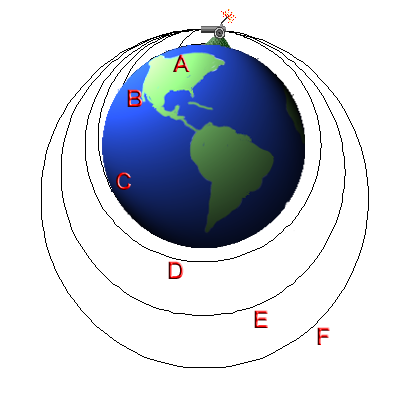
What if you want to leave orbit entirely? You need to achieve (). This is the minimum speed required for an object to break free from a gravitational field without any further propulsion. It's reached when the object's initial kinetic energy is equal to its negative gravitational potential energy. At this speed, its total energy is zero, allowing it to coast to an infinite distance, where it will have zero kinetic and zero potential energy.
Newton's framework was so powerful that it allowed him to derive all three of of planetary motion from his single law of gravitation. Kepler had described how planets moved based on observation; Newton explained why they moved that way based on fundamental principles.
The Limits of Newton
For centuries, Newton's theory of gravity was thought to be the final word. It accurately predicts the motion of planets, the paths of cannonballs, and the tides. However, it's not perfect. The theory assumes that gravity is an instantaneous force, acting across vast distances with no delay. It also fails to perfectly predict the orbit of and cannot explain phenomena in extremely strong gravitational fields, such as those around black holes.
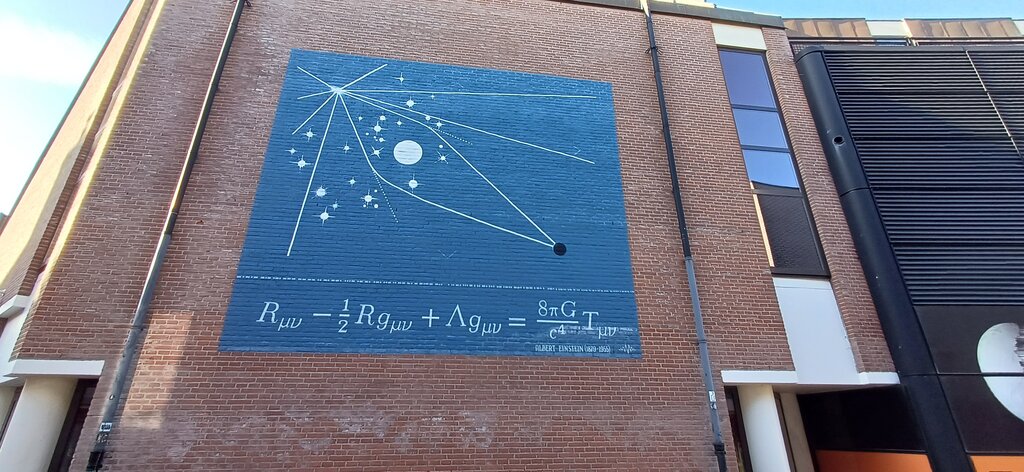
These limitations paved the way for Albert Einstein's theory of General Relativity, which reimagines gravity not as a force, but as a curvature of spacetime caused by mass and energy. While Newtonian gravity remains an excellent approximation for most situations in our solar system, Einstein's theory is necessary for understanding the universe at its most extreme scales.