Mechanics of Planetary Rotation
Angular Momentum Conservation
A Spinning Start
Our solar system didn't begin with a bang, but with a slow, vast swirl. Billions of years ago, a giant cloud of gas and dust, hundreds of times larger than our current solar system, drifted through space. This cloud, the solar nebula, wasn't perfectly still. It had a slight, almost imperceptible rotation, a leftover from the motions of the gas and dust that formed it.
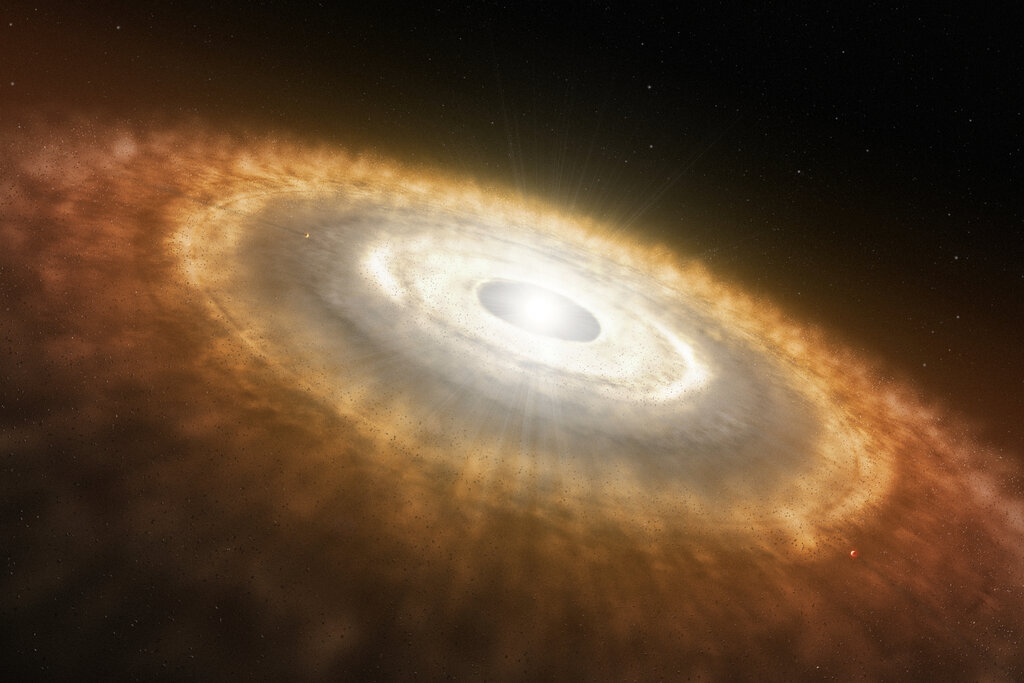
Over millions of years, gravity began to pull this material inward. The vast majority of the mass collapsed toward the center, forming a dense, hot core that would eventually ignite as our Sun. The rest of the material didn't fall straight in. Instead, it flattened into a spinning disc, much like a ball of pizza dough flattens when a chef tosses and spins it. This spinning disc of cosmic debris is known as a protoplanetary disk—the nursery where planets are born.
The Cosmic Skater
As this cloud of gas and dust contracted, a fundamental law of physics kicked in: the conservation of angular momentum. Think of a figure skater spinning on the ice. When her arms are extended, she spins at a certain speed. But when she pulls her arms in close to her body, her spin accelerates dramatically. She hasn't pushed off the ice again; she's simply changed how her mass is distributed.
Like a figure skater pulling in her arms to spin more rapidly, the collapsing proto-Solar System with its averaged out particle momentum began to spin faster and faster.
The same principle applied to the solar nebula. As gravity pulled the material closer to the center, the radius of the rotating cloud decreased. To conserve angular momentum, the cloud had to spin faster. This is the same reason water spins faster as it goes down a drain.
Building a Spinning Planet
Within the fast-spinning protoplanetary disk, dust and rock began to stick together through a process called accretion. Small particles collided to form pebbles, which then collided to form boulders, and eventually, these boulders grew into planetesimals—the building blocks of planets. As these clumps of matter grew, they continued to orbit the young Sun, carrying with them the angular momentum of the disk.
The Earth formed from countless collisions of these planetesimals. Each impact contributed its own mass and momentum to the growing planet. While some collisions may have been head-on, most were glancing blows from objects moving in the same general direction within the disk. This barrage of off-center impacts imparted a net spin on the proto-Earth, much like hitting a billiard ball off-center makes it spin. This is why most planets in our solar system, including Earth, spin in the same direction that they orbit the Sun.
A planet's rotation isn't an inherent property of its matter. It's a fossil record of the motion and collisions that created it.
Once it was spinning, the Earth kept spinning due to another concept: inertia. An object in motion stays in motion unless acted upon by an external force. In the vacuum of space, there's very little to slow Earth's rotation down. While the Moon's gravity does create tidal friction that has gradually slowed our day over billions of years, the initial momentum from its formation is so immense that our planet continues to spin.
Time to see if you've got these concepts down.
What was the name of the vast, rotating cloud of gas and dust that our solar system formed from?
The solar nebula began to spin faster as gravity pulled it inward. This is an example of which physical principle?
The spin of our planet is a direct consequence of the physical laws that governed the birth of our solar system. From a slowly swirling cloud of dust to a spinning, rocky world, the Earth's rotation is a testament to the power of gravity and the elegant principle of conservation.