Mechanics of Planetary Rotation
Nebular Angular Momentum
The Great Cosmic Spin-Up
Our solar system wasn't born from a static, motionless void. It began as a vast, rotating cloud of gas and dust called a giant molecular cloud. The initial rotation was incredibly slow, perhaps taking millions of years to complete a single turn. But as gravity began to pull this cloud inward on itself, a fundamental principle of physics took over: the conservation of angular momentum., This is the same principle an ice skater uses. When she pulls her arms in, her spin speeds up dramatically. The molecular cloud did the same thing. As its radius shrank under gravity, its rotational speed had to increase to keep its angular momentum constant. This process is often called 'spin-up'.
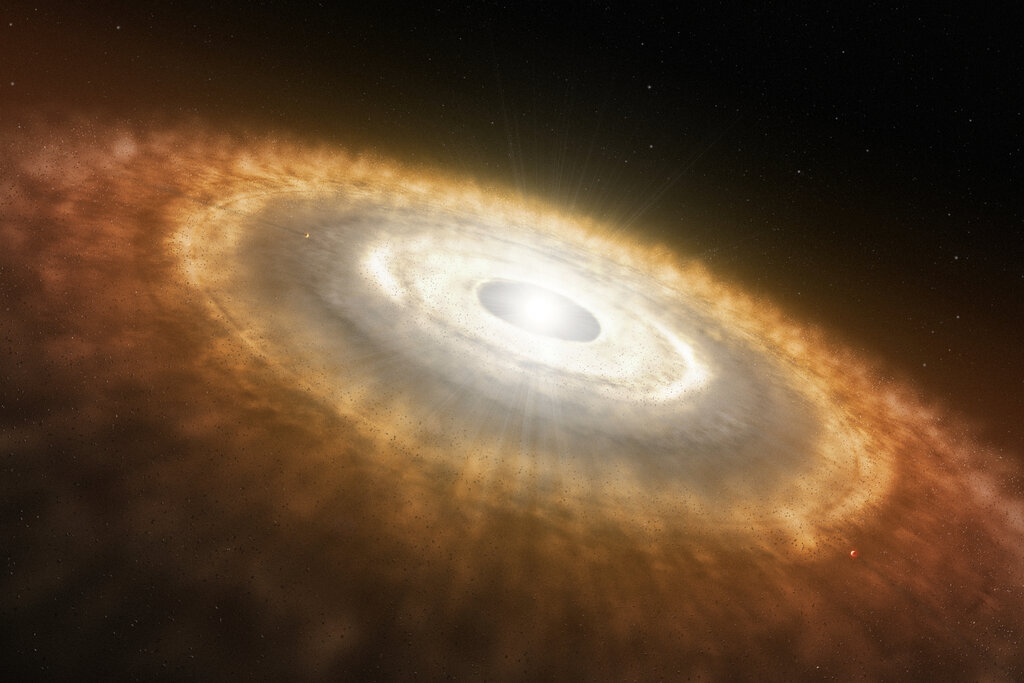
As the cloud collapsed under gravity, the conservation of angular momentum ensured that the cloud’s initial rotation was magnified, eventually flattening it out into a disc.
This accelerated spinning had a profound effect on the cloud's shape. The centrifugal force, an outward push felt by rotating objects, counteracted gravity most strongly at the cloud's equator. At the poles, gravity was mostly unopposed. This dynamic squashed the collapsing sphere of gas into a wide, flat, spinning disk known as a ., with a dense, hot protostar forming at its center.
From Dust to Worlds
Within this rapidly spinning disk, the stage was set for planet formation. Tiny grains of dust and ice began to stick together, a process called accretion. Over time, these small clumps grew into larger bodies called planetesimals, the building blocks of planets.
Crucially, these forming bodies inherited the angular momentum of the part of the disk they came from. Since the entire disk was spinning in the same direction, all the planets that formed from it ended up orbiting the Sun in that same direction and on roughly the same flat plane. Earth's daily rotation is a direct consequence of this initial spin, passed down from the original molecular cloud.
The spin of the Earth is not a separate phenomenon; it's a preserved piece of the motion of the primordial cloud that formed our entire solar system.
The initial distribution of mass within the disk wasn't perfectly uniform. Some regions were slightly denser than others. These denser clumps exerted a stronger gravitational pull, collecting more material and growing faster. The tiny gravitational interactions between these forming protoplanets acted as torques, or twisting forces. While the overall angular momentum of the system was conserved, these torques could transfer rotational energy between bodies, slightly altering their final spin rates and axial tilts.
This is why, while all planets orbit in the same direction, their rotational speeds and tilts vary. Earth's 24-hour day and 23.5-degree tilt are the result of this complex dance of gravity, accretion, and momentum exchange that took place over billions of years.
Before we go, let's test your knowledge on the concepts we've just covered.
What is the fundamental principle of physics that caused the giant molecular cloud to spin faster as it collapsed?
The accelerated spinning of the collapsing cloud caused it to flatten into a wide, flat structure known as a...
The formation of our solar system from a spinning cloud is a beautiful example of physical laws playing out on a cosmic scale. The rotation we experience every day has its origins in the faint, slow turn of a giant gas cloud long before the Earth itself existed.