Mechanics of Lunar Rotation
Tidal Bulge Physics
The Shape of Gravity
Gravity feels like a constant, uniform force, but it weakens with distance. This simple fact has profound consequences for celestial bodies. The side of the Moon facing Earth is about 3,800 kilometres closer than the far side, so it experiences a slightly stronger gravitational pull. The centre of the Moon feels a medium pull, and the far side feels the weakest pull of all.
This difference in gravitational force across an object is called a gravitational gradient an effect that stretches the Moon along the Earth-Moon line. It's not a violent pull, but a persistent, gentle stretching. Imagine pulling on a piece of dough. If you pull harder on the end closest to you than the middle, and harder on the middle than the far end, the dough will elongate.
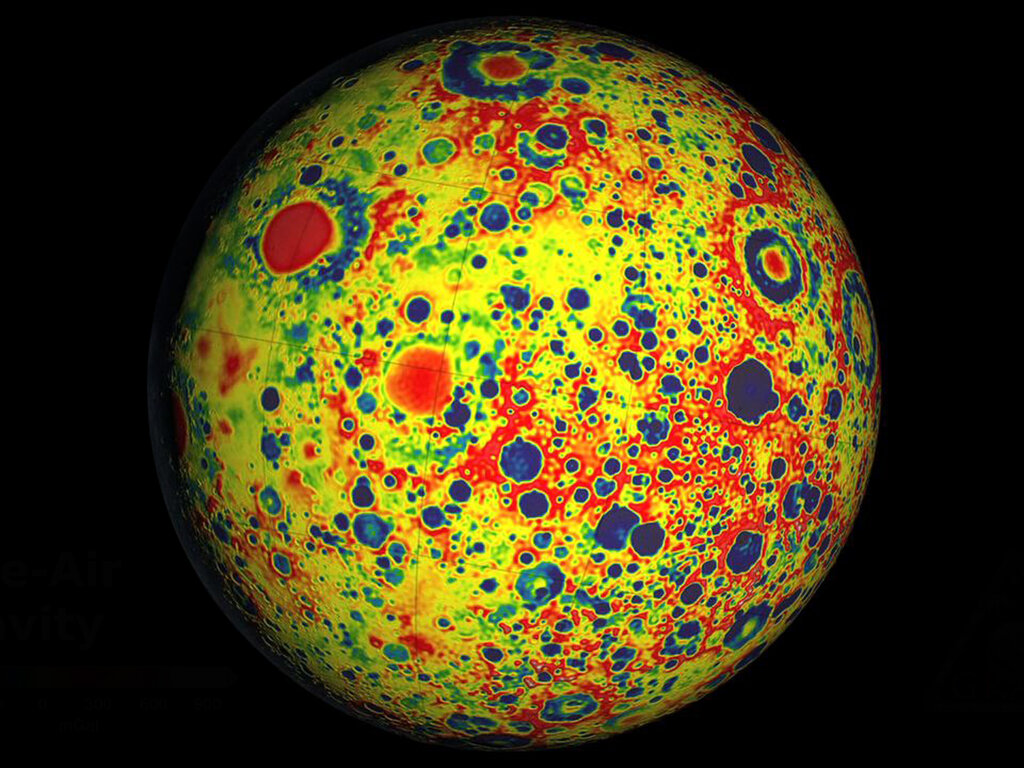
This is precisely what happens to the Moon. Earth's pulls the near side away from the centre and pulls the centre away from the far side. The result is a slight distortion, creating two bulges. One bulge faces Earth, where the pull is strongest. A second, counterintuitive bulge forms on the far side, which is essentially 'left behind' as the rest of the Moon is pulled more strongly towards Earth.
The Moon is not perfectly round. It's a slightly elongated sphere, permanently stretched by Earth's gravity.
Visualising the Bulge
This constant stretching creates what are known as tidal bulges. These are not ripples of water like Earth's ocean tides, but bulges in the solid rock of the Moon itself. The Moon is more elastic than you might think, and over geological timescales, this relentless pull has reshaped it.
A Redistribution of Mass
These bulges represent a fundamental redistribution of the Moon's mass. Material from the Moon's crust and mantle is shifted into these two protrusions. While the distortion is small relative to the Moon's overall size, it's significant enough to alter its gravitational field.
The mass concentrated in these bulges creates a gravitational torque. This torque acts like a brake, playing a crucial role in slowing the Moon's rotation over billions of years until its rotational period matched its orbital period, resulting in the synchronous orbit we see today.
This locking of one face towards Earth is a direct consequence of the tidal bulges created by Earth's gravity. It's a common phenomenon throughout the solar system, with many moons tidally locked to their parent planets.
What is the primary cause of the tidal bulges on the Moon?
How does Earth's differential gravity affect the Moon's physical shape?