Mechanics of Influence and Cognitive Autonomy
Dual Process Persuasion
The Brain's Two-Track Mind
Persuasive messages don't travel down a single path in our minds. Instead, they're sorted onto one of two tracks, a concept outlined by the Elaboration Likelihood Model (ELM). Think of it as choosing between a scenic, winding country road and a direct, efficient motorway. The route you take depends entirely on your motivation and ability to think deeply about the message.
The central route is the motorway. It's for when you're highly motivated, interested, and have the mental energy to engage. You scrutinise the arguments, weigh the evidence, and form a reasoned opinion. The peripheral route is the country road. It's the default path when you're distracted, uninterested, or mentally tired. Instead of analysing the message itself, you rely on shortcuts, or heuristics, like the speaker's confidence, an emotional appeal, or a catchy slogan.
When persuasion occurs through the central route, the resulting attitude change tends to be more enduring, resistant to counter-persuasion, and predictive of behavior.
This dual-process system is a feature, not a bug, of our cognitive architecture. It allows us to conserve mental energy for what truly matters. But understanding which track is likely to be engaged, and why, is the key to understanding how influence works on a neurological level.
The Rider and the Elephant
To understand which route a message takes, we need to look at the parts of the brain doing the driving. The central route is managed by the Prefrontal Cortex (PFC), the brain's executive suite. This area handles logic, planning, and conscious decision-making. It's the analytical 'rider' carefully steering towards a conclusion.
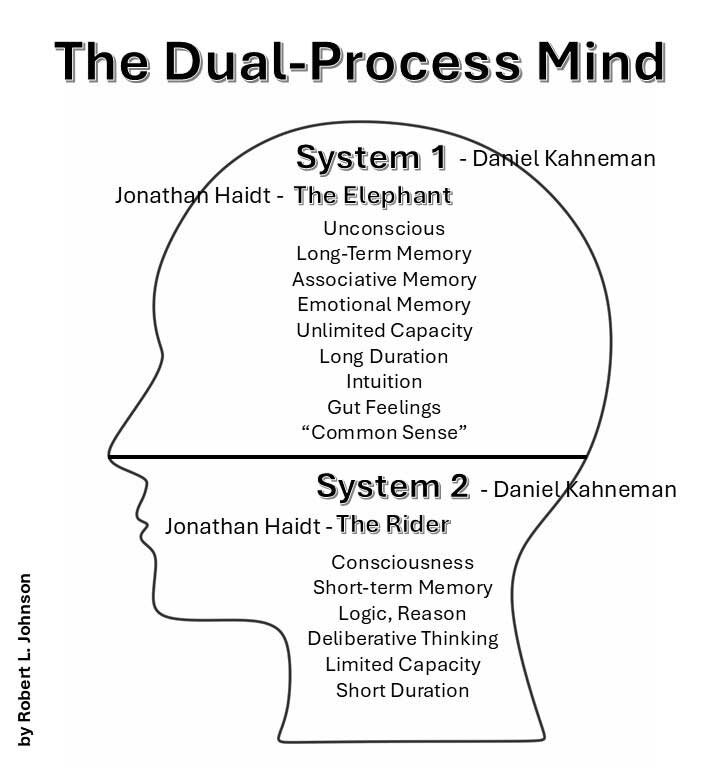
The peripheral route, however, is the domain of the amygdala. This deeper, older part of the brain is the 'elephant'—it's powerful, emotional, and acts on instinct and gut feelings. When a message is emotionally charged or our cognitive resources are low, the amygdala can take over in what's known as an amygdala hijack, bypassing the PFC's careful analysis. This is the neurological basis of System 1 thinking—fast, automatic, and emotional.
Forcing the Scenic Route
Influential messages are often designed to deliberately push us onto the peripheral path, making us more susceptible to simple cues and emotional appeals. This is achieved by manipulating three key factors: personal relevance, physiological arousal, and cognitive load.
If a topic feels irrelevant to our lives, we won't spend precious mental energy analysing it. High physiological arousal—from fear, excitement, or even loud music in an advert—activates the amygdala and makes rational thought more difficult. Finally, there's cognitive load, which occurs when our working memory is overwhelmed. A message that is too complex, delivered too quickly, or presented alongside distractions makes it nearly impossible for the PFC to keep up. The brain defaults to the peripheral route, and the emotional elephant takes charge.
A tired or overloaded brain is a persuadable brain. It looks for the easiest answer, not necessarily the best one.
By understanding these mechanisms, we can see that systemic influence doesn't require mythical 'mind control'. It simply requires a working knowledge of the brain's natural tendencies and the triggers that shift us from logical analysis to emotional reaction.
Time to check your understanding.
According to the Elaboration Likelihood Model (ELM), what are the two main routes through which persuasive messages are processed?
You're scrolling through social media while tired and see a political advert. Instead of analysing the candidate's policies, you find yourself swayed by the powerful, patriotic music and the candidate's confident smile. Which route are you most likely using to process this message?
By recognising when your brain is being pushed towards the peripheral route, you can consciously engage your prefrontal cortex and make more considered decisions.