Mechanics of Fold Mountain Systems
Mechanics of Compression
The Physics of the Squeeze
When tectonic plates collide, they exert immense compressional forces on the Earth's crust. This isn't a gentle nudge; it's a slow-motion collision of continent-sized masses. To understand how this pressure builds mountains, we need to think like engineers and geophysicists, using the concepts of stress and strain.
Stress is the force applied per unit of area, while strain is the deformation or change in shape that results from that stress.
In a simple scenario, you might imagine stress as a single force pushing from one direction. But within the Earth's crust, the forces are complex and multi-directional. To capture this, we use a mathematical tool called the stress tensor to describe the state of stress at a single point. It accounts for forces acting perpendicular to a surface (normal stresses) and parallel to it (shear stresses). It's the combined effect of these stresses that determines how the rock will ultimately deform.
During mountain building, the dominant stress is compressional, primarily acting horizontally. As this stress accumulates, the strain is initially elastic, meaning the rock would bounce back if the force were removed. However, once the stress exceeds the rock's elastic limit, permanent deformation occurs. This is the turning point where the crust begins to shorten.
Crustal Shortening and Uplift
Crustal shortening is the fundamental process of compression. The lithosphere is squeezed horizontally, forcing it to occupy less lateral space. But that rock mass doesn't just disappear. To conserve volume, the crust thickens vertically. This vertical displacement is what we see as uplift, the creation of mountains and plateaus.
The ratio between horizontal shortening and vertical uplift is not always one-to-one. It depends on the mechanical properties of the rock and the underlying mantle. For example, a very rigid crust might resist thickening and instead transmit stress over a wider area. In contrast, a weaker, hotter crust will deform more easily, leading to more pronounced local thickening and higher mountain peaks. The principle of also plays a critical role, as the thickened crustal 'root' sinks into the denser mantle, which in turn provides buoyant force that pushes the mountains even higher.
How Rocks Behave Under Pressure
The lithosphere isn't a single, uniform material. Its response to compressional stress varies dramatically with depth. Temperature and confining pressure are the key factors that dictate whether a rock will break or bend.
In the cool, upper crust, rocks are relatively brittle. Under compression, they tend to fracture, creating faults where large blocks of rock slide past each other. This is known as brittle deformation.
Deeper in the crust, however, temperatures and pressures are much higher. Here, rocks behave more like a very slow-moving fluid, a property called ductility. Instead of breaking, they bend and flow over millions of years, creating the immense, wavelike structures we call folds. This process is known as ductile deformation. Most major mountain ranges are a combination of both processes, with large-scale folds at depth and faulting closer to the surface.
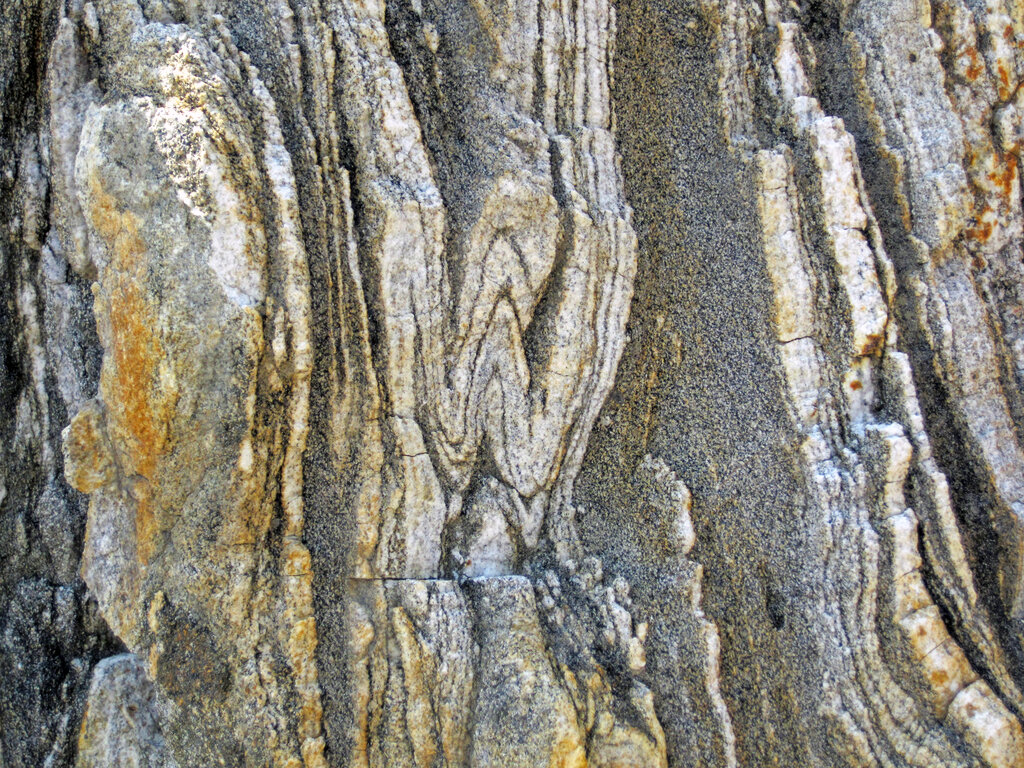
The rate of convergence also matters. A rapid collision is more likely to cause widespread fracturing and brittle faulting. A slow, grinding convergence over tens of millions of years allows more time for the rock to heat up and deform ductilely, leading to the formation of complex, large-scale folds. Understanding these mechanical properties is key to interpreting the architecture of any mountain belt on Earth.
When tectonic plates collide, the Earth's crust is squeezed horizontally. What is the direct result of this process, known as crustal shortening?
In the context of mountain building, how does the behavior of rock in the cool, upper crust differ from rock in the hot, deeper crust under compressional stress?