Mechanics of Earths Seasons
Axial Tilt Dynamics
The Constant Lean
The Earth doesn't sit straight up as it spins. Instead, its axis, the imaginary line running through the North and South Poles, is tilted. This tilt is about 23.5 degrees relative to its orbital plane, the flat disc on which it travels around the Sun. This specific angle is known as the and it's the single most important reason we have seasons.
What's crucial is that this tilt doesn't wobble around randomly during the year. The Earth’s axis maintains a remarkably stable orientation, a concept called parallelism. As Earth journeys around the Sun, its axis consistently points to the same spot in the vastness of space. For now, the North Pole points almost directly at a star called —our North Star.
An Orbit of Opposites
This fixed tilt is the key to understanding seasons. Imagine Earth on one side of its orbit. If the Northern Hemisphere is tilted towards the Sun, it receives more direct sunlight for longer parts of the day. The sun's rays hit the ground at a steep angle, concentrating their energy. This is summer.
Six months later, when the Earth is on the opposite side of the Sun, that same fixed tilt means the Northern Hemisphere is now pointed away. The sun's rays strike at a shallow angle, spreading their energy over a larger area and resulting in less heat. Days are shorter. This is winter. The Southern Hemisphere experiences the exact opposite cycle.
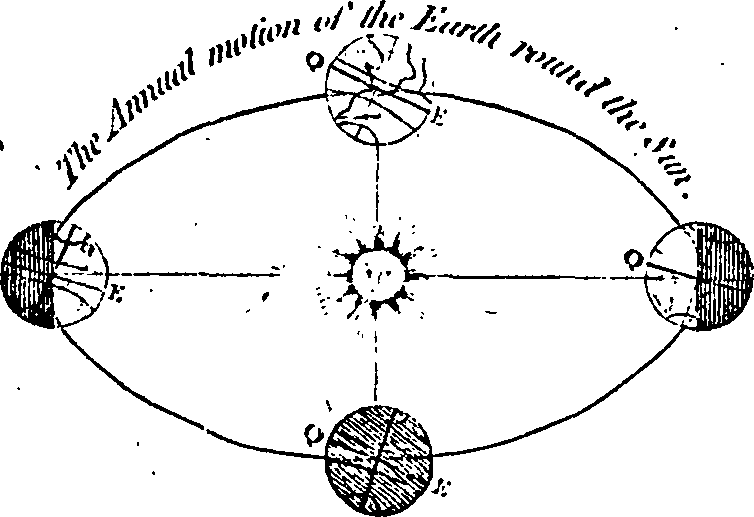
This shows that seasons are a result of geometry, not proximity. Many people mistakenly believe we have summer when the Earth is closer to the Sun, but the opposite is true for the Northern Hemisphere. Our seasons are dictated by the angle of sunlight, which is controlled by our planet's unwavering 23.5-degree lean.
Earth's tilted axis causes the seasons.
While we call the axis stable, it does undergo a very slow wobble, much like a spinning top. This is called and it completes one full cycle every 26,000 years. This long-term motion has significant effects on climate over millennia, but for our yearly seasons, the axis is effectively fixed in place.
Now, let's test your understanding of how Earth's tilt shapes our world.
What is the primary reason for the changing seasons on Earth?
When it is summer in the Northern Hemisphere, which season is the Southern Hemisphere experiencing?
Understanding this constant, parallel tilt is the foundation for grasping why we experience the cyclical rhythm of the seasons.