Mechanics of Earth's Rotation
Nebular Angular Momentum
The Cosmic Spin-Up
About 4.6 billion years ago, our solar system was just a vast, slowly swirling cloud of gas and dust called the [{
Like a figure skater pulling in her arms to spin more rapidly, the collapsing proto-Solar System with its averaged out particle momentum began to spin faster and faster.
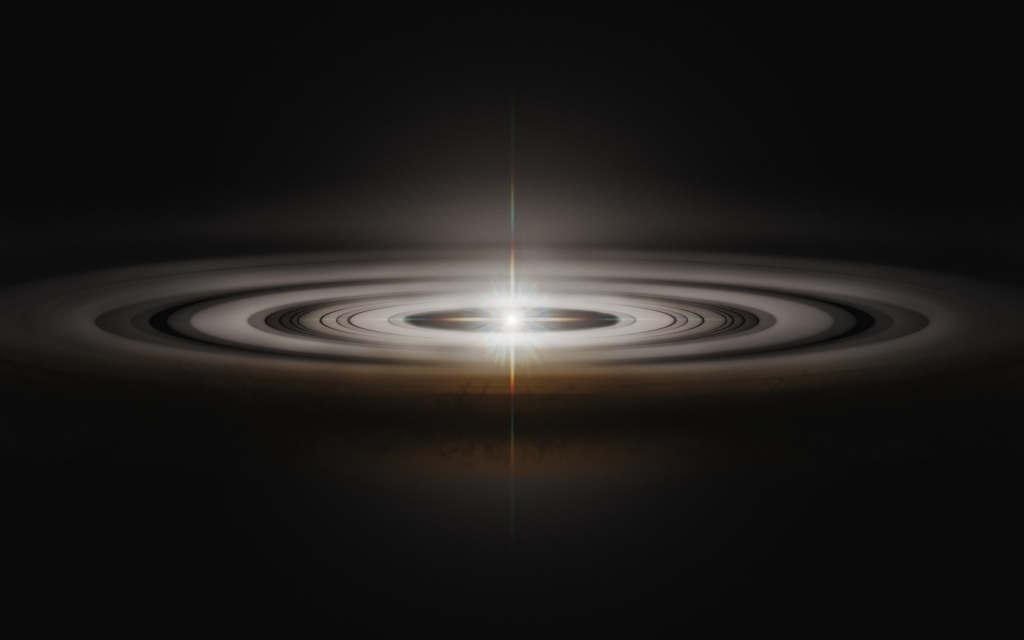
The law of conservation of angular momentum states that an object's rotational energy must remain constant unless an external twisting force, or torque, acts on it. As gravity began pulling the solar nebula's material inward, the cloud's radius shrank dramatically. To conserve angular momentum, the cloud had to spin faster. This process flattened the collapsing cloud into a spinning pancake of material known as a [{
From Disk to Planets
The angular momentum of the initial cloud didn't just disappear or stay with the Sun. It was distributed throughout the entire protoplanetary disk. Every particle of gas and dust orbiting the young Sun carried its own share of this momentum.
As gravity caused material to clump together into larger bodies, these new objects inherited the angular momentum of their constituent parts. This is why most planets in our solar system orbit the Sun and rotate on their own axes in the same direction—counter-clockwise, as viewed from above Earth's North Pole. It's the shared rotational heritage from the original spinning disk.
Earth's Primordial Day
This process of inheriting momentum meant that the early Earth spun much, much faster than it does today. Immediately after its formation, a day on Earth was likely only about six hours long. The planet was a hot, molten, rapidly rotating sphere.
The planet's current 24-hour day is the result of billions of years of gradual slowing. This deceleration is primarily caused by the gravitational pull of the Moon, which creates tidal friction. The energy lost from Earth's spin has been transferred to the Moon, pushing it farther away from us over time. The initial spin, however, was a direct consequence of the great cosmic collapse that formed our solar system.
Let's check your understanding of these cosmic mechanics.
What is the name given to the vast, swirling cloud of gas and dust from which our solar system originated?
According to the principle of conservation of angular momentum, what happened as the solar nebula was pulled inward by gravity?
Understanding this initial spin is key to grasping how planetary systems form and evolve.