Mechanics of Earths Rotation
Angular Momentum Origins
A Cosmic Inheritance
Earth's rotation isn't an isolated event; it's a four-and-a-half-billion-year-old habit inherited from the birth of our solar system. The story begins with the —a vast, cold, and slowly swirling cloud of interstellar gas and dust. While this initial rotation was extremely slow, the sheer scale of the nebula meant it held an immense amount of angular momentum.
As gravity began pulling the material in this cloud towards its centre, a fundamental principle of physics took over: the conservation of angular momentum. Think of an ice skater spinning. When her arms are outstretched, she spins slowly. When she pulls them in, her speed dramatically increases. The nebula did the same. As its material contracted, its radius decreased, forcing it to spin much, much faster to conserve its total angular momentum.
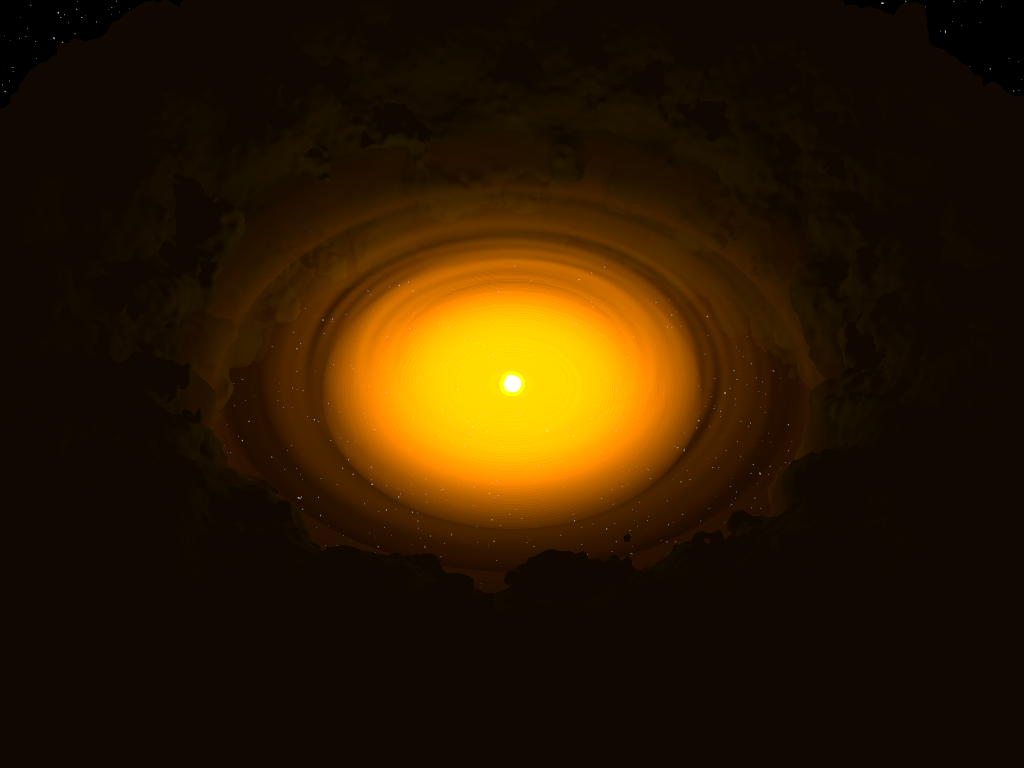
This accelerated spinning had a profound effect on the cloud's shape. It couldn't collapse equally in all directions. Instead, the centrifugal force generated by the rapid rotation pushed material outwards along the equator, flattening the collapsing sphere into a vast, spinning plate of material. This was the protoplanetary disk.
Building a Spinning Planet
Within this , the particles of dust and gas weren't just orbiting the new protostar at the centre; they were also colliding and sticking together. Through a process called accretion, tiny grains grew into pebbles, pebbles into boulders, and boulders into planetesimals—the building blocks of planets. Each of these planetesimals carried the angular momentum of its particular orbit within the disk.
The formation of Earth was a chaotic series of these planetesimals smashing into one another. Each collision contributed its own mass and momentum to the growing proto-Earth. The final rotation of our planet is the net sum of these countless impacts. While a head-on collision might not have added much spin, a glancing blow from a large object could have dramatically increased its rotational speed or even altered its tilt. The overall prograde, or counter-clockwise, spin of most planets in our solar system is a direct reflection of the original rotation of the solar nebula itself.
An Uninterrupted Spin
Once Earth formed and settled into its spin, there was very little to stop it. The key is the near-total lack of external forces, or torque, in the vacuum of space. Torque is a twisting force that can change an object's angular momentum. On Earth, friction from the air or ground quickly slows a spinning top. But in space, there is virtually no friction to slow a planet down.
An object in motion stays in motion. For a spinning planet, this means its rotation will continue indefinitely unless acted upon by an external twisting force (torque).
This isn't to say Earth's rotation is perfectly constant. The gravitational pull of the Moon, for instance, creates tidal bulges on Earth. The friction of these tides moving across the planet's surface exerts a tiny but persistent torque, which very gradually slows our rotation. This effect lengthens our day by about 1.8 milliseconds per century. It's a minuscule change, but over billions of years, it adds up, a slow-motion testament to the forces still gently shaping our planet's cosmic spin.
Ready to test your understanding of how our world got its spin?
What is the fundamental principle that explains why the solar nebula spun faster as it collapsed?
The rapid spinning of the collapsing solar nebula caused it to flatten into a structure called a...
The rotation we experience every day is a direct link to the chaotic and energetic birth of our solar system, a constant reminder of our cosmic origins.