Mechanics of Earths Rotation
Primordial Spin Origins
The Cosmic Spin Cycle
Everything in space spins. Stars, galaxies, planets, and moons all rotate. Earth is no exception, turning on its axis once every 24 hours. This spin isn't an accident; it's a direct consequence of how our solar system was born about 4.6 billion years ago from a vast, swirling cloud of gas and dust known as the solar nebulas.
The Earth spins because it formed in the accretion disk of a cloud of hydrogen that collapsed down from mutual gravity and needed to conserve its angular momentum.
Initially, this cloud was enormous and diffuse, with particles moving in random directions. Even with all this randomness, the cloud as a whole had a slight, average net rotation. As gravity began to pull the cloud inward, a fundamental law of physics took over: the conservation of angular momentum. This principle dictates that for a spinning object, its rotational speed must increase as its mass moves closer to the centre of rotation.
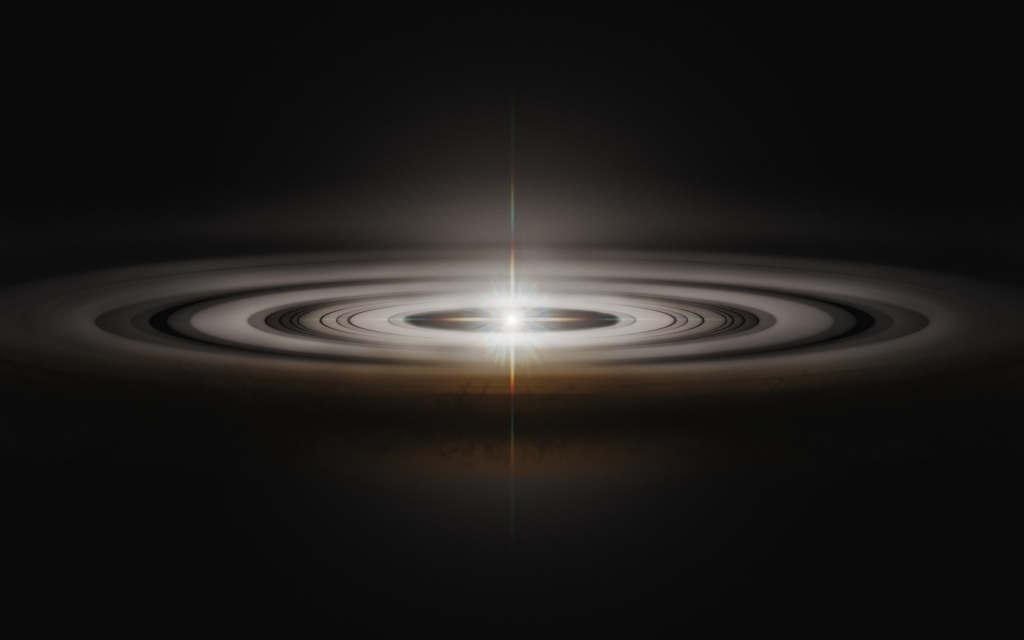
Think of a figure skater pulling their arms in to spin faster. The solar nebula did the same thing on a cosmic scale. As gravity crushed the cloud, it spun faster and faster, preventing all the material from simply falling into the centre. Instead, the material flattened out into a spinning platter called an accretion disk.
Building a Spinning Planet
Within this rapidly rotating accretion disk, particles of dust and ice began to stick together. Gravity drew these small clumps into larger bodies called planetesimals, the building blocks of planets. These planetesimals orbited the young Sun in the same direction as the disk's spin.
Collisions were constant. As planetesimals merged, they formed larger protoplanets. Each collision wasn't a perfect head-on impact. They were glancing blows, with objects striking each other off-centre. Each of these impacts imparted its own angular momentum to the growing body, contributing to its overall spin. Over millions of years, this chaotic dance of accretion built the planets, including a young, molten Earth that was already rotating.
The Giant Impact
While accretion set Earth spinning, one cataclysmic event likely had the most significant influence on its final rotation and tilt: the giant-impact hypothesis. This theory suggests that early in its history, Earth was struck by a Mars-sized protoplanet named Theias.
This was no gentle merger. The impact was colossal, liquefying both bodies and sending a vast cloud of debris into orbit around Earth, which later coalesced to form our Moon. The sheer force of this off-centre collision would have dramatically altered Earth's angular momentum, setting its initial rotation rate and knocking its axis to the 23.5-degree tilt we have today. This tilt is the reason we have seasons.
After this formative period, Earth's rotation has remained remarkably stable. In the vacuum of space, with no significant external forces to slow it down, the planet has kept spinning due to inertia, preserving the angular momentum from its violent birth.
Angular Momentum
noun
A measure of the amount of rotation an object has, which depends on its mass, shape, and speed of rotation. In a closed system, it is a conserved quantity, meaning it remains constant unless acted upon by an external torque.
Time to check your understanding of how Earth got its spin.
What is the fundamental principle of physics that explains why the solar nebula spun faster as it collapsed under gravity?
The giant-impact hypothesis suggests Earth was struck by a Mars-sized protoplanet. What is the name given to this protoplanet?
So, the next time you experience day turning into night, you can thank a cloud of interstellar dust, the laws of physics, and a cosmic collision for setting our world in motion.