Mechanics of Earths Rotation
Primordial Angular Momentum
From Cloud to Disc
Everything that makes up our solar system, from the Sun to the furthest comet, began as a vast, cold cloud of gas and dust drifting through space. This enormous structure, called an interstellar molecular cloud, was mostly hydrogen and helium, with trace amounts of other elements. It was stable for a time, but a nearby event, perhaps the shockwave from a supernova, disturbed its equilibrium. Gravity took over, pulling the cloud's particles inward.
As this massive collection of material began to collapse, it didn't just fall straight toward the center. The cloud had a very slight, almost imperceptible, initial rotation. This tiny bit of spin was the crucial ingredient that set the stage for everything to come. The process is explained by the , which describes how a spinning cloud of gas and dust can give birth to a star and its planets.
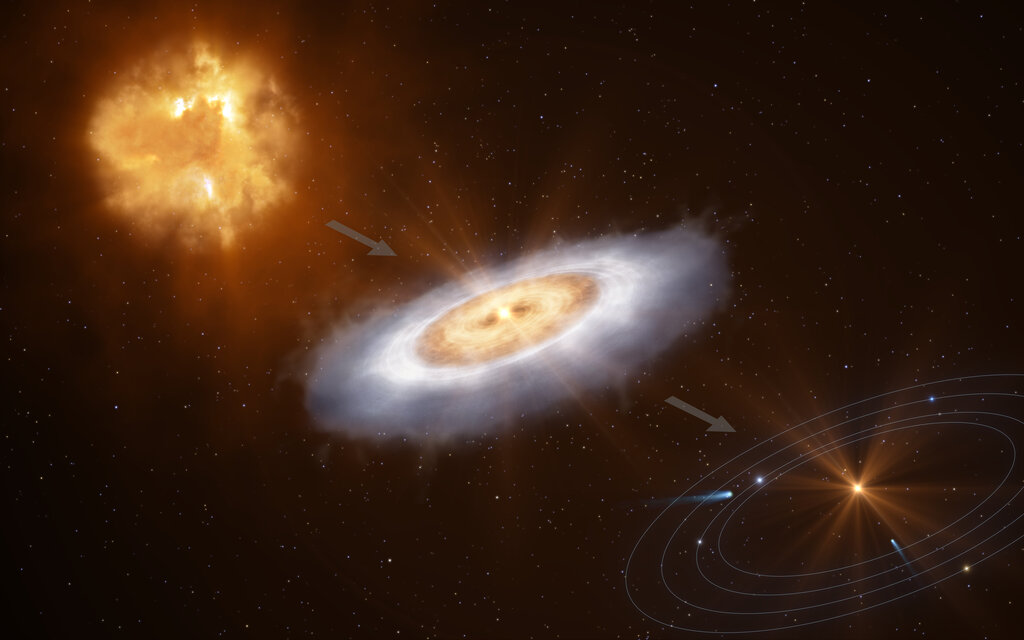
The collapse transformed the shape of the cloud. Instead of shrinking into a simple ball, it flattened into a spinning disc. This happens for the same reason that a ball of pizza dough flattens when a chef tosses and spins it in the air. The combination of inward gravitational pull and outward rotational force created a wide, thin structure known as a protoplanetary disk, with a dense, hot protostar forming at its center.
The Cosmic Figure Skater
To understand why the collapsing cloud spun faster and flattened, we need to look at a physical principle called the s. Imagine a figure skater spinning with her arms outstretched. When she pulls her arms in, her spin speeds up dramatically. She hasn't pushed off the ice again; she has simply changed the distribution of her mass.
The interstellar cloud behaves in the same way. As gravity pulled the gas and dust inward, condensing it into a smaller volume, the cloud's rotational speed had to increase to conserve its total angular momentum. This principle is a fundamental law of physics.
Birth of a Spinning Planet
Inside the fast-spinning , things were chaotic. While the overall motion was in one direction around the central protostar, there were local swirls and eddies, like whirlpools in a river. Gravity caused dust and gas particles to clump together. As these clumps grew larger, their own gravity attracted more material, a process called accretion.
These growing clumps, or protoplanets, inherited the angular momentum from the part of the disk they formed in. The overall rotation of the disk determined the direction of their orbit around the young Sun and also gave them their initial spin. This is why most planets in our solar system, including Earth, orbit and rotate in the same counter-clockwise direction (when viewed from above the Sun's north pole).
The final rotational speed of a planet like Earth was determined by a combination of the initial momentum from the disk and later collisions with other large bodies during the violent, early days of the solar system.
Let's review the key ideas about how our planet got its spin.
What was the initial state of the material that would eventually form our solar system?
The principle explaining why the spinning cloud of gas sped up as it collapsed is known as the...
The entire process, from a diffuse cloud to a system of spinning planets, is a direct consequence of gravity and the conservation of angular momentum acting on a colossal scale over millions of years.