Mechanics of Earths Rotation
Angular Momentum Origins
A Spinning Start
Our solar system didn't begin with a bang, but with a slow, gentle turn. Billions of years ago, the space now occupied by our sun and planets was a vast, cold cloud of gas and dust. This nebula, like almost everything in the universe, had a slight, almost imperceptible rotation. As gravity began to pull this cloud inward on itself, a fundamental law of physics took over: the came into play.
Think of an ice skater spinning on the spot. When her arms are outstretched, she spins slowly. When she pulls them in, her speed dramatically increases. The dust cloud did the same thing. As gravity pulled its material closer to the centre, its rate of spin had to increase to keep its total angular momentum constant. This principle is described by a simple relationship.
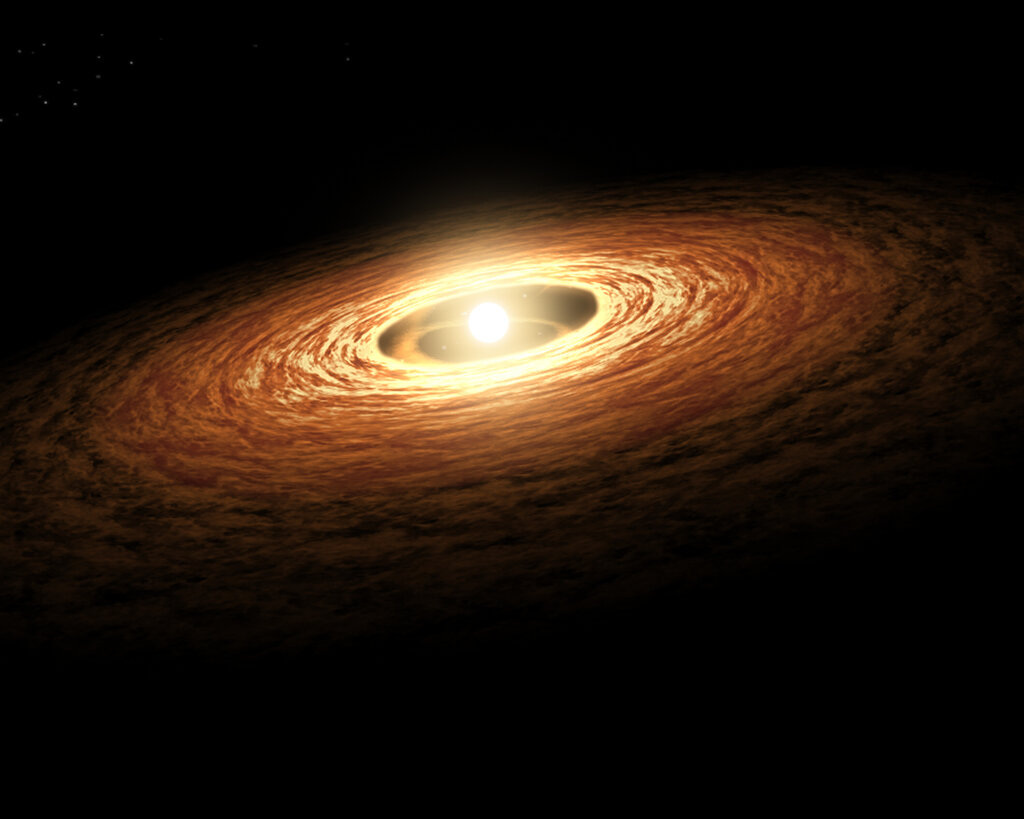
The increasing spin had another crucial effect: it flattened the collapsing cloud. The material was pulled strongly toward the centre by gravity, but the rotational motion created an outward push, strongest at the equator. This prevented everything from simply collapsing into a single point, instead forming a vast, rotating pancake of material called a with a dense, hot proto-sun at its centre.
Building a Spinning World
Within this spinning disc, the stage was set for planet formation. Dust grains began to stick together, first through static electricity, then through their own weak gravity. Over millions of years, these tiny clumps grew into pebbles, then boulders, and eventually into planetesimals—the building blocks of planets. This process is known as accretion.
Accretion wasn't a gentle process. It was a series of countless collisions, some small and some planet-shatteringly large.
Because everything in the disc was orbiting the proto-sun in the same direction, these collisions weren't usually head-on. Instead, they were glancing blows. Each time a planetesimal merged with the growing proto-Earth, it didn't just add its mass; it also added its own angular momentum. A strike on one side would nudge Earth's rotation in one direction, while a strike on the other side would nudge it in the other. Over time, the net effect of these countless impacts gave Earth its characteristic spin and axial tilt.
Why It Still Spins
Once it was set in motion, Earth kept spinning for a simple reason: there’s almost nothing in space to stop it. An object in motion stays in motion unless acted upon by an outside force. This is inertia. In the near-vacuum of space, there is no significant air resistance or friction to slow Earth down. The total rotational energy is immense.
However, Earth's spin isn't perfectly constant. The gravitational pull of the Moon and, to a lesser extent, the Sun, creates tides. This tidal friction acts as a very gentle brake, slowly transferring some of Earth's rotational energy to the Moon's orbit. As a result, Earth's day is gradually getting longer—by about 1.8 milliseconds per century. It's a tiny change, but over geological time, it adds up. When the dinosaurs roamed, a day on Earth was only about 22 hours long.
Let's review the key concepts we've covered.
Ready to test your understanding?
What is the name of the vast, flattened, rotating cloud of gas and dust from which the planets formed around the young sun?
The principle that explains why the solar nebula spun faster as it collapsed is called the conservation of ____.
The spin of our planet is a direct inheritance from the swirling cloud that gave birth to the solar system. It’s a testament to a fundamental physical law, set in motion by gravity and preserved for billions of years by the emptiness of space.