Mechanics of Earths Rotation
Angular Momentum Origins
The Cosmic Spin Cycle
Earth's rotation isn't an accident. It's a relic of our solar system's formation, a direct consequence of a fundamental physical law: the conservation of angular momentum. This principle states that for a spinning object, its total spin remains constant unless an external twisting force, or torque, acts on it.
Our story begins about 4.6 billion years ago with a vast, slowly rotating cloud of gas and dust known as the solar nebula. As gravity pulled this material inward, the cloud began to collapse and flatten into a spinning disk, much like a ball of pizza dough flattens when a chef tosses and spins it. This structure is called a protoplanetary disk.
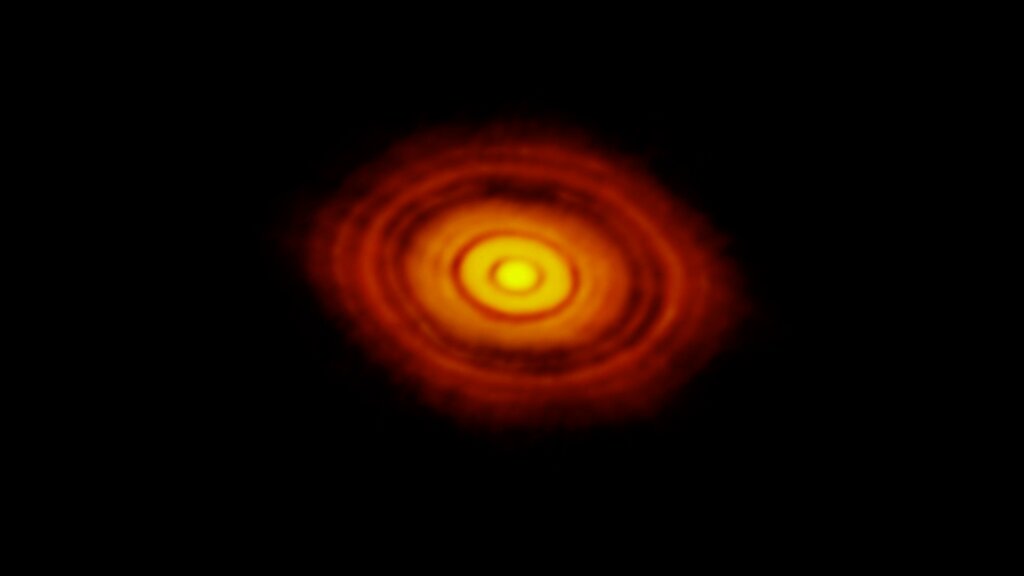
Within this swirling disk, particles of dust and gas began to stick together, forming larger and larger clumps. These clumps, called planetesimals, were the building blocks of planets. Since the entire disk was rotating, every particle within it had angular momentum. As these particles gathered to form the proto-Earth, their individual angular momentum was combined and conserved, setting our young planet spinning.
From Cloud to Planet
To understand how the collapse of the nebula led to a spinning Earth, think of an ice skater. When a skater pulls their arms in, their rotational speed increases dramatically. This happens because they are reducing their rotational inertia, which is a measure of an object's resistance to changes in its rotation. By bringing their mass closer to the axis of rotation, their speed must increase to keep their angular momentum constant.
The same principle applied to the solar nebula. As gravity pulled the gas and dust inward toward the center of the disk, the material's rotational inertia decreased. To conserve angular momentum, the entire system had to spin faster. The material that eventually became Earth was part of this accelerating cosmic swirl.
For the planet orbiting the Sun, this torque is zero: the only force acting is gravity, and that force acts in a line from the planet towards the center of the Sun, and therefore has zero torque—no leverage—about that central point, so the planet’s angular momentum about that point must remain constant.
A Violent Beginning
The formation of Earth wasn't a gentle process. In the chaotic early solar system, countless planetesimals collided. These impacts didn't always happen head-on. Most were off-center, delivering a powerful torque that could alter the proto-Earth's spin. Imagine spinning a basketball; a slap on its side will change its rotation. These ancient collisions did the same on a planetary scale.
One of the most significant of these events was the giant impact hypothesized to have formed our Moon. A Mars-sized body is thought to have slammed into the early Earth, a cataclysmic collision that would have blasted material into orbit and dramatically changed Earth's rotational speed and axial tilt. The 23.5-degree tilt that gives us our seasons is likely a direct result of this violent history.
Once these initial torques set Earth's rotation, another property took over: its massive rotational inertia. Like a giant gyroscope, Earth's immense mass and size give it a powerful tendency to keep spinning. This inertia has allowed it to maintain a relatively stable rotation for billions of years, a constant motion inherited from a spinning cloud of stardust.
Let's test what you've learned about the origins of Earth's rotation.
What is the fundamental physical principle that explains why the collapsing solar nebula resulted in a spinning Earth?
The analogy of an ice skater pulling in their arms to spin faster illustrates which aspect of Earth's formation?
So, Earth's daily spin is more than just a clock; it's a preserved motion from the very birth of our solar system, shaped by gravity and ancient collisions.