Mechanics of Earths Rotation
Primordial Spin Origins
A Spinning Start
Roughly 4.6 billion years ago, our solar system was a vast, swirling cloud of gas and dust known as the solar nebula. This enormous cloud, spanning light-years across, wasn't perfectly still. It had a slight, collective rotation, a result of the turbulent motions of the interstellar medium from which it formed.
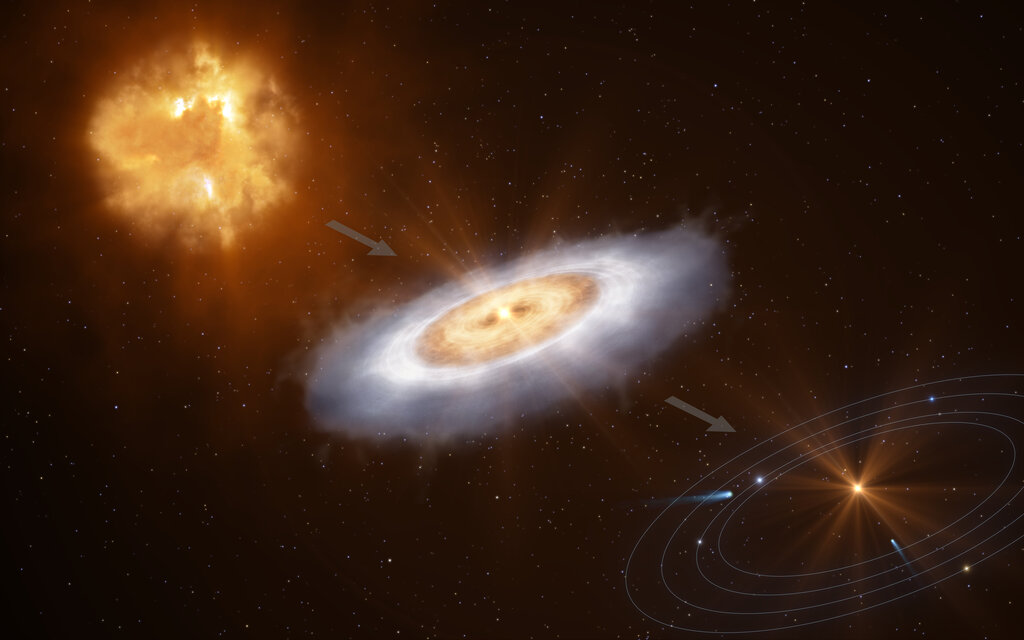
As gravity began to pull this material inward, a fundamental principle of physics took over: the conservation of . Think of an ice skater spinning. When she pulls her arms in, her rotation speeds up dramatically. The solar nebula did the same thing. As gravity compressed the cloud, its rotational speed increased, causing it to flatten into a spinning disk called a protoplanetary disk. The vast majority of the material collapsed into the center to form the Sun, but the surrounding disk held the raw ingredients for planets.
The entire solar system was already rotating before the Earth even existed. Earth's spin is an inheritance from this primordial motion.
From Dust to Planets
Within this fast-spinning protoplanetary disk, dust and ice particles began to collide and stick together. This process, known as accretion, started small. Tiny grains formed pebbles, pebbles formed boulders, and boulders merged to become —celestial bodies hundreds of kilometers across. These planetesimals were the building blocks of planets.
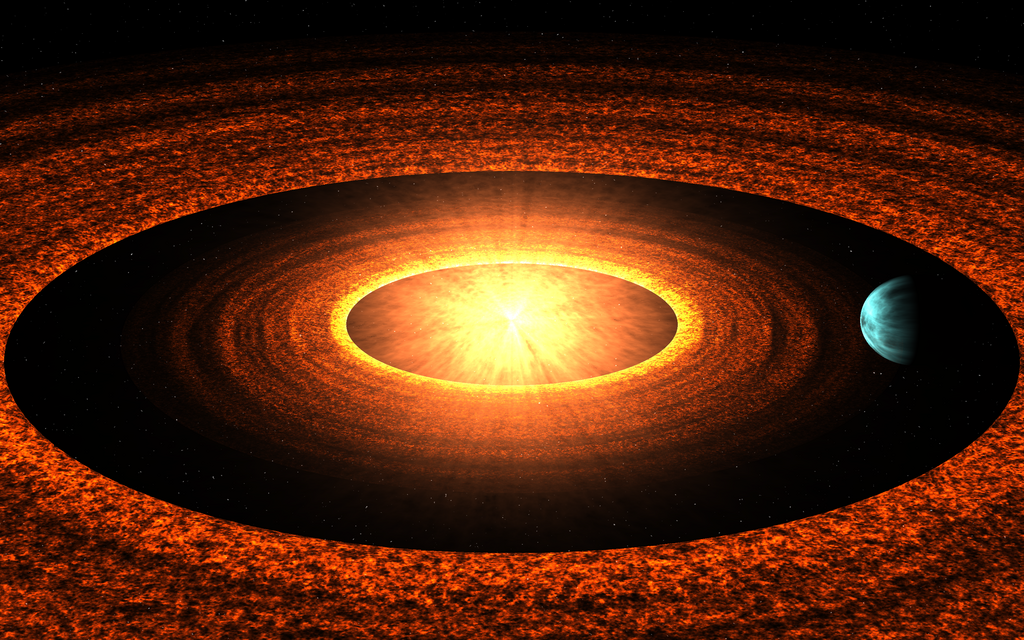
Each of these planetesimals carried the angular momentum of its particular orbit within the disk. As they combined to form a larger body, their individual momenta were averaged out. The result was a new, much larger object—a protoplanet—that inherited the net rotational energy of all its constituent parts. The direction and initial speed of a planet's rotation were determined by the sum of these countless collisions.
A head-on collision might not change the spin much, but a glancing blow from a fast-moving planetesimal could significantly increase the protoplanet's rotational velocity. The slightly off-center accumulation of material is what gave Earth its initial spin.
A Lasting Legacy
The spin Earth was born with 4.5 billion years ago is largely the same spin it has today. While the rate has changed slightly over eons, primarily slowing due to the Moon's tidal friction, the fundamental energy was imparted during its formation. The 24-hour day we experience is a direct consequence of the conservation of angular momentum in a collapsing cloud of interstellar gas.
Let's review the key terms from this process before testing your knowledge.
Ready to see what you've learned?
What was the name of the vast, swirling cloud of gas and dust from which our solar system formed?
Which physical principle explains why the solar nebula spun faster and flattened as gravity pulled it inward?
So, the next time you watch a sunrise or sunset, you can thank a spinning cloud of gas and dust from billions of years ago.