Mechanics of Earths Planetary Rotation
Primordial Angular Momentum
From Dust to Spin
Billions of years ago, our solar system was just a vast, cold cloud of gas and dust drifting through space. This wasn't an empty, static cloud. It was a solar nebula—a swirling collection of particles with a slight, almost imperceptible rotation, a leftover from the motions of the galaxy itself. Everything that would become the sun, the Earth, and all the other planets was mixed together in this colossal cloud.
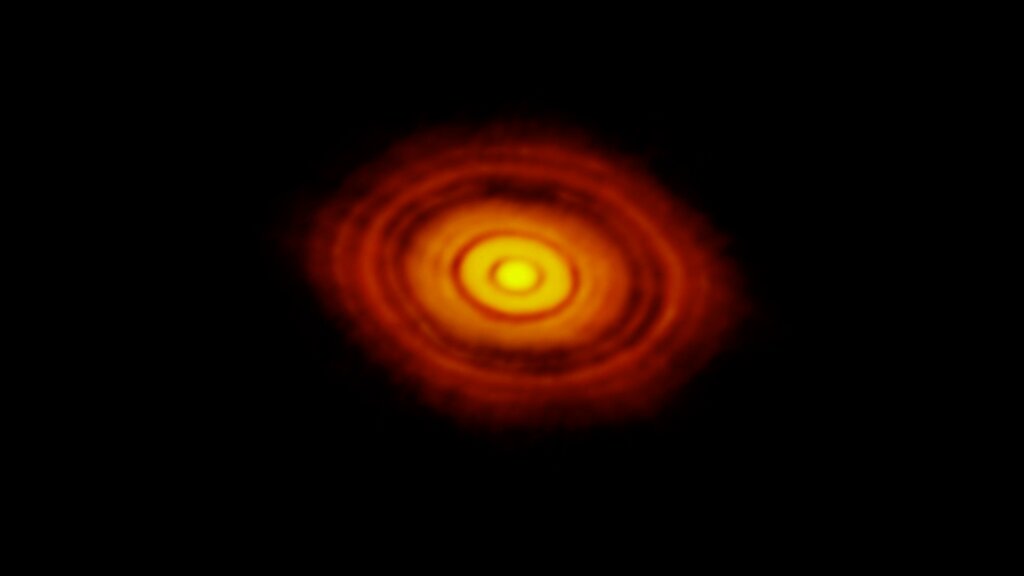
Over millions of years, gravity began to pull this material inward. The vast majority of the gas and dust collapsed toward the center, getting denser and hotter, eventually igniting to form the sun. The remaining material didn't fall straight in. Instead, it flattened into a spinning record of gas and dust called a protoplanetary disk.
The Cosmic Skater
To understand why this collapsing cloud spun faster and faster, we need a core principle of physics: the s. Think of an ice skater spinning on the ice. She starts her spin with her arms outstretched. When she pulls them in close to her body, her spin speeds up dramatically, even though she didn't push off the ice again. The same law governs planets.
As the solar nebula collapsed under gravity, its mass was pulled closer to the center of rotation. Just like the skater pulling in her arms, the cloud's moment of inertia decreased. To keep its angular momentum conserved, the cloud had to spin faster. This accelerated rotation prevented all the material from simply falling into the protostar at the center, ensuring there was enough left over to form planets.
Building a Spinning Planet
Within the fast-spinning protoplanetary disk, the stage was set for planet formation. Dust grains began to stick together through a process called s. Tiny clumps grew into pebbles, pebbles into boulders, and boulders into city-sized objects called planetesimals. These were the building blocks of planets.
Each of these planetesimals was orbiting the young sun within the spinning disk. As they collided and merged, their individual angular momentums combined. The overall motion of the disk meant that collisions happened more often from one direction, imparting a net spin to the growing planet. Earth's rotation is the sum total of all that inherited momentum from the primordial disk.
The final spin of a planet was also influenced by late-stage, giant impacts. The collision that is thought to have formed our Moon, for instance, would have drastically altered Earth's rotational speed and knocked its axis to its present 23.5-degree tilt.
So, the reason Earth spins is not an accident. It's a direct consequence of the formation of the solar system itself. The initial, faint rotation of a giant gas cloud was concentrated by gravity, transferred to a disk, and ultimately passed on to the planets that formed within it. Let's review the key terms from this process.
Ready to test your knowledge?
What was the initial state of our solar system billions of years ago, before the sun and planets formed?
Which physical principle explains why the solar nebula spun faster as gravity pulled it inward?
This foundational spin, inherited from the birth of the solar system, has shaped everything on our planet, from the cycle of day and night to the patterns of our weather.