Mechanics of Diamond Core Drilling
Diamond Bit Engineering
The Self-Sharpening Edge
A diamond drill bit is more than just a hard cutting tool. It's a precisely engineered system designed to wear down. This might sound counterintuitive, but for diamond-impregnated bits used in exploration, controlled erosion is the key to efficient drilling. These bits aren't single, large diamonds; instead, they consist of countless tiny diamond particles suspended within a metallic matrix that forms the crown of the bit.
The fundamental challenge is keeping the bit sharp as it grinds through kilometres of rock. The secret lies in a principle called 'self-sharpening'. The metallic matrix must erode at a rate that is perfectly synchronised with the wear and tear on the diamonds. As one layer of diamond grit becomes dull or fractures, the surrounding matrix wears away, exposing a fresh, sharp layer of diamonds beneath. Get this balance wrong, and the drilling operation grinds to a halt. If the matrix erodes too quickly, the bit's lifespan is drastically shortened. If it erodes too slowly, the diamonds become polished and smooth, a condition known as 'glazing', where the bit simply slides over the rock instead of cutting it.
Matching Matrix to Rock
The choice of matrix is a careful calculation based on the ground conditions. Drillers face everything from soft clays to incredibly hard, abrasive quartzite. The rule of thumb is simple: use a soft matrix for hard rock, and a hard matrix for soft rock.
Hard, non-abrasive rock requires a soft matrix bond. The matrix, typically made of bronze or other soft alloys, erodes easily. This is necessary because the diamonds themselves wear down quickly against hard formations, and a rapid matrix erosion rate is needed to constantly expose new cutting points. Conversely, in soft, abrasive formations like sandstone, a hard matrix made of materials like tungsten carbide is used. The rock itself does much of the work of eroding the matrix, so the bond must be tough enough to hold onto the diamonds for as long as possible, preventing premature shedding and maximising the bit's life.
The selection process also considers the rock's structural integrity. Geologists use a metric called (RQD) to quantify the degree of jointing or fracture in a rock mass. A high RQD (90-100%) indicates solid, competent rock, while a low RQD suggests highly fractured ground. For highly fractured ground, a bit with a harder matrix might be chosen to withstand the constant vibration and impact, even if the rock itself is not particularly hard.
| Rock Type | Compressive Strength | Abrasiveness | Recommended Matrix Bond |
|---|---|---|---|
| Chert, Quartzite | Very Hard | High | Very Soft |
| Granite, Basalt | Hard | Medium-High | Soft to Medium |
| Limestone, Dolomite | Medium | Low-Medium | Medium to Hard |
| Sandstone, Shale | Soft | High (Abrasive) | Hard |
| Clay, Broken Ground | Very Soft | Low | Very Hard |
Profile and Waterways
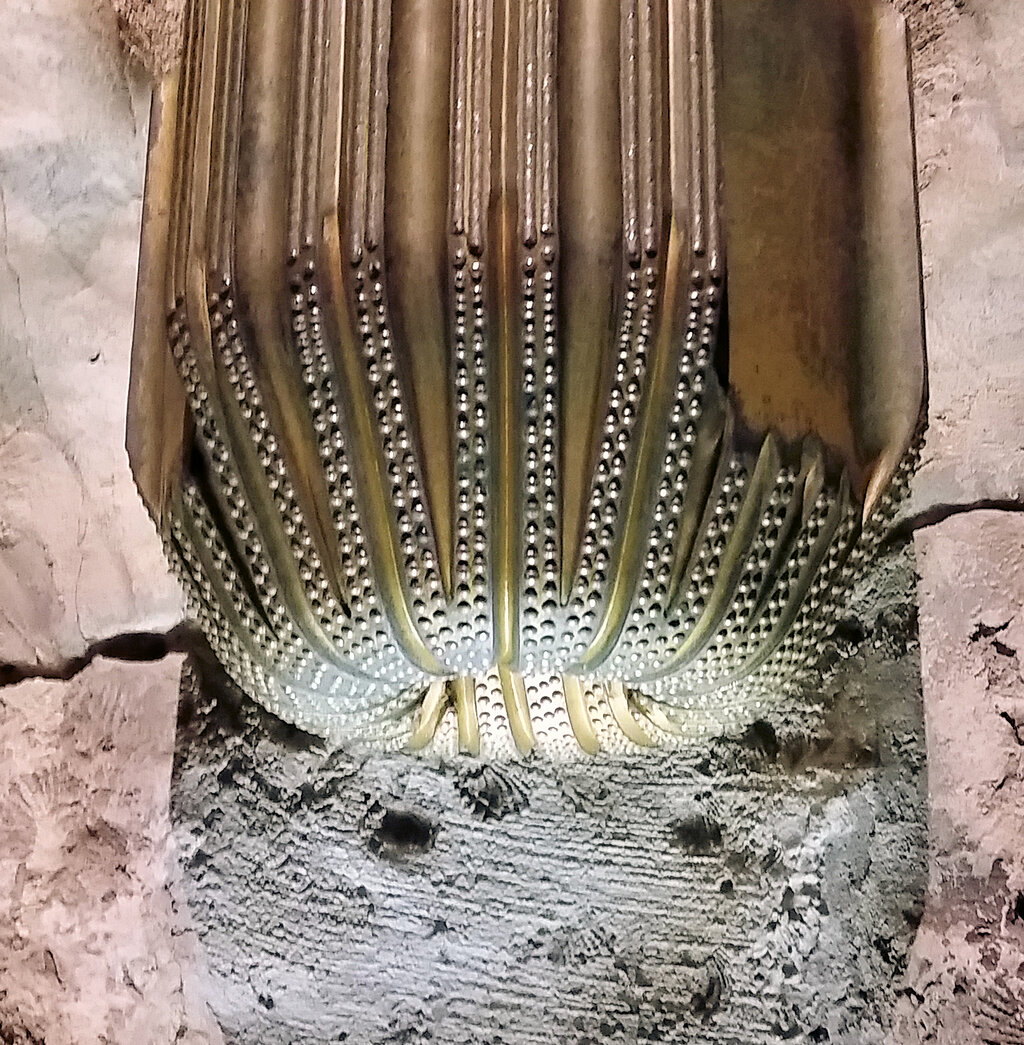
Beyond the matrix, the physical shape of the bit's crown plays a critical role. Different bit profiles are designed for different ground conditions. A 'flat-face' profile provides good stability and produces a high-quality core sample, making it ideal for competent, solid rock. For softer or more fractured formations, a 'semi-round' or 'V-ring' profile can improve flushing and cutting efficiency.
Equally important are the waterways, which are channels moulded into the bit face. Their job is to allow drilling fluid, or 'mud', to flow to the cutting face. This fluid cools the bit, stabilises the borehole, and, most importantly, flushes away the rock cuttings. Without efficient flushing, the cuttings build up, grinding down the bit and matrix prematurely and slowing progress.
The design of these waterways is a trade-off. More waterways provide better flushing but reduce the surface area available for cutting. In hard, solid rock, fewer waterways are needed. In soft, sticky clays that produce a lot of cuttings, a 'wide-face' design with deep, broad waterways is essential to prevent the bit from getting clogged.
Diamond Selection
The diamonds themselves are the final piece of the puzzle. While natural diamonds were once the standard, today's high-performance bits almost exclusively use because their properties can be precisely controlled. Manufacturers can specify the size, shape, and friability (the tendency to fracture) of the diamond grit to match the application.
Larger diamond particles, or a lower concentration of diamonds, are often used in softer rocks to allow for greater penetration. For very hard and fine-grained rocks, a higher concentration of smaller diamond grit is more effective. This creates more cutting points and distributes the load more evenly, grinding the rock down in a process more akin to sanding than cutting.
This careful balancing act between matrix wear, bit profile, waterways, and diamond grit size allows exploration teams in Western Australia to drill efficiently through some of the world's most ancient and challenging geology, pulling core samples from deep within the Earth that tell the story of the continent's mineral wealth.
Let's review the key concepts of diamond bit engineering.
What is the primary purpose of the 'self-sharpening' feature in a diamond-impregnated drill bit?
When drilling in soft, abrasive formations like sandstone, a driller should select a bit with a soft matrix.
Understanding these engineering principles is crucial for any drilling operation. The right bit, matched to the right conditions, is the difference between an efficient, cost-effective exploration programme and one that gets stuck in the ground.