Mechanics of Cellular Inheritance
Cell Cycle Regulation
The Cell's Internal Clock
A cell doesn't divide on a whim. It follows a strict internal schedule, a biochemical clock that ensures everything happens in the right order. This schedule is known as the cell cycle, and it's driven by a core partnership of two protein types: cyclins and cyclin-dependent kinases (CDKs). Think of CDKs as engines that are always present in the cell but are switched off by default. Cyclins are the keys that turn these engines on. When a specific cyclin binds to its partner CDK, it forms an active complex that kick-starts the next phase of the cell cycle.
The concentration of cyclins rises and falls in a predictable pattern, which is how they get their name. For instance, as a cell prepares to move from its growth phase (G1) into the DNA synthesis phase (S), the levels of G1/S cyclins increase. These cyclins bind to their corresponding CDKs, forming active complexes. The activated CDK then phosphorylates, or adds a phosphate group to, other proteins. This chemical modification acts like a switch, activating target proteins that initiate DNA replication. Once the task is complete, the cyclins are degraded, switching the CDK engine off until the next cycle.
Checkpoints and Gatekeepers
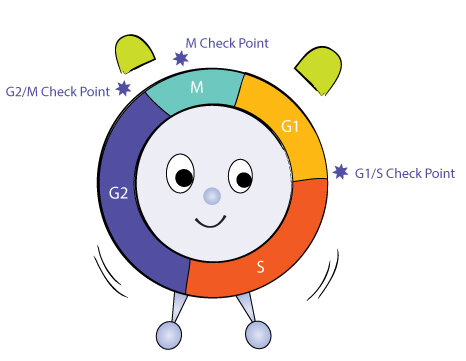
The cell cycle isn't just a simple timer. It has critical quality control steps called checkpoints. These are points where the cell pauses to check if everything is ready for the next phase. The two most important are the G1/S checkpoint and the G2/M checkpoint. The G1/S checkpoint, often called the restriction point, is the point of no return. Before this point, the cell needs external growth signals to proceed. After it passes this checkpoint, it's committed to dividing.
A key gatekeeper at this checkpoint is the (Rb). In a resting cell, Rb acts as a brake by binding to a transcription factor called E2F. This prevents E2F from activating the genes needed for DNA replication. When the G1/S cyclin-CDK complexes become active, they phosphorylate Rb. This changes Rb's shape, causing it to release E2F. Now free, E2F turns on the genes for S phase, and the cell moves forward.
What happens if the DNA is damaged? The cell has another crucial guardian: the . Often called the "guardian of the genome," p53 is a sensor for DNA damage. If it detects broken or mutated DNA, it can halt the cell cycle by activating the production of proteins that inhibit CDKs. This gives the cell time to repair the damage. If the damage is too severe to be repaired, p53 takes its role a step further and triggers apoptosis, or programmed cell death, preventing the damaged cell from becoming cancerous.
Think of checkpoints as traffic lights for the cell. Green means all systems are go. A yellow light, triggered by a protein like p53, means pause for repairs. A red light means the damage is irreparable and the cell must be removed from the road.
Cleaning Up the System
For the cell cycle to proceed in one direction, the proteins that trigger one phase must be destroyed before the next can begin. If M-phase cyclins lingered into the next G1 phase, the cell would be in chaos. The cell's solution is a highly efficient disposal system involving a small protein called .
Large enzyme complexes, such as the Anaphase-Promoting Complex (APC), act as ubiquitin ligases. They attach ubiquitin tags to specific proteins, like cyclins, marking them for destruction. The tagged proteins are then recognized and degraded by a cellular machine called the proteasome. This process of ubiquitin-mediated proteolysis ensures that cyclin levels drop sharply at the end of a phase, effectively resetting the system and allowing the cell to cleanly transition to the next stage.
Ready to check your understanding of the cell's internal controls?
What are the two primary types of proteins that partner to drive the cell cycle forward?
How does an active cyclin-CDK complex primarily exert its effect to advance the cell cycle?
This intricate network of activators, inhibitors, and disposal systems ensures that cells divide only when needed and that the genetic information they pass on is accurate. When this regulation fails, the consequences can be severe.