Mechanics and Strategy of Martial Arts
Strike Mechanics Comparison
Two Paths to Power
When you see a Muay Thai kick and a Karate punch, you’re watching two different philosophies of generating force. One is a spinning axe, the other a piercing spear. Both are effective, but they get there through entirely different biomechanics. The key difference lies in how they use the ground and transfer energy through the body.
Muay Thai is all about rotational power. Think of a roundhouse kick. The fighter doesn't just swing their leg; they pivot on their standing foot, swing their arm for counterbalance, and rotate their entire torso and hips into the strike. The power comes from torque, a twisting force that builds momentum like a spinning top. This motion treats the leg like a baseball bat, aiming to 'cut' through the target, not just hit it. The entire body's mass is thrown behind the strike, making it incredibly powerful but also requiring more time and space to execute.
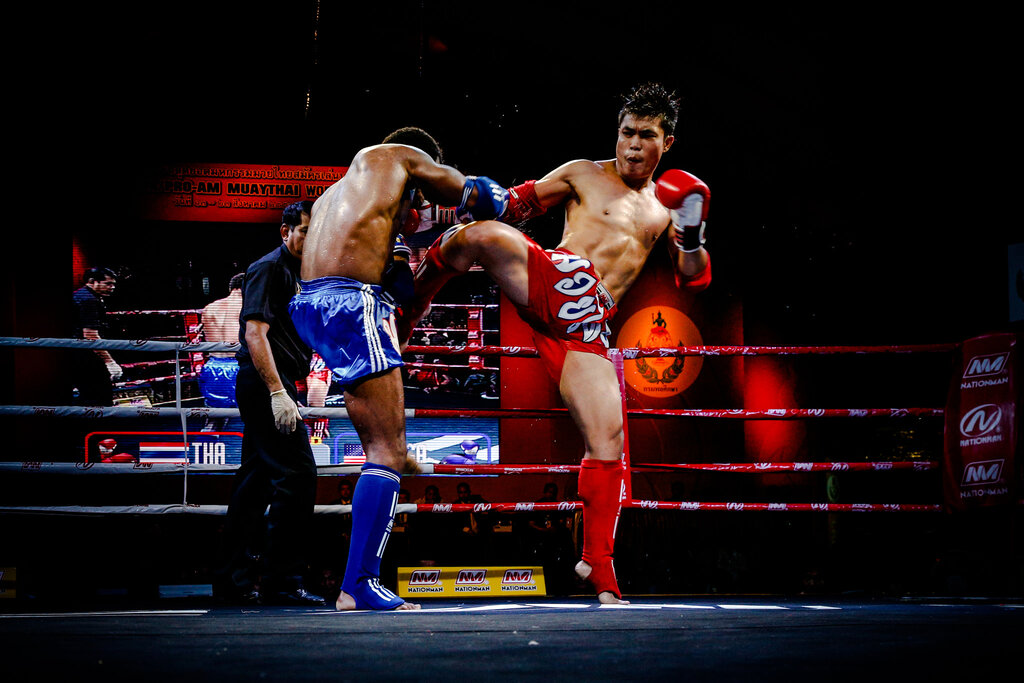
This rotational approach creates a continuous flow of energy. The kinetic chain starts from the ground, travels up the legs, through the core, and unleashes through the shin. Because the goal is to drive through the target, there is less emphasis on retracting the limb quickly. This 'driving' mechanic is designed to cause deep tissue damage and break an opponent's structure.
Linear Force vs. Rotational Torque
Karate, especially in techniques like the reverse punch (gyaku-zuki), prioritises linear acceleration. The power is generated explosively and travels in a straight line from the fighter's core to the target. Imagine a coiled spring suddenly releasing. A Karateka plants their feet firmly, drives from the rear leg, and snaps their hip forward just at the moment of impact. The energy travels from the ground up to the fist in a direct, piston-like motion.
This 'snapping' motion is key. Unlike the Muay Thai roundhouse, a Karate punch or kick is designed to penetrate the target and then immediately recoil. This quick retraction, known as hikite for the pulling hand in a punch, serves two purposes: it prepares the fighter for the next movement and helps focus the energy into a single, sharp point of impact. The damage is percussive, like a hammer strike, meant to shock the system. This method is incredibly fast and efficient, requiring less energy per strike, but its power is concentrated over a smaller impact area.
Impact and Implications
The choice between these systems has significant tactical consequences. The rotational power of a Muay Thai kick is devastating if it lands, but it leaves the fighter momentarily off-balance and committed. The wide, swinging motion can be easier to see and counter if an opponent has good timing. It excels in wearing opponents down and breaking limbs or ribs through sheer force.
Karate's linear strikes, by contrast, are built for speed and surprise. They are harder to read and allow for rapid combinations. Because the limb recoils quickly, the fighter can maintain better balance and defensive posture. However, generating knockout power with a linear strike requires exceptional timing and precision. The focus is on finding an opening and delivering a single, decisive blow. This is connected to the concept of Ikken Hissatsu, or 'to annihilate with one blow,' a core principle in many traditional Karate styles.
Our data indicates that the typical Karate and Taekwondo snap-like kick is based heavily on rapid knee extension, while Muay Thai uses a technique that places greater emphasise on COM movements to develop high impact forces.
Ultimately, both systems are masterful applications of physics. One uses the prolonged, powerful application of rotational torque to bludgeon through defenses. The other uses the sudden, explosive release of linear energy to pierce them. Understanding this fundamental difference is key to appreciating the strategy behind every strike in intermediate and advanced combat.
Ready to check your understanding of these mechanics?
Which type of force is primarily associated with a Muay Thai roundhouse kick?
The quick retraction of a punch in Karate, known as hikite, serves to prepare for the next move and to focus energy into a sharp point of impact.