Mechanics and Strategy of Martial Arts
Striking Biomechanics
The Kinetic Chain
A powerful strike isn't born in the arm or the leg. It starts from the ground. The secret to generating knockout force is understanding how to link your entire body into a single, efficient system for transferring energy. This concept is called kinetic linking, and it's what separates a shove from a devastating blow.
Think of it like cracking a whip. The handle moves a short distance, but by the time that energy travels to the tip, it's moving incredibly fast. In martial arts, your feet are the handle. You generate initial force by pushing off the ground. That energy then travels up through your ankles, knees, and into your hips. The rotation of your hips and torso acts as the wave in the whip, amplifying the energy before it's funneled through your shoulder and finally unleashed through your arm or leg.
Effective striking isn't about isolated muscle strength; it's about sequential energy transfer through the body's interconnected segments.
This chain reaction is what allows a 150-pound fighter to generate hundreds of pounds of force. Interrupting any link in that chain—by being off-balance, having a weak core, or failing to rotate the hips—causes a massive drop in power.
Stance as Strategy
Your stance is the foundation from which all strikes are launched. It's not just a ready position; it's a strategic choice that dictates your offensive options and defensive vulnerabilities. The two primary archetypes are the squared stance and the bladed stance, each with distinct biomechanical trade-offs.
A squared stance, common in Muay Thai, places the feet roughly shoulder-width apart with the torso facing the opponent. This opens up the hips, allowing for powerful, torque-driven rotation in both directions. It’s an ideal platform for delivering devastating roundhouse kicks and for checking incoming leg kicks.
Conversely, a bladed stance, seen in styles like Karate and fencing, presents a much smaller target by turning the body sideways. This stance prioritizes linear movement, allowing for explosive in-and-out footwork and a long, fast jab. However, generating power with the rear hand or leg requires more significant rotational adjustment.
| Stance Type | Biomechanical Advantage | Biomechanical Trade-off |
|---|---|---|
| Squared | Maximizes hip torque for powerful circular strikes. | Presents a larger target to the opponent. |
| Strong base for checking kicks. | Can be slower for linear blitzing attacks. | |
| Bladed | Minimizes target area, enhances defensive posture. | Rear-side power generation is less direct. |
| Promotes rapid linear footwork (in and out). | More vulnerable to leg kicks on the lead leg. |
Heavy Hits vs. Snapping Strikes
Not all strikes are created equal. The difference between a
heavy punch and a snapping kick comes down to a fundamental physics trade-off: mass versus velocity.
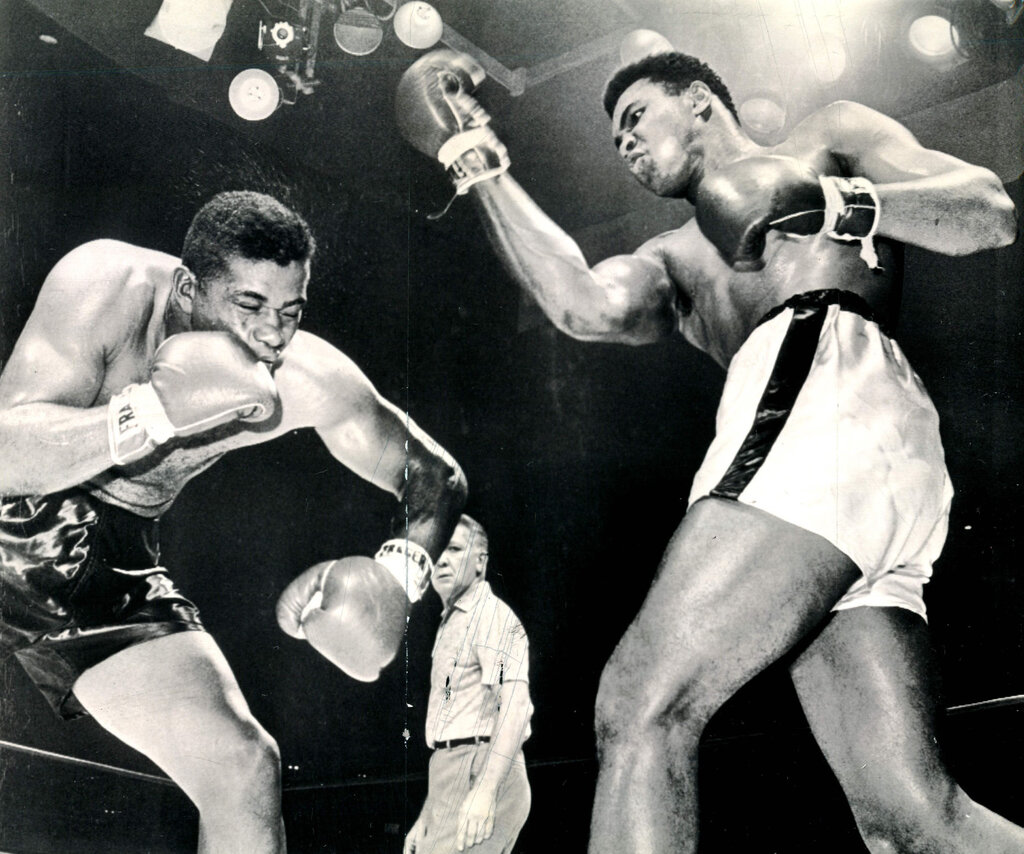
A heavy, linear strike like a boxer's straight cross is designed to transfer as much body mass as possible into the target. The goal is to drive the body's center of mass forward in a straight line, committing weight behind the punch. The formula (Force = mass × acceleration) governs this principle. Here, maximizing the effective mass () behind the strike is crucial for impact.
Circular, or snapping, strikes operate differently. A Taekwondo roundhouse kick, for example, prioritizes speed above all else. Its destructive power comes from the principle of kinetic energy, defined by the formula below.
These strikes are less about pushing through a target and more about creating a whip-like impact. The energy is highly concentrated at the point of contact for a brief, shocking moment.
Defense and Absorption
Defense isn't passive. A good block does more than just stop a strike; it absorbs and redirects the force to protect your own structure. Simply holding your arm out to block a powerful kick will likely result in a broken arm. True structural defense involves the entire body.
When blocking, you want to create a solid frame. This means engaging your core, slightly bending your knees to lower your center of gravity, and ensuring your blocking limb is supported by your body's mass, not just its own strength. The impact force should travel through your arm or leg, into your torso, and down into the ground, a process known as shock absorption (also called force dissipation).
Redirecting force is an even more advanced skill. Instead of meeting force with force, a fighter might use a parry or a slight body shift to make the strike glance off. This not only neutralizes the attack but also disrupts the opponent's balance, creating openings for a counter-attack. This turns their kinetic energy against them.
Now that we've broken down the mechanics of generating and absorbing force, let's test your understanding of these core principles.
The concept of linking the body into a single system to transfer energy from the ground up is known as...
A fighter who wants to present a smaller target and prioritize explosive, linear footwork would most likely use a:
Understanding the 'why' behind the movements transforms your practice from simple mimicry into a science. By applying these biomechanical principles, you can optimize every strike, defense, and step for maximum efficiency and power.