Mechanics and Philosophy of Combat Arts
Kinetic Power Generation
The Body as a Whip
A powerful strike isn’t born in the arm or the leg. It begins with the floor. Every punch, kick, and elbow is the final crack of a whip, with the energy starting from your connection to the ground. This sequence of energy transfer is called the kinetic chain.
Think of your body as a series of connected links: feet, ankles, knees, hips, torso, shoulders, and finally, your limbs. To generate maximum power, you must transfer energy efficiently from one link to the next. The process starts with pushing against the floor, creating a that travels up through your legs.
Inefficient movement in any part of the chain causes an “energy leak,” resulting in a weaker, slower strike.
The Engine of Power
If the ground is the source of power, the hips are the transmission. The rotation of the hips and core generates torque, a rotational force that multiplies the linear energy coming up from your legs. This is where the real magic happens. A punch thrown with only the arm is weak; a punch driven by hip rotation can be devastating.
A stable core is essential to transfer this rotational force without it fizzling out. Your abdominal and oblique muscles act like a rigid conduit, ensuring the power generated by your hips is delivered directly to your shoulder and, finally, your striking limb. Without this core tension, the chain is broken.
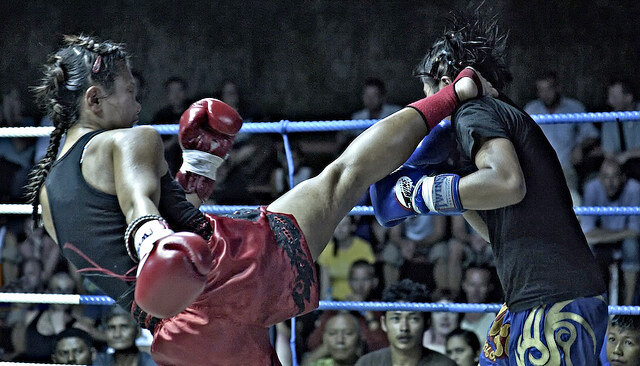
Comparing striking mechanics
Different striking arts have evolved unique ways to manage the kinetic chain, each with its own trade-offs. Let's compare two classic examples: the Muay Thai roundhouse kick and a traditional Karate reverse punch (gyaku-zuki).
The Muay Thai roundhouse kick is an exercise in maximising rotational power. It uses a 'double pivot'—the supporting foot and the hip rotate almost in unison. This creates a long, powerful arc, treating the leg like a baseball bat. The goal is to transfer the entire body's momentum into the target. This generates incredible force but is a slower, more committed technique.
In contrast, a Karate punch often emphasizes linear or 'vertical' force. The power still comes from the ground and a sharp hip rotation, but the movement is more direct and explosive. Instead of a wide, swinging arc, the force is driven in a straight line from the rear foot, through the hip, and out the fist. This technique prioritizes speed and penetration, seeking to focus all the energy on a single point at the moment of impact. This is often described by the term —the decisive focus of power.
| Feature | Muay Thai Roundhouse | Karate Reverse Punch |
|---|---|---|
| Primary Force | Rotational (Torque) | Linear / Snapping |
| Hip Action | Full, open rotation | Sharp, quick snap |
| Footwork | Pivot on ball of foot | Firmly planted, driving forward |
| Energy Path | Arcing and circular | Direct and linear |
| Goal | Impact and damage | Penetration and speed |
Alignment and Stability
Proper alignment between the hips and shoulders is crucial for effective force transmission. If your shoulder and hip are not aligned along the path of the strike, energy will be wasted. Imagine trying to shoot water through a bent hose—you lose pressure. Keeping your structure aligned ensures maximum force reaches the target.
This leads to the constant trade-off between stability and mobility. A deep, wide stance, like a Karateka's zenkutsu-dachi, provides a powerful, stable base for generating ground reaction force. However, it's slow to adjust. A lighter, more mobile Muay Thai stance allows for rapid movement and checking kicks, but may sacrifice some of the rooted power of a deeper stance. There is no single 'best' stance; the right choice depends on the technique and the situation.
According to the kinetic chain principle, what is the initial source of power for a powerful strike?
What is the primary role of the hips in generating a powerful strike?
By understanding these biomechanical principles, you can look past superficial differences in style and see the universal truths of power generation that unite all effective striking arts.