Mechanical Watchmaking Mastery
Movement Architecture Analysis
The Architecture of a Movement
The layout of a watch movement, known as its caliber, is a blueprint for its function. Everything is organized around a core principle: the efficient transfer of energy. This journey begins at the mainspring, the powerhouse of the watch, and follows a carefully engineered path through a series of gears to the escapement, which regulates the release of that energy.
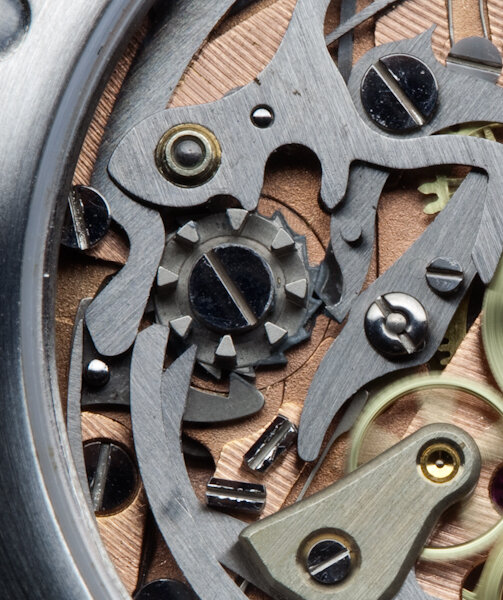
The mainspring barrel contains a coiled spring that stores potential energy when wound. The inner end of this spring hooks onto the barrel arbor, a central shaft. As the spring unwinds, it turns the entire barrel, which has gear teeth on its outer edge. These teeth engage the first wheel of the gear train, beginning the process of mainspring torque transmission.
The gear train, or wheel train, is a series of interlocking gears that steps up the rotational speed from the slow, powerful turn of the mainspring barrel to the rapid, light motion required by the escapement. Each wheel in the train drives a smaller gear, called a pinion, on the next wheel's arbor. This relationship defines the gear ratio, which is calculated to precisely manage power delivery and the rate of the hands.
Holding this entire system in place are the plates and bridges. The main plate is the movement's foundation. On top of it, bridges and cocks are mounted to form the upper framework, securing the wheel train arbors in their jeweled bearings. A bridge is a plate supported by screws at both ends, while a cock is supported at only one end. The most prominent example is the balance cock, which holds the delicate balance wheel assembly.
The specific arrangement of these components is a hallmark of different and helps in identifying a caliber at a glance. Some designs use a single, large bridge to cover most of the train, while others use multiple smaller bridges, or 'finger' bridges, for each wheel.
Driving the Seconds Hand
The layout of the gear train directly influences how the seconds hand is displayed. The two main configurations are direct drive and indirect drive.
In a traditional layout, the fourth wheel of the train rotates once per minute. Placing the seconds hand directly on the arbor of this wheel creates a "small seconds" sub-dial. This is a direct seconds drive—simple, efficient, and mechanically pure.
To achieve a central seconds hand that sweeps from the middle of the dial, an indirect system is often used. This requires an additional set of small gears to transfer power from the fourth wheel's position off to the side back to the center of the movement. This adds complexity and can introduce a tiny amount of backlash or "stutter" to the hand's motion if not engineered perfectly.
| Feature | Direct Seconds (Small Sub-dial) | Indirect Seconds (Center Sweep) |
|---|---|---|
| Layout | Seconds hand on the fourth wheel's arbor. | Extra gears transfer motion to the center. |
| Efficiency | High; minimal components. | Lower; slight power loss from extra gears. |
| Complexity | Simpler, more robust design. | More complex, requires careful engineering. |
| Common Use | Traditional dress watches, chronographs. | Most modern sports and field watches. |
Beyond the gear layout, precision is paramount in the unseen details. Jewel hole clearances, for instance, are critical. The tiny space between a gear's pivot and the jewel bearing it sits in must be exact. Too tight, and friction will increase, robbing the movement of energy. Too loose, and the gear train will not mesh correctly, leading to poor power transmission and inaccuracy. These tolerances are measured in microns, highlighting the incredible precision required in movement architecture.
The interactions between the various components of a Swiss lever escapement must be meticulously adjusted in a very precise order.
Understanding these architectural principles—from the mainspring barrel to the bridge configuration and drive systems—is the key to analyzing any mechanical movement. Each caliber tells a story through its layout, revealing the design choices and engineering trade-offs made by its creators.