Mechanical Engineering Core Principles
Thermodynamic System Analysis
Analyzing Energy in Flowing Systems
In thermodynamics, we often analyze systems where mass flows across the boundary. Think of a jet engine, a power plant turbine, or even a simple water pump. Unlike a sealed, fixed-mass system (a control mass), these open systems constantly process new material. To analyze them, we define a control volume—a specific region in space that we focus on, like the interior of a turbine casing.
For many engineering devices operating for long periods, we can assume steady-flow conditions. This means the properties within the control volume—like mass, temperature, and pressure—do not change over time. Under these conditions, the mass entering the system must equal the mass leaving it. The same principle of balance applies to energy.
The Steady-Flow Energy Equation
The First Law of Thermodynamics for a steady-flow open system is expressed by the Steady-Flow Energy Equation (SFEE). It states that the rate of energy entering the control volume must equal the rate of energy leaving it. This accounts for energy transferred as heat and work, as well as the energy carried by the mass itself.
Let's apply this to a steam turbine. In a typical turbine analysis:
- We assume it's adiabatic, meaning there's negligible heat transfer ().
- Changes in kinetic and potential energy from inlet to outlet are often small enough to be ignored (, ).
With these simplifications and a single inlet and outlet, the SFEE reduces dramatically.
Efficiency Beyond the First Law
The First Law is about accounting. It tells us energy is conserved, but it doesn't tell us anything about the quality of that energy or the direction of processes. A hot cup of coffee cools down in a room; the energy is conserved, but you'll never see the cool coffee spontaneously draw heat from the room to become hot again. This is the domain of the Second Law.
In the real world, processes have irreversibilities like friction, which degrade the quality of energy. To quantify this, we use the concept of exergy—the maximum possible useful work that can be extracted from a system. Second Law efficiency, or exergy efficiency, measures how well a device performs relative to its ideal, reversible potential.
Second Law Efficiency () = (Actual useful work output) / (Maximum possible useful work output)
A process with high Second Law efficiency destroys very little exergy. For a turbine, this means the actual work it produces is very close to the work it would produce in a perfectly reversible (isentropic) process. Maximizing this efficiency is a primary goal in designing power systems. We want to convert as much of the high-quality energy (like the high-pressure steam entering a turbine) into useful work as possible, minimizing the exergy destroyed by irreversibilities.
Power Cycles in Action
Now let's apply these principles to two of the most important thermodynamic cycles in mechanical engineering: the Rankine cycle and the Brayton cycle. These are the workhorses behind most of the world's electricity generation and transportation.
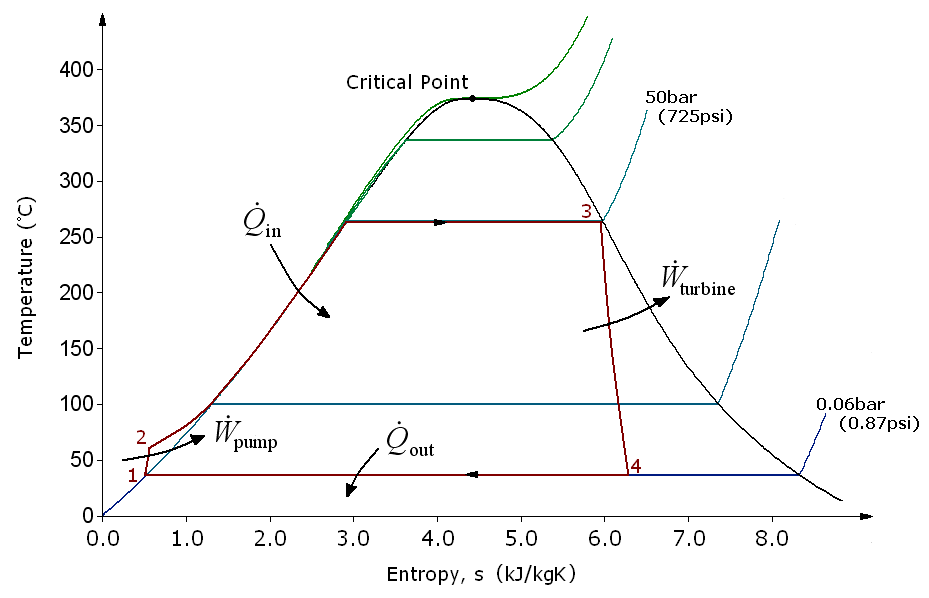
The Rankine cycle is the model for steam power plants. Water is pumped to a high pressure, boiled to create high-pressure steam (heat input), expanded through a turbine to produce work, and then condensed back into water (heat rejection) to repeat the cycle.
To improve the efficiency of the Rankine cycle, engineers often use two key techniques:
- Reheat: After partially expanding through a high-pressure turbine, the steam is sent back to the boiler to be reheated. This higher-temperature steam then expands through a low-pressure turbine, producing more work and preventing excessive moisture at the turbine exit.
- Regeneration: Some steam is bled off from the turbine at various points and used to preheat the feedwater before it enters the boiler. This reduces the amount of heat that needs to be supplied by the fuel source, increasing overall efficiency.
Next is the Brayton cycle, the basis for gas turbine engines. Air is compressed, mixed with fuel, and combusted (heat input). The hot, high-pressure gas then expands through a turbine to produce work. A portion of this work drives the compressor, and the rest is the net output. In a jet engine, the turbine's primary job is to run the compressor, and the remaining high-energy exhaust gas provides thrust.
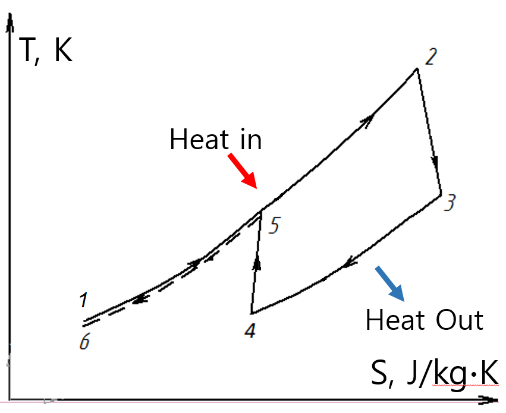
Just like the Rankine cycle, the Brayton cycle can be optimized. One common method is using a regenerator, which is a heat exchanger that uses the hot exhaust gas from the turbine to preheat the compressed air before it enters the combustion chamber. This reduces fuel consumption and boosts efficiency. These continuous improvements, a legacy tracing back to innovators like James Watt and his work on the steam engine, are what drive modern thermodynamic design.
Time to check your understanding of these core system analysis concepts.
In the analysis of an open system like a jet engine, what is the term for the specific region in space chosen for study, through which mass can flow?
True or False: The First Law of Thermodynamics explains why a cool cup of coffee will not spontaneously draw heat from its surroundings to become hot.